Pages

The name of this blog, Rainbow Juice, is intentional.
The rainbow signifies unity from diversity. It is holistic. The arch suggests the idea of looking at the over-arching concepts: the big picture. To create a rainbow requires air, fire (the sun) and water (raindrops) and us to see it from the earth.
Juice suggests an extract; hence rainbow juice is extracting the elements from the rainbow, translating them and making them accessible to us. Juice also refreshes us and here it symbolises our nutritional quest for understanding, compassion and enlightenment.
Artificial Intelligence (AI) is not used in the creation of the items on this blog.
Showing posts with label extinctions. Show all posts

Wednesday, 20 May 2026

Prediction, Prophecy, or Probability

Nostradamus
This blog begins with a supposition that globally we are in a mess; although predicament might be a more technical term than mess. The mess is made up of environmental, social, personal, and familial elements.

Can we get out of this mess? The answer to that seems to clearly be “no!” The reasons for this answer are many, and a later blogpiece may address those reasons. One of the compelling reasons for answering “no” however is that collectively we do not appear to realise that we are in a mess.

If we are unable to get out of the mess, can we get through it? By that I mean can we pass through a bottleneck and emerge, as a living species, on the other side of the bottleneck. We have been through a bottleneck before, although most of us won’t remember doing so; after all, it happened almost one million years ago. At that time 98% of the Earth’s hominid population failed to survive, leaving only approximately 1,280 reproductive individuals to make it through.1

So, it has been done before. Could it happen again? Could we get through this mess and pass through a bottleneck to a future in which Homo sapiens is one of the surviving species on the planet?

There are at least three major techniques by which we might answer that. We could predict the future, based on previous trends, and using a logical approach to analysis. We might approach a soothsayer or someone with special authority from a divine being to prophesise the future. Or, thirdly, we could assign probabilities to a range of scenarios.

As the Latin etymology of the word implies, prediction literally means to say before. Prediction usually implies one prescribed outcome. To say something will happen before it has happened is a recipe for being accused, at best of being wrong, at worst of lying.

In the current situation (in the midst of a mess) there are some who take the techno-optimist view that our future technological expertise will enable us to get through the mess. Others proclaim that this is the end of the road for humans. The Sixth Mass Extinction that is upon us, they say, includes Homo sapiens as one of the species that will go extinct. Then, there are many others who take a number of different positions between these two extremes.

All of them make a prediction that excludes all other possibilities.

What about prophecy? Can we reliably seek the announcement of a prophet to foretell the future. Some do. Etymologically, prophecy derives from the Old French word profete meaning a prophet or soothsayer. Prior to the Old French the word goes back to the Greek word propheteia which meant to have the gift of being able to interpret the will of God. Hence, prophecy has a spiritual or divine factor in its meaning, and a prophecy is passed on to a human prophet via some supernatural being.

For many early prophets the purpose of their prophecy was to warn of impending consequences should changes in behaviour not occur. For later prophets (e.g. the well-known Nostradamus) the prophecies were less about warnings and more about outlying future events. Some prophesies succeeded, but many (perhaps most) did not.

Prophecy too, is not a reliable foretelling of the future.

Finally, we could assign probabilities to a range of future scenarios. This is what most futurists do. Probability also has an interesting etymological history. During the 16th century it meant that something was likely to be true. By the early 18th century the word had taken on the statistical meaning of the frequency with which a proposition is true measured against experience. Hence, absolute certainty would have a probability of 100% and complete uncertainty would be 0%. The probability of something being true, in the statistical sense, lies somewhere between 0% - 100%, rarely being set at either of the extremes.

Thus, a number of future scenarios could be described and assigned a probability of accurately depicting what actually happens in the future.

Coming back now to the earlier question. Can we get through the mess? Furthermore, if we can get through, will those who do so emerge with a more healthy and sustainable culture?

I am extremely reluctant to predict the future, as being certain of what the future will bring is impossible for me to predict (if you’ll excuse the circular argument.) I do not have access to any divine or supernatural message and so I am unable to prophesy anything about the future.

It is, however, possible for me to assign probabilities towards differing future scenarios. Some of those possible scenarios hopefully will include societies and cultures that are wise enough to not make the mistakes we have made in getting ourselves into this mess. Hopefully too, those future societies will be able to inhabit the Earth in a sustainable and cooperative manner, respecting all the Earth’s creatures.  

For us now, on the edge of this mess and peering into the bottleneck we might ask ourselves: How can we skew the probabilities towards a higher chance of betterment in a post-collapse future?

The answer to this is not what we do in the future.

The answer lies in what we do here and now.

The answer exists in what seeds we sow today that may bear fruit tomorrow. The answer rests on our ability to plant the seeds, knowing that we will not be fortunate enough to eat the fruits thereof.

And that enterprise involves giving up the paradigms we have been living with and adopting new paradigms.

How we do that is the subject of another blogpiece.

Notes

1. Juliet Dubois, Daily Galaxy, 5 June 2025, Only 1,280 Survived: The Near-Extinction Event That Nearly Wiped Out Humanity 1 Million Years Ago

Wednesday, 19 November 2025

8,699,999 + 1

Ernst Haeckel's
"Tree of Life."
(note the position of MAN)
It is estimated that there are 8,699,999 animal species on Earth. Plus one; the species we call Homo sapiens.

That makes a total of 8.7 million species. Of these 8.7 million, it is thought that as many as 86% have not yet been discovered, let alone described. Yet, that number is only the animal species, a small fraction of all species.

If plant and microbial species are added into the count then the total number of species upon the Earth could be one trillion, or more.

Yet, that one species – Homo sapiens – has come to domesticate, dominate, or destroy many of the other species that share this planet with us.

Of all the mammals upon the Earth, we humans account for 34% of the total biomass. Mammals domesticated by us make up 62% of the total biomass. That means that just 4% of the Earth’s total mammalian biomass is made up of wild mammals.1

Just 4%! The biomass of wild land mammals has declined by an estimated 85% since humans emerged onto the planet. 85%! The numbers are staggering.

Humanity has also domesticated chickens, which are not mammals. What about them? Well, that is a sordid tale as well. Domesticated chickens make up 71% of the total bird mass on the planet.

What of the number of species we have destroyed?

It is estimated that the average length of time for a species to exist on the Earth, before becoming extinct, is between one and ten million years, with most going extinct at the lower end of this range. The extinction rate, since the arrival of humans, is assessed as being between 100 and 1,000 times the natural background extinction rate. Another staggering number.

All the numbers and figures cited above are because of that one extra species added to the 8,699,999 total for all animal species. Just one! Yet another staggering number.

How did, and why should, one species, amongst 8.7 million animal species, come to domesticate, dominate, and destroy so many creatures?

Within western cultures the origin can perhaps be traced back to its genesis. Yes – Genesis. The first book of the Bible. Whether a person today, living a westernized lifestyle, is a religious follower of the Bible is immaterial. Western culture has its roots firmly embedded within Judeo-Christian belief systems.

Genesis 1, verses 26-28 twice repeats the phrase that humans are to ‘have dominion over the fish of the sea, over the birds of the air…and over every living thing that moves on the earth.’2 This word dominion has for some two and a half thousand years often been interpreted as meaning mankind has the right to subdue, control, and exploit the creatures of the earth.

Over the past couple of centuries this interpretation has come under scrutiny, with many Biblical scholars and linguists advising that the original Hebrew words limited the interpretation to meaning a stewardship or governance.

Notwithstanding the debates within Biblical scholarship, the right of dominance is the one that has firmly entrenched itself within western worldviews. By extension, this right of dominance and control led those worldviews to a belief in human exceptionalism – the belief that humans are different from, and superior to, other forms of life.

This Biblically mandated role for humankind remained a foundation of the human journey for many centuries. It was not until the middle of the 19th century that the Biblical position on the place of humans was challenged. Darwin’s On The Origin Of Species, published in 1859, introduced humans to the Theory of Evolution. But even this theory did not dislodge the belief in human exceptionalism. If anything, it gave it pseudo-scientific credibility.

The German naturalist, Ernst Haeckel, was fascinated by Darwin’s ideas and actively promoted them. In doing so, Haeckel depicted evolution as a tree with man (sic) placed at the apex of the tree, insinuating that humanity was the inevitable and only possible outcome for evolution (see graphic). This depiction still has favour today. Human exceptionalism remains embedded within our westernized worldview.

With two such powerful influences upon westernised worldviews – the Biblical one and the evolutionary tree one – it is little wonder that the 8.7 million species upon the Earth have become domesticated, dominated, and destroyed by just one species – us.

A final comment should be made about this one species. Yes, we are one species amongst 8.7 million, but we don’t all share the same worldviews. The worldviews summarised above have been developed over millennia within western cultures. They are not shared by many indigenous and nature-based cultures. However, the process of colonisation, beginning in the late 15th century, has all but eradicated any other worldview.

Human exceptionalism remains a dominant view throughout the world.

8,699,999 creatures continue to suffer because of this view.

Notes:

1. All data from https://ourworldindata.org/wild-mammals-birds-biomass  accessed 18 November 2025

2. Text from Holy Bible, New King James Version, Genesis 1: 26-28

Wednesday, 5 June 2024

What If We Weren't Alone?

Homo sapiens and
Homo neanderthalensis
The question ‘are we alone in the Universe?’ has been pondered for decades. The Search for
Extraterrestrial Intelligence (SETI) is a collective term for the many forms of search that exist for intelligent life beyond our planet. Scientifically, the search began in earnest soon after the invention of radio.

What would we do if intelligent life were discovered elsewhere in our own galaxy or in other galaxies? How would we react? What would we think of our own existence? Would we react with fear, or with open arms?

Would we re-evaluate our own place in the cosmos? What about our life on this planet? Would we reconsider our place here on Earth?

Crucially, would we continue to think of ourselves as the supreme beings? Would we continue to think of ourselves as the Crown of Creation or as the Pinnacle of Evolution?

Of course, notwithstanding various conspiracy theories and ufology, there has not yet been any scientific evidence to confirm the existence of extraterrestrial intelligence. Nor, however, has there been any scientific evidence to confirm that extraterrestrial intelligence does not exist.

Are we alone? We don’t know, but so far, we seem to be.

Yet, we haven’t always been alone.

Just 100,000 years ago, right here on our home planet, we Homo sapiens were not alone. We shared the planet with at least five other hominins of the genus Homo. The longest living of these was Homo erectus who lived from around 2 million years ago up until the relatively recent time of about 100,000 years ago. Homo erectus was widespread throughout Eurasia.

Two of the others, Homo luzonensis and Homo floresiensis were confined to islands (Luzo in the Philippines and Flores in Indonesia respectively.) We, Homo sapiens, most likely did not know of the existence of these two long-lost cousins at the time they existed.

But the other two hominins, Homo neanderthalensis and Homo denisova we probably did know of, as well as interacting with. Homo neanderthalensis (the Neanderthals) roamed throughout Eurasia from (possibly) around 430,000 years ago until as recent as 40,000 years ago.

Homo denisova were an Asian species living from about 285,000 years ago until just 25,000 years ago.

We certainly did know of these hominin cousins. Indeed, we knew them quite well. Modern day Homo sapiens of European descent contain approximately 2% Homo neanderthalensis DNA. Homo sapiens from Asia, Melanesia, and Australian Aborigines contain up to 6% Homo denisova DNA.

Hence, as little as 20,000 – 40,000 years ago we were sharing our planet with two other species of Homo. We were sharing the land, trees, fruits, nuts, grains, and waterways with these cousins for some 80% to 90% or more of our existence.

What if those two species were still extant? Significantly, what if all five of them were still living and breathing somewhere on Earth?

We would have to re-evaluate our notions of superiority. We would have to recognise that we (Homo sapiens) had to share this planet with at least five other species within our genus. Recognising that, we might even begin to accept that we needed to share this Earth with other-than-human species.

A corollary to this thought experiment is the question of why these other five species of Homo died out? The reason is chilling.

A study in 2020 strongly suggests that the extinction “coincides with increased vulnerability to climate change.”1 In the case of Homo neanderthalensis competition with Homo sapiens at a time of severe climate change appears to have hastened their demise.

The study further suggests that we (homo sapiens) managed to survive the climate change of the time because we were the “only species whose climatic niche was still expanding … when the Neanderthals went extinct.”

Nowadays, however, we have nowhere further to expand. Climate change affects everyone, everywhere. We are the latest of the Homo genus, we may well be the last.

Unless we change how we perceive of ourselves and if we were to think of ourselves as not alone.

Note:

1. Pasquale Raia et al., Past Extinctions of Homo Species Coincided with Increased Vulnerability to Climatic Change, One Earth 3, 480–490 October 23, 2020.

Wednesday, 28 June 2023

Living In The Time Of Dying (Film Review)

‘Our world is trembling.’ These are the first words spoken in Michael Shaw’s film-doco Living in the Time of Dying.

With a title like that and with this as an opening line you might expect this film to be full of despair, doom, and hopelessness. But, it isn’t. It might be a stretch to say it is a joyful or happy film, yet there are glimpses of such feelings throughout the film.

One overriding emotion that does frequently arise is that of love.

Michael Shaw is an Australian filmmaker who, in order to make this film, sold his house and spent most of 2019 researching and interviewing four remarkable people for this film.

Catherine Ingram is a teacher of meditation and Buddhism. It is her words and voice that begin the film. She is well known as the author of Facing Extinction,1 originally written in 2019 and updated in 2021 during coronavirus.

Dahr Jamail is an American journalist who has received awards for his writing about Iraq. However, it his book The End of Ice that is the reason for Shaw’s interest in interviewing him.

Jem Bendell, best known for his 2018 paper Deep Adaptation,2 is Professor of Sustainability at Cumbria University. His paper has been downloaded more than one million times.

Stan Rushworth is a Cherokee elder and citizen of Chiricahua Apache Nation – an honour Stan says that cannot be refused, nor can it be requested – ‘it is a gift’ he says. He is the author of four books.

All four of these people bring a different, yet complementary, perspective to the topics of, social/environmental collapse, climate chaos, the 6th mass extinction, overshoot, and the time of dying.

Shaw’s primary purpose in interviewing these four people, and in producing the film, is to attempt to answer the question; How do we live in the knowledge that the planet (including humans) is dying?

Shaw asks this question in various ways. When asking Stan Rushworth what traditional owners of the land could offer at this time, Stan is quick to remind Shaw, and the films viewers, that the message indigenous people have to offer is one they have ‘been saying…since Day One.’

Yet, westerners (colonisers of indigenous cultures) have not listened. Dahr Jamail reiterates this when he says ‘it is all about listening.’

This is a film about our values, about how we live with each other and the more-than-human beings on this planet. It is not a film about how much carbon is in the atmosphere or even about mitigation attempts. There are only two graphs in the film and no numbers. As such, this is a film that speaks more directly to our hearts than to our minds.

This film is less than an hour long. Spending an hour watching and listening to this film will reward you in many ways. It is available for free at https://www.livinginthetimeofdying.com/

Notes:

1. This essay is no longer available. As Catherine says about it: “I wrote the long-form essay “Facing Extinction” in early 2019.  Over these past years I have occasionally been able to update the information and perspectives contained therein. However, I am finding that the speed with which the data is changing and the pressing issues that we are immediately facing, such as the exponential rise of artificial intelligence and transhumanism, have made some of this essay obsolete.  I have thus decided to remove it.There is, however, a Youtube video of the author reading the original essay still available.

2. Deep Adaptation is available on Jem Bendell’s website - https://jembendell.com/ - either by using the ‘Search” button or by scrolling to the bottom of his home page.

Monday, 27 March 2023

What Shall We Don't?

When we realise the reality of climate crisis, social/environmental collapse, or mass extinction, a common question to ask ourselves, or others, is, ‘What shall we do?’

The question seems to be a reasonable one to ask. Perhaps even an obvious question to ask.

If we did not ask questions, then we would not devise answers. And answers to questions around climate change, collapse, and extinction, mean solutions – do they not?

More Beautiful Questions

The answers (solutions) we come up with are shaped by, if not determined by, the questions we ask. To take this understanding further, we must admit that the answers we come up with are limited by the questions we ask. It is possible to contend that it is our questions that are the limiting factors, not the answers.

Warren Berger has spent a lot of time asking questions about questions. In his 2014 book A More Beautiful Question1 Berger defines a beautiful question as one that is:

‘…an ambitious yet actionable question that can begin to shift the way we perceive or think about something – and that might serve as a catalyst to bring about change.’

Note that Berger asserts that a beautiful question is one that helps to ‘shift the way we perceive or think about something.’ This is a critical observation when it comes to asking questions about climate, collapse and extinction.

What Shall We Do?

When we ask this question, we are asking; what shall we perform, execute, achieve, or carry out? We are asking ourselves, what action shall we take?

Therein lie the limitations around asking this question (what shall we do?) The answers inevitably lead to actions and things to make or do.

It can be argued that asking what shall we do? has steered us towards answers that have led us into the predicaments we face. It is a one way, uni-directional, linear question, with progress (and its twin – perpetual growth) as its favoured answers.

The question itself tempts us into believing that solutions are possible. We get enticed into seeking answers in new technology. It is such a seductive question that we answer it without really considering the by-products or long-term consequences of what we do.

Woefully, many of the answers (solutions) put forward to “solve” the “problems”2 of climate, collapse, and extinction serve only to exacerbate the predicaments, and/or to shift the problem from one ecosystem to another.

What if we were to ask a totally different question? What if we asked a more beautiful question, one that shifts the way we perceive or think about climate, collapse, and extinction?

What could we ask?

What Shall We Don’t?

Asking What shall we don’t? is one such question.

Admittedly, this is an uncomfortable question. What do you mean – what shall I don’t?

Don’t, do not, refrain from, stop, desist, cease, abstain. You can’t be serious!

Indeed, it is this reaction to the question – that it asks for something unnatural of us – that is its potency. It is a question that very few of those facing the predicaments of climate, collapse, and extinction are asking. Perhaps the only movement asking this question is the degrowth movement, although possibly not so explicitly and not as succinctly.

Ask it we must.

If what we have done has led us into the predicaments, then surely asking what we do not do is a viable and useful question to ask.

This blogpiece does not intend answering the question, suffice to say that the question can be applied to every sphere of human life and activity. How we travel, where we shop, what we eat, how we build, what we build – all these domains, and more, can be exposed to such a question.

This blogpiece is simply posing the question as a stimulus to shifting the ways in which we perceive climate, collapse, and extinction.

Furthermore, if the question helps to bring about change then all the better.

What is on your To Don't list?

Notes.

1. Berger, Warren, A More Beautiful Question: The Power of Inquiry to Spark Breakthrough Ideas, Bloomsbury, USA, 2014.

2. Problems may or may not have solutions. However, predicaments (as we are currently experiencing) do not have solutions, only outcomes.

Wednesday, 7 September 2022

Are We Threatened Too?

Today (7 September) has been designated as Threatened Species Day in the country in which I live – Australia.

There are over 1,700 Australian species and ecological communities that are known to be threatened and at risk of extinction. World-wide, over 41,000 species are threatened with extinction.

Let me say that again. Over 41,000 species world-wide are threatened with extinction.

Well over a quarter of those threatened species belong to the Mammalia family (mammals).

That is the group (Mammalia) that includes us – Homo sapiens.

We can be more precise. Homo sapiens belong to the family Hominidae (Great apes) which includes chimpanzees, gorillas, orangutan, and bonobo. Amongst this family, our closest cousins – chimpanzees and bonobos – are listed as Endangered and “at very high risk of extinction in the wild.”

What about us? Are we threatened or in danger of extinction?

The IUCN says “no.” On the Red List Homo sapiens is classified as LC – Least Concern. Amongst the family Hominidae we are the only species with this classification. All others are classified as Vulnerable (VU), Endangered (EN), or Critically Endangered (CR). We are also the only ones in this family where the population is increasing. All others are decreasing (although gibbons are stable.)

Why are we not listed as threatened? The IUCN justifies our classification as of Least Concern because “…the species is widely distributed, adaptable, currently increasing, and there are no major threats resulting in an overall population decline.”

Really? At least three observations come out of this.

First, there is a strong causative link between the increase in our population size and the decrease in the populations of all other Great apes, not to mention the decrease in populations of numerous other species.

The extinction rate of all animals has increased significantly over the past quarter of a century, and especially since the Industrial Revolution. That is our doing.

The second observation is that our increasing population, and the consumptive practices of a large proportion of our population, should be an ecological warning bell. We have been overshooting our carrying capacity globally since the early 1970s, with the rich, westernised nations, overshooting long before that. Any ecologist will tell you that when a species overshoots its carrying capacity it is only a matter of time before there is decline.

Furthermore, the greater we exceed our carrying capacity then the greater is likely to be the decline. This would suggest that we are threatened.

Thirdly, the IUCN states that as far as we are concerned “…there are no major threats resulting in an overall population decline.” It is perhaps difficult to recognise a threat to ourselves when the threat is principally ourselves. Homo sapiens is the threat to Homo sapiens.

Ironically, we have appropriated for ourselves the species name Homo sapiens (Wise human), yet we are showing little collective sign of the wisdom such a designation suggests.

What would it take for the sapient part of our species categorisation to be made manifest?

Amongst the range of possibilities would have to be an acknowledgement that we are a threatened species, and that we conspired to place numerous other species on the threatened list. Having done that, we would be wise to confess our hubris in claiming our heights of evolution.

The Earth does not belong to us. We belong to the Earth. This would be a wise mantra for us to adopt.

Thursday, 14 July 2022

The Insect Crisis (Book Review)

In 1962 Rachel Carson published Silent Spring, the book that kick-started the modern environmental movement. In that book she outlined the environmental issues caused by the widespread use of pesticides and insecticides.

She also asked the following question: “How could intelligent beings seek to control a few unwanted species by a method that contaminated the entire environment and brought threat of disease and death even to their own kind?”

Now, Oliver Milman, in The Insect Crisis,1 is showing us that the question is still relevant sixty years later. Not only does Milman continue this line of questioning, but he has also produced a book clearly describing the consequences of not heeding or listening to Carson’s pleas.

These two books coming exactly sixty years apart (Silent Spring and The Insect Crisis) could easily be the two books that flank the modern environmental movement. One warns us, the other shows us what happens when we don’t listen.

Milman provides so much research and surveys showing the drastic decline (in lots of places, extinction) of insects since the release of Silent Spring that it is almost overwhelming and difficult to read.

Yet, we all intuitively know that Milman is correct. For those of us who were alive at the time of the release of Carson’s book, we can clearly recognise today: the lack of bugs on car windshields; the severe reduction in the number and variety of butterflies in our gardens and parks; the fewer bee stings; the lessened likelihood of seeing a praying mantis or cricket on our lawns. These and many other once commonly seen insects have all but disappeared.

And that is a serious problem says Milman. Most of us recognise insects (especially bees) as pollinators. They are also responsible for breaking down dead vegetation, for removing waste material, for aerating soils, for shifting nutrients around, and providing food for other creatures.

The reason for this demise? Milman is unequivocal. He points the finger squarely at us. We might think that climate change is the reason for the decrease. Climate change is only but the latest human-invoked threat that insects are facing. Insects have faced the same threats since Carson first pointed them out sixty years ago. Insects are threatened by insecticides, pesticides, deforestation, monocultural agriculture, urbanisation, light pollution, and the extinction of other species.

These pressures upon insect populations predate our current recognition of climate change. Insects and many other flora and fauna are now facing extinction. We have come to recognise this as the Sixth Mass Extinction. Yet, insects predated dinosaurs. In a chilling passage just one page from the end of his book, Milman quotes from a December 2020 research paper:

“This is not insects’ sixth mass extinction – in fact, it may become their first.”

If we understand the importance of insects to the life of the rest of the planet, including humans, then it could be that this may not become just the first mass extinction for insects – but also the first mass extinction for humans!!

Milman’s book is a must read for those who want to gain a greater understanding of another of Rachel Carson’s statements in Silent Spring:

“In nature, nothing exists alone.”

Note:

1. Oliver Milman, The Insect Crisis: The Fall of the Tiny Empires that Run the World, Atlantic Books, London, 2022.

Tuesday, 5 July 2022

No Way Out; Only Through

Photo: Ricardo Viana on Unsplash
We’re in a mess.

There’s no way out. There may (or may not) be ways through.

Let me explain.

In 2006 (updated in 2010) the eminent philosopher, futurist, and systems thinker, Ervin Laszlo, published Chaos Point: 2012 and Beyond.1 In that succinct book Laszlo proposed that when societies undergo transformation, they do so in four phases. First is the Trigger phase, followed by the Accumulation phase, then the Decision-window, and finally the Chaos Point.

Our current society, Laszlo asserts, saw the Trigger phase pass by from 1800 to 1960 with innovation upon innovation giving humanity greater efficiency and manipulation of our surroundings. The Accumulation phase (1960 – 2010) saw higher levels of resource use, rocketing population growth, increasing complexity, and massive environmental impacts.

Laszlo then predicted that the few short years until 2012 were crucial. These, he proposed, were the years in which humanity had a Decision-window: a few short years in which the pressures of the previous phases made society unstable and subject to fluctuations. These years were the years in which humanity had to make the decision whether to break-through or break-down (in Laszlo’s words.)

The fourth phase, Chaos Point, is one in which the system becomes critically unstable, with wild fluctuations, and will emerge into either Breakdown or Breakthrough.

In the ten years since Laszlo’s critical timing of 2012, it is extremely difficult to argue for anything other than a breakdown in social, environmental, and planetary systems having occurred. Laszlo characterised this period as one of rigidity of thinking and lack of foresight, leading to situations in which institutions can no longer cope with the mounting and intensifying crises.

Simply put – we are in a mess.

A more sophisticated word for mess would be predicament.

Predicaments are not like problems, not even like a collection of problems. Problems suggest possible solutions. Predicaments are not solvable. Erik Michaels writes of this and notes that predicaments only have outcomes, and these are notoriously unpredictable, and hence unmanageable and uncontrollable.

Once in a predicament (or mess) there is no way out. We cannot solve our way out of it. Furthermore, nor can we solve our way out of it before we get into it, if the trigger points tipping us into the mess have already been tripped.

Since Laszlo wrote his book the evidence for triggering tipping points, and exceeding planetary boundaries has been mounting. So much so, that we have to admit we are now in a mess.

Ways Through

If there is no way out of a mess, then what happens?

There may be a way (or ways) through the mess. But, please, do not ask me what those ways are, or where they will lead. No one can answer those questions. The ways through will possibly be many, or none. There is no way of predicting whether humanity will survive this mess.

Furthermore, the outcome of this predicament will not be known for many generations. In terms of the most well-known aspect of this mess – climate change2 – we know that for the earth to cool back to pre-Industrial (or even pre-1970) levels, it will take several centuries once carbon stops being emitted into the atmosphere.

Hence, there is only one question we must pose ourselves.

How do we treat one another, the other-than-human creatures, and the earth herself?

That is a question that only each one of us can answer.

The answers can only be ethical, possibly spiritual. The answers cannot be technological, industrial, nor even political.

Notes

1. Ervin Laszlo, Chaos Point: 2012 and Beyond, Hampton Roads Publishing Company Inc., Charlottesville, Virginia, USA, 2006 (updated 2010) There is a review of this book on this blogsite (although readers will note that I am not as optimistic about the outcome now as I was at the time of writing the review – March 2012)

2. Climate change is only one aspect of the mess we are in. Climate change is a symptom, not a cause. The symptom is Overshoot which induces many inter-related and mutually reinforcing symptoms: e.g., deforestation, soil loss and erosion, air and water pollution, insect depletion, flora and fauna extinctions, growing inequalities, war and terrorism, plagues and pandemics, homelessness, food shortage, toxic waste… ad nauseum.

Tuesday, 10 May 2022

What Seeds Are We Sowing?

There is an Indian proverb that states:

“Blessed is the person who plants trees under whose shade they shall never sit.”

It is a proverb that is highly relevant as we face environmental/social collapse.

The signs of collapse have been with us for some years, and grow more apparent each year. The Earth’s tipping points are imminent, and some of them possibly already tipped.

We are in a predicament. We no longer have problems to solve. Predicaments inherently do not have solutions. Predicaments must be navigated. There are no solutions to the wicked problems that have merged to become this predicament.

It is as though we are at the entrance to a deep, dark, forbidding, cave that we must enter. This cave passes through a mountain and there is an entrance on the other side. We have no idea what we will find in that cave. We have no idea what monsters or gremlins we will face. We have no idea what lies on the other side. We do not even know if there is to be another side for us.

There is no forestalling this journey. We must, and will, face the darkness. We will enter a time of collapse, of uncertainty, of chaos.

Will homo sapiens emerge from the other side of the mountain alive?

No-one knows.

We cannot determine what lies on the other side. No amount of visioning, nor of hoping for, will be of any use.

Certainly, no-one alive today is likely to emerge from beneath the mountain on the other side.

So, rather than fantasize, imagine, or visualise what the future will look like, we might ask ourselves a simple question.

What seeds are we planting today, knowing that we will never sit in the shade of the trees, nor eat of their fruit? What will we plant today that may bear fruit for whoever, or whatever, may emerge from the other side of this mountainous predicament?

Will the seeds we sow be healthy ones? Will they be of benefit in the future world? Will they provide shade in the future?

Over the past two (or more) years we have witnessed a lot of unhealthy seeds being sown. We have seen seeds of: polarisation, hatred, vitriol, dis-information, lies, deceit, distrust, violence, and irresponsibility all being planted.

If humans are to emerge from this collapse, then these are not the seeds of a healthy society on the other side.

Before it is too late, we must begin sowing seeds of: harmony, cooperation, love, beauty, trust, respect, care, and responsibility.

We must primarily sow seeds of sacredness; seeds that recognise our place within nature, rather than a place outside of nature.

If there is any answer to the question, “What do I/we do?” then this is it.

Sow healthy seeds.

Saturday, 19 February 2022

How Will We Die?

How will we die? Collectively, systemically, and culturally I mean; not how will we die individually. Although, the way in which we die individually may foreshadow how we will die collectively.

But first: Collectively? Systemically? Culturally? Surely not. We humans are ingenious are we not? We humans will continue on, will we not? We’re not about to die out – surely not?

Well, indications are strong that we may be on the road to doing so. There has been talk of the Sixth Mass Extinction for some time now. Little do many of us humans realise that we are on that extinction list.

This blogpiece will not traverse the evidence for suggesting we are facing extinction. The possibility has been, briefly, discussed elsewhere on this blogsite.

Rather, this blogpiece accepts the likelihood of extinction, or at least a collapse of our ecological/social/economic/cultural systems. This blogpiece asks the question that arises from that acceptance: Can we face our collective death with dignity and grace?

The seeds of an answer to that question can be found in the ways in which we face our individual deaths in our present (western-styled) culture. And the quick answer to that is: not very well.

We live, by and large, in a death-phobic culture. Our medicalisation of death has conditioned us to want to prolong life, rather than accept the reality of death and thus die with dignity and grace.

In his excellent book about death and dying (Die Wise1), Stephen Jenkinson writes in one poignant passage about More Time. He writes of the assertion that palliative care and the medical system provides us with more time to live. In reality, however, Jenkinson claims that “More Time almost always means more dying.”

Our Way of Life Must Die

Our current (western-styled) lifestyle, and the systems we create to support that lifestyle, are unsustainable, violent, and human-centred. This cannot continue. We have already over-shot the environmental limits. Climate change is but the latest symptom of that overshoot.

Yet, we are still acting as if our lifestyles can continue. Furthermore, any alternative solutions that are being offered are simply attempts to prolong our lifestyles, albeit with supposedly sustainable, green, or socially just technologies.

If, then, we are facing environmental and social collapse, and our present attitudes and behaviours are geared towards either a) denying our coming cultural death, or b) attempting to prolong our lifestyles by various fixes and solutions, then we are not approaching this death in a wise manner.

Can we discover ways to approach our cultural death that are wise? Can we learn to collapse with dignity and grace?

It is a big ask.

Our systems are old and are dying. Vanessa Machado de Oliveira2 refers to modernity as being unable to teach us how to allow it (modernity) to die. She notes that “most people will not voluntarily part with harmful habits of being that are extremely pleasurable.”

She then goes on to explore ways of:

“…acting with compassion to assist systems to die with grace, and to support people in the process of letting go – even when they are holding on for dear life to what has already gone.”

Perhaps the first step is to honestly face our present (cultural) fear of death. Should we learn to accept death as part of life, rather than attempting to make more time to prolong dying?

Maybe then we will be able to face collapse wisely and to act compassionately.

Notes:

1. Stephen Jenkinson, Die Wise: A Manifesto for Sanity and Soul, North Atlantic Books, Berkeley, California, 2015

2. Vanessa Machado de Oliveira, Hospicing Modernity, North Atlantic Books, Berkeley, California, 2021. (Review forthcoming)

Tuesday, 4 January 2022

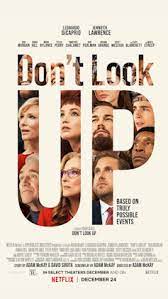
Don't Look Up - Film Review

“It is as if the world’s astronomers were telling us that an asteroid is heading our way and will make a direct hit destined to wipe out all of life, to which the public responds by remaining fascinated with sporting events, social media, the latest political machinations, and celebrity gossip.”

Reads like the script of the film Don’t Look Up doesn’t it? The above quotation was written almost two years before the film came out. In a highly recommended article in 2019 titled Facing Extinction1 Catherine Ingram addressed the probability of human extinction and possible emotional, psychological, and spiritual responses to that scenario.

Ingram is not the only one who has warned us of such a probability. Many others have done the same, and that is the theme of the film Don’t Look Up.

The film, however, is not another attempt to warn us. It is, unashamedly, a parody of our collective desire to look away (to not look up.)

Certainly, the film is corny, absurd, and over-the-top Hollywoodism and jingoism. As such, it is a film that this reviewer would normally not wish to view. However, as has been said: the experience is not the same thing as the message. The experience of watching this film may be cringe-worthy. The message, however, is compelling. We simply are not taking sufficient (if any) notice of the warnings that scientists, and others, have been trying to tell us since at least the early 1970s.

The film is an analogy and the comet (that is destined to destroy Earth) is a metaphor for a number of inter-connected, mutually reinforcing events. Indeed, it is possible to think of comet as an acronym. The comet metaphorically alludes to (inter alia): Climate change, Overshoot, Mass extinction, Environmental destruction, Techno-addiction.

Many of our sacred cows of distraction are held up in the film and shown for what they really are – dangerous addictions. Whether our addiction be to mobile phones, or celebrity gossip, or the worship of the hero/saviour, Don’t Look Up rails against them all.

This film then, is a warning to take the warnings seriously.

Will it make a difference? Maybe, maybe not.

Does the film offer any hope? Maybe, maybe not. It depends upon what sort of hope you are expecting. The final scenes mirror the final words of Catherine Ingram’s paper with which this review was introduced:

“…it is likely you have had many moments when you knew that love was all that ever really mattered. And in your final breaths it is likely to be all that is left of you, a cosmic story whispered only once.”1

1. Catherine Ingram, Facing Extinction, first published February 2019, updated July 2021. https://www.catherineingram.com/facingextinction/ accessed 4 January 2022.

Wednesday, 25 August 2021

Our Second Biggest Threat

Will the human race survive the Anthropocene Extinction – the sixth mass extinction?  It’s debatable.  And, what threatens our chances of survival?  This blog names our second biggest threat.

Covid?  The current (this blog written in August 2021) pandemic sweeping the world may or may not be the precursor to other more virulent pandemics to come.

No, covid is not our second biggest threat.

Climate chaos then?  We know the world is getting warmer.  We know that our human produced carbon emissions are a large part of that warming.  We know this warming is causing climate chaos.  We know this will almost certainly worsen.

No, not even climate chaos is our second biggest threat.

Perhaps ecological overshoot?  We know we have been extracting more and more from the earth, and producing more and more waste and pollution.  We know that since the early 1970s the earth has not been able to keep up with our ecological demand.  Our ecological footprint massively exceeds the earths biocapacity.

No, ecological overshoot is not our second biggest threat.

Our second biggest threat is our increasing polarization, and, along with it, our seemingly diminishing ability to communicate with one another.

This current covid pandemic is a glaring example of our inability to engage with one another in mutually respectful, and creative ways.  Take a look at social media posts about covid.  Two primary ‘camps’ seem to have formed.1  In one camp are those who say we must all wear masks, get a vaccine, accede to lock-downs.  The other camp comprises those who say all the restrictions threaten individual rights, and that the vaccines are dangerous.

Each camp has its adherents who are prepared to hurl abuse at those in the other camp.  Each camp has those who label the other camp followers as ‘idiots,’ ‘uneducated ignoramuses,’ or worse epithets.  Each camp claims that the other does not know what they are talking about.  Each camp accuses the other of not doing their research.

In short, each camp has proponents who are unwilling to engage with the other.

That is the threat.

If we are unable to engage with each other, without descending into name-calling and judgemental accusations, then there is very little chance that we can find any passage through the threats of climate change and ecological overshoot.  And, without that ability to engage with one another, we will not survive the Anthropocene Extinction.

The inability to engage with one another, though, is itself a symptom of the second biggest threat.

Polarization.

Again, covid is a very good marker of this trend to further and further polarization.  Each of the camps referred to above seem to be becoming further and further entrenched in their own ‘truth story.’  Each seem to be retreating into an echo chamber, wherein those who disagree are kept outside (defriended on facebook for example) and more and more evidence for their viewpoint can be found within the echo chamber.

Covid is only the latest example of this increasing polarization.  In a disturbing piece of research published in 2015, researchers in the U.S. tracked the level of cooperation, or lack thereof, between Democrats and Republicans in the U.S. House of Representatives between 1949 and 2012.  The results (see diagram) are revealing.2  Polarization has been increasing during those sixty plus years. Democrats are in blue, Republicans in red.


Of course, it could be argued that the U.S. House of Representatives does not represent the state of the world.  That is true, but only to an extent.  Our political systems often reflect the situation within the electorate, and/or tend to guide that level of political/social discourse within the electorate.  Furthermore, we know that the U.S. has a huge influence upon the culture of the western world.

Furthermore, we have established infrastructure that exacerbates, even thrives on, polarization.  Our parliamentary and legal systems, in particular, are structured on adversarial lines.  These are recipes for polarization.

Sadly, there is no way we can negotiate our way through covid, climate chaos, or ecological overshoot, if we remain trapped within echo chambers, especially echo chambers that we are adding more and more soundproofing to.

That is why polarization is our second biggest threat.

Our Biggest Threat?

You may be wondering what I consider our biggest threat to be?

Polarization is an inevitable outcome of a disconnect from one another.  When we view humanity in terms of ‘us’ and ‘them’ then we have begun the slippery slide towards polarization.

Our disconnect from one another is itself constructed on an even more fundamental disconnection.

Our disconnection from nature.

This is our biggest threat.  Yet, it is a threat we hardly even see, let alone acknowledge.  Starting with our disconnect from nature we easily slide into a disconnection from one another, and further still – a disconnection from our own selves (I prefer the term ‘soul’). 

When that happens, we find ourselves on a slide that ends with toxic individuality – the ultimate disconnect, and the ultimate polarization.

Is there a way to recover?  Is there a way to reconnect?  Is there a way to step out of our echo-chambers?  Is there a way to rediscover our souls?

Is there a way to survive?

Notes:

1. Presently it does appear that each of these ‘camps’ constitute only a small segment of the population.  Most people seem to be placing themselves outside of either camp.  How long that will last is unknowable.

2. https://journals.plos.org/plosone/article?id=10.1371/journal.pone.0123507 Accessed 25 August 2021