Pages

The name of this blog, Rainbow Juice, is intentional.
The rainbow signifies unity from diversity. It is holistic. The arch suggests the idea of looking at the over-arching concepts: the big picture. To create a rainbow requires air, fire (the sun) and water (raindrops) and us to see it from the earth.
Juice suggests an extract; hence rainbow juice is extracting the elements from the rainbow, translating them and making them accessible to us. Juice also refreshes us and here it symbolises our nutritional quest for understanding, compassion and enlightenment.
Artificial Intelligence (AI) is not used in the creation of the items on this blog.
Showing posts with label Feminism. Show all posts

Tuesday, 17 January 2023

Re. Reweaving The Web Of Life (Book Review)

Just over forty years ago Pam McAllister edited one of the most important books exploring the interface between feminism and nonviolence. With more than 50 contributors writing articles, letters, poems, and songs, Reweaving The Web Of Life1 proved just how incisive and diverse could be the critique of patriarchy. It also helped to unlock the door into a new society beyond the confines and constraints of inequality and violence.

Pam McAllister and the other women (although two men did co-author one article, More Power Than We Want) contributing were not only pointing out the failings of patriarchy and the existing world-order, they were looking forward, expectantly, to a different future. Importantly, they recognised that the future and the present were intricately linked (one of the many wefts and warps woven into the book) together. As McAllister put it in her Introduction:

‘A new world, the world I long for, cannot be built with the tools, psychology, belief systems of the old. It will be born of the changes encoded in the details of our lives as we are living them now. The fabric of the new society will be made of nothing more or less than the threads woven in today’s interactions.’

The title of the book comes from the title of Catherine Reid’s essay – Reweaving the Web of Life ­– in which she tells the story of a group of women calling themselves The Spinners. The Spinners were allied with the “Vermont Yankee Decommissioning Alliance” opposed to the construction and then continuance of a 620 MWe nuclear reactor on the Connecticut River.

Reid’s essay tells how The Spinners used thousands of yards of coloured yarn, threads, and strings which they secured to various trees, and then began spinning and weaving before the police could respond. Significantly, the nonviolent action of The Spinners took place just three days after the beginning of the accident at Three Mile Island nuclear reactor.2

The story of The Spinners is one of dozens of examples of the use of nonviolence by women cited in the book.

McAllister writes of how a Tarot card reading helped her with the strength she needed to write the book. One of the cards she took was labelled Strength and showed a woman stroking a lion. The convergence of feminism with nonviolence and strength is clear in the symbolism.

It is no coincidence that McAllister wove together the threads of feminism with those of nonviolence. In common with many feminists at the time, McAllister raged at ‘patriarchy’s brutal destructiveness’ and refused to adopt it’s (violent) ways. Furthermore, she asserted that she ‘refused to give in to despair or hate or to let men off the hook by making them the “other”.’

In that statement McAllister alluded to one of patriarchy’s underpinnings – that of separation and disconnection. McAllister, and the other contributors were having nothing of that sort of divisive thinking. For many within progressive movements of the time this (idea of non-separation) was quite a radical thought.

All but one of the contributors were US based, which was a deliberate decision on McAllister’s part. She intended following up with a book featuring contributors from other parts of the world. That idea morphed into two books presenting stories of women using nonviolence from all over the world: - You Can’t Kill The Spirit (1988) and This River of Courage (1991).

Reweaving the Web of Life is a landmark book, bringing together as it does, many contributors writing about the theory behind feminism and nonviolence, as well as telling stories of actual experience.

For anyone wishing to delve deeper into ways to re-weave the web of life, then this book is a must-read.

Notes:

1. Pam McAllister (ed.), Reweaving The Wed Of Life: Feminism and Nonviolence, New Society Publishers, Philadelphia, 1982

2. The Three Mile Island accident was a partial meltdown of one of the reactors at Three Mile Island nuclear power plant in Pennsylvania in March 1979. At the time, the International Atomic Energy Agency (IAEA) rated the accident at Level 5 on its 7-level International Nuclear Event Scale. It remains the most significant nuclear accident in US commercial nuclear power plant history.

Tuesday, 8 March 2022

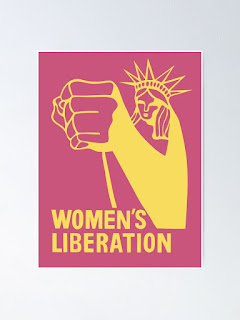
International Women's Day - A Liberation

I write this on 8 March 2022 – almost 50 years since the United Nations proclaimed 8 March as International Women’s Day.

The day itself has antecedents that stretch back to 1908 when women garment workers marched in New York demanding better working conditions and the right to vote. From there, women demanded (and celebrated the day) throughout a number of European countries.

In 1917, tired of the war, mostly women protested in Russia demanding bread and suffrage. This was to be one of the precursors of the revolution that brought the Russian empire, and the rule of the Tsar, to an end. Russian women gained the right to vote that year, before their sisters in the UK and USA.

Ofttimes in these days International Women’s Day is viewed through the lens of equality. Have women gained similar rights as men? Has the pay discrepancy reduced? Are women gaining access to institutions of power once reserved exclusively for men?

Yet, not all women are focused simply upon equality. Germaine Greer cynically stated that,

“I didn’t fight to get women out of behind vacuum cleaners to get them onto the board of Hoover.”

Germaine Greer, and many other feminists (especially during the 1970s and 1980s) advocated liberation. Indeed, the feminist movement of that time was often called the Women’s Liberation Movement.

Liberation, as readers will know, means something much much more than equality.

Did men hijack the intent of liberation? Did men simplify the message (or at least hear the message) to one of “equality with men”? Did men maintain the institutions of patriarchy by allowing for the equality of women so that women could participate in those institutions? Did men do this so that the institutions would not have to change?

Are men afraid of liberation? Any form of liberation – not women’s only.

I don’t know the answers to these questions. However, I would rather the questions were posed and that we have to think about them, than have glib and simplistic answers available.

During the 1970s and 1980s, women’s liberation was a political project. Yet, even within the political phraseology there was a radically different understanding of “political.” Political did not mean women having equal access to the political institutions. It did not mean more women in the seats of government. It did not mean more women heads of state. Although all those aspirations are worthy, for the women’s liberation movement, political institutions and structures themselves had to be rethought.

To quote Germaine Greer again:

“I do think that women could make politics irrelevant; by a kind of spontaneous cooperative action the like of which we have never seen; which is so far from people’s ideas of state structure or viable social structure that it seems to them like total anarchy — when what it really is, is very subtle forms of interrelation that do not follow some heirarchal pattern which is fundamentally patriarchal. The opposite to patriarchy is not matriarchy but fraternity, yet I think it’s women who are going to have to break this spiral of power and find the trick of cooperation.”

That, men and women, is a totally transformed understanding of the role and nature of politics.

Thus, as another International Women’s Day is celebrated, let us recall the radical liberation ideas of the feminists who were active fifty years ago – at the time the international institution of the United Nations was proclaiming the day.

Thursday, 16 April 2020

Personal, Political, Planetary

“The personal is political,” became one of the catch-phrases of the feminist movement of the 1960s and 70s.  The slogan caught on after an article written by Carol Hanisch was published in 1969. 

Prior to the feminist movement of that time, issues such as childcare, household labour, and problems like depression and anxiety, where considered purely personal or private in nature.  They had nothing to do with politics.  Hanisch’s article and the feminist movement as a whole challenged this, and reframed the very notion of politics.

Before continuing, lets stop to consider the meaning of political.  Too often, “political” gets constrained within terms of political parties, parliaments, Prime Ministers, politicians, elections etc.  The word politics however, comes from the Greek polis meaning the community of citizens of a city or city-state.

Politics then involves all of us.  It is a collective term.  We could describe politics as being the process by which a community or society makes decisions for its collective well-being or sustainability.

As such, we are all political beings.1

With this understanding it becomes clear that indeed, the personal IS political.  It is not a one-way effect though: the political is also personal.

In other words, everything is connected, as the later environmental movement went on to tell us.  As that environmental movement expanded and began to understand more and more (with the help of systems thinking) about the truth of inter-connection we began to understand that there is a planetary element as well.

Our personal behaviours and actions have an effect upon our environment.  Our collective decisions have effects also. 

The relatively new theories of chaos and complexity show that very small inputs to a system can have enormous results, and often these results are unpredictable and possibly even difficult to associate with the initial small input.

Such is the complexity, intricacy, and connectivity of all aspects of the world – the personal, the political, and the planetary.

We are now able to recognise that not only is the personal political, the personal is also planetary. 

Recognising and understanding these three ‘P’s is like knowing how a two edged sword works – it cuts both ways.

Our personal behaviours may have damaging planetary implications.  Our personal behaviours may also have healing implications. 

Our choices matter.  Our personal choices may be just as significant as our collective political choices.  What we choose to do in one arena has an influence upon what is done in another.

There are some who contend that individual (personal) actions are insignificant (almost of no value) and that only systematic (political) change will make a difference.  Others suggest that the only thing we can do is act as individuals.

Understanding the connection between the Personal, the Political, and the Planetary gives us another insight – one in which everything matters, everything influences everything else.

This last point may only just be coming to be realised in western thought.  Buddhism and other eastern philosophies have known this for centuries.  Buddhism calls it dependent arising.

Note:
1. Even to say that one is apolitical or non-political is still to make a political statement, and is an act that has collective impact.

Tuesday, 10 April 2018

Men Have Nothing To Fear From Feminism (post-script)

Last month I posted two blogs (here and here) about feminism, patriarchy and masculinity.  Since
then I have come across a couple of items that add to or expand on those themes.  I would like to share them here.  One is a cartoon about "toxic masculinity" and the other is a short video about feminism, patriarchy and gender equality in Iceland.

In the cartoon, the artist (Luke Humphris) outlines succinctly how patriarchy can lead to a condition known as "toxic masculinity" which is particularly damaging to men and those around them.

In the video, the presenter/interviewer (Liz Plank) takes us to Iceland where she interviews a group of men who state clearly that feminism has been of benefit to men and that there is nothing to fear from feminism.  (For those who want to jump ahead to this segment of the video, go to 2 min 55 seconds in).


The cartoon strip can be accessed here.https://thenib.com/toxic-masculinity

Thursday, 22 March 2018

Feminism: What Have Men To Fear? (Part 2)

In last weeks blog I asked whether men had anything to fear from feminism.  In that blog I proposed and briefly addressed two proposals:
  1. Feminism is misunderstood, and
  2. Feminism is not the problem.  Patriarchy is.
In this blog I intend briefly addressing the other two proposals:
     3. Feminism has not achieved its aims, and
     4. Men are also oppressed by patriarchy and stand to benefit by understanding and supporting feminism.

Feminism Has Not Achieved Its Aims

If feminism sought liberation from the patriarchal system, then it has not yet achieved that goal.  In many ways, the patriarchal system has become even more entrenched, with some women participating in it enthusiastically.  The (masculine) values of patriarchy are alive and well:
  • Aggression is still, all too often, seen as the way to achieve what we want.
  • Right and wrong, black and white, good and bad; polarities are still the way the world is portrayed.
  • Adversarial techniques are still the method of choice in our legal system, politics, the media, and our educational system.
  • Self-worth is measured (possibly increasingly so) by economic success, popularity, identification with idols (sports stars and pop idols for instance), strength, power, and influence.
Meanwhile, as patriarchy continues to thrive, the non-human parts of the planet are abused, misused, and exploited.  Other living beings that share the Earth with us are being made homeless, or worse still – extinguished.

The women's’ (and men's’) liberation movement have much to do.

Men Are Oppressed By Patriarchy

When I stated that women sought liberation from the patriarchal system, it is my contention that men could also benefit.  Why do I say that?  Consider these:
  • Under patriarchy, men’s feelings and emotions are stifled.  Most men grew up hearing phrases such as “big boys don’t cry.”  A few weeks ago I was talking with a friend whose father had been in the Australian navy during the war.  His father died young.  A friend of his father’s told him one day that he and the father came back from the war traumatised, yet were told to “go have a beer and get over it.”  Sadly, such sentiments remain today.
  • Stifling of emotion can lead many men to unhealthy coping mechanisms: alcoholism, chronic gambling, and depression to name but three.
  • Afraid to show (or even acknowledge) anything that suggests “weakness” can result in over-compensating by resorting to violence.  This is displayed in everything from schoolyard bullying, to a pub punch-up, through to domestic violence and all the way to the war in Syria.
  • Stifling of emotion is implicated in the high rate of suicide amongst men.  In may parts of the world, men kill themselves at a rate three times that of women.  In Australia, suicide and self-inflicted injury is the third highest cause of death amongst men, behind coronary heart disease and lung cancer,  It ranks higher than such causes as stroke and prostate cancer.
  • Patriarchy coerces men to disconnect from their children, families and community.  The song Cats In The Cradle by Harry Chapin, poignantly notes the sadness of a man trying to connect with his son late in life, only to find that “my boy had grown up just like me,” and did not have the time, nor the energy, to connect with his father.
  • Patriarchy especially discriminates against gay men, black men, young men and boys, and “weak” men.
  • Patriarchy is implicated in the phenomenon known as “toxic masculinity.”  Toxic masculinity aspires towards toughness, but is based in fear: fear of seeming or looking – soft, weak, tender, less “manly.”  It is characterised by domineering behaviour, the devaluation of women (including misogyny), and extreme self-reliance.
No, patriarchy is not good for men.  I must add a rider here.  This recognition that patriarchy oppresses men should not be read as a devaluation of the role patriarchy has in oppressing women.  The intent is to show that men have nothing to fear from feminism.

Finally:

  • NO!  Women are not the problem.
  • NO! Feminism/Women's’ Liberation is not the problem.
  • YES! Men and women can be partners and allies.
  • YES! Women and men stand to benefit by a liberation from what oppresses each gender – patriarchy.

Friday, 16 March 2018

Feminism: What Have Men To Fear?

Often I hear statements such as these from men:
  • Men don’t know who or what they are anymore because of feminism.
  • Men are oppressed by feminism.
  • Feminism says that men and women are equal, but we’re not!
These, and similar statements, suggest that feminism has been damaging to men, to families, and to relationships between men and women.

Is this so?  What follows is one man’s perspective.  I do not claim this to be truth – simply my understanding.  It is also, by necessity, simplified.

Let me begin by summarising this perspective in four proposals, which I will elaborate upon over the next two blogpieces:
  1. Feminism is misunderstood by men (and some women).
  2. Feminism is not the problem that many men make it out to be.  The problem is patriarchy.
  3. Feminism has not achieved what it set out to do.  It has been (in many instances) diverted from that goal.
  4. Men are also oppressed by patriarchy, and have something to benefit from understanding and supporting feminism.
In this blog I will elaborate upon the first two of these proposals.

Feminism Is Misunderstood

Let’s go back to the 1960s.  In that decade women began to meet together in “consciousness raising” groups.  Out of these groups a movement was born (perhaps better thought of as re-born when we think of the women’s rights movements of the 18th1 and 19th centuries.)  This movement became known as “Women's Liberation.”  Very soon, the (male) media subjected this movement to what the powerful often do – minimise and belittle, and dubbed it “Women's Lib.”  Perhaps because of this, the term “feminism” became the more popular name.  Today, the name has morphed into “gender equality.”

In that naming and renaming journey, “liberation” got dropped and was replaced by “equality.”  Indeed, one of the early feminist writers from the 1960/70s, Germaine Greer, caustically noted that “feminism aimed at liberation, but settled for equality.”  She later expanded on this by saying, “… seekers after equality clamoured to be admitted to smoke-filled male haunts.”

So – how is liberation different from equality?  Equality suggests assimilation.  Women are assimilated into male domains, in much the same way as indigenous people are assimilated into western culture.  Assimilation and equality imply getting rid of difference.  Liberation, however, asserts and celebrates difference.

Furthermore, if feminism means women becoming equal with men, then that implies that men and masculinity are the gold standard to be measured against.  Hardly liberation, and hence, not feminism in its original sense.

Feminism Is Not The Problem

… and nor (I might add) are men, per se.  The problem, according to the early feminist writers, is a system called “patriarchy.”  Patriarchy is a self-referring, self-justifying, and self-supporting system of beliefs, values and power.  Patriarchy asserts that “male” values, qualities and behaviours are paramount.  It rewards those who display and aspire to these.  Furthermore, patriarchy, like most systems, is largely invisible to those within it, because it is portrayed as being; normal, traditional, the-way-it-is, or simply “just because.”

Within the system of patriarchy the lessons we learn accumulate in our lives and we come to internalise them.  The longer this goes on, the harder it is to see that these lessons are not necessarily normal or “the truth.”  Then, not being able to see the system for what it is, it is difficult to gain distance from it.

The early feminists were right to point the finger at this oppressive system and to catalogue the range of institutions and establishments that make it up (e.g. marriage, bureaucracy, business, politics, the media, education, science, religion …)  They were also correct to note that women participating in these establishments supported these establishments, and did nothing to enhance the liberation of women (or men for that matter – but I’ll get to that.)

Two examples from politics serve to illustrate this:
  • Margaret Thatcher became “successful” and powerful because she aspired to be as domineering as men.  Indeed, she became moreso to “prove” her masculine values and abilities.
  • Julia Gillard, on the other hand, attempted to bring her “feminine” values and behaviour into the realm of politics.  She was side-lined and ridiculed within the political arena and by the media circus, and eventually tossed out of politics.2
I mentioned earlier that feminism stressed difference and diversity, rather than equality.  Patriarchy, on the other hand, promotes and exploits difference towards its own ends.  Not only in stressing the difference between men and women in order to suppress female values and qualities, but also in other arenas.  It used difference to justify slavery and to send children down mines.  Patriarchy also used difference to “transport” Britain’s “unwanted” to the penal colonies of Australia.

The next blog will expand upon the other two proposals – i.e. feminism has not achieved its goal, and men are also oppressed under patriarchy.

Notes:
1. Mary Wollstonecraft’s Vindication of the Rights of Women was published in 1792.

2. Margaret Thatcher (aka the Iron Lady) was Prime Minister of Great Britain from 1979 to 1990.  Julia Gillard was the Prime Minister of Australia from 2010 to 2013.