Pages

The name of this blog, Rainbow Juice, is intentional.
The rainbow signifies unity from diversity. It is holistic. The arch suggests the idea of looking at the over-arching concepts: the big picture. To create a rainbow requires air, fire (the sun) and water (raindrops) and us to see it from the earth.
Juice suggests an extract; hence rainbow juice is extracting the elements from the rainbow, translating them and making them accessible to us. Juice also refreshes us and here it symbolises our nutritional quest for understanding, compassion and enlightenment.
Artificial Intelligence (AI) is not used in the creation of the items on this blog.
Showing posts with label Mindfulness. Show all posts

Wednesday, 18 December 2024

Presenting Time

Where I live (in Australia) at this time of year Christmas is acknowledged, even if not celebrated. For many people and families that means it is a time of giving presents.

Present: to give a gift to someone. This is the sense in which the word present is used in this context.

However, I wonder how many people know that there is a connection to this meaning of present and the temporal meaning, i.e. the present time, as distinct from the past or the future.

The connection may not seem apparent. Let’s trace the etymological roots of the two meanings.

To give the gift of a present literally means to place an object in front of someone – in their presence. It comes from pre meaning before or spatially in front of, and the Latin esse meaning to be. Hence, we get the idea of something being in front of,

Another way in which present can be thought is that of one person being in the presence of another. That is, literally standing before someone else, and in their immediate vicinity. When we think of it this way it is possible to recognise this as being both in the immediate vicinity spatially, as well as being present at the same time as the other person.

How else would someone be in the presence of another unless it was in the same location and at the same time?

When we consider all this then it is possible to recognise the strong connection between giving a gift of a present and that of the present time.

Perhaps the greatest present that we can offer another person, and ourselves, at this time is the gift of being present at this time, now, the present.

In a world that seems fixated on the future – whether hopeful or expect of a better future, or anxious and fearful of what is to come – living in and for the present is a sane way to life.

Let us present ourselves a present of the present moment.

Tuesday, 28 May 2024

Story Of Awe

This story starts a long, long time ago, in a place far, far away, and involves something very, very small.

How long ago? Up to 100,000 years ago. Homo sapiens was yet to move out of Africa when this story began.

How far away? Think of it this way: if you were to get in a car and drive at a steady 100 km per hour without stopping, it would take you more than 170 years to travel the distance. So, if you left at about the time Charles Dickens was writing some of his classic novels, you would only just be arriving now!

How small? Do this: place your thumb and forefinger together. Imagine the space between. This thing would fit inside that space, with room to spare.

What is it?

A Photon.

150 million km away in the core of our Sun, hydrogen atoms smash into one another in a process known as fusion. In doing so, energy is released in the form of quantum packets of energy. We call these photons, or more commonly as light. Because of the extreme density at the core of the sun, a Photon gets blocked and slowed so that it can take as much as 100,000 years to travel to the surface of the Sun – a distance of slightly less than 700,000 km. (Remember that car travelling at 100 km per hour. It would travel that distance in roughly nine and a half months.)

But, having spent that long, long time getting from the core to the surface of the Sun, this tiny Photon sprints to the Earth in just eight minutes, travelling at the speed of, well – light!

When it gets here, what does this highly energetic, very small Photon do? It lands on leaves in the forest. In those leaves Photon meets a character called Phil, first name – Chloro. Photon and Chlorophyll shake hands. Chlorophyll says to the Photon, ‘I’ll take all your colours, and just reflect back the green.’

Photon replies, ‘Okay, let’s make some energy too.’

And so, the dance of energy continues on. Wow!

From that dance something else emerges, is created, and is released. Oxygen. Literally, the air (along with nitrogen and a small number of other elements) that you and I breathe.

Thus, when I breathe mindfully, I am thanking the Sun, thanking Photon. I say thank you to the leaves of the tree, thank you to Chloro Phil.

Then when I breathe out, the tree in turn says thank you to me, for I am breathing out carbon dioxide, Tree uses this molecule in conjunction with Photon to make glucose and other organic molecules, which are used as Tree’s energy source.

Isn’t that Awesome?

When I enter a forest and stop and look, listen, feel, taste, and smell I know that I am part of this endless cycle that began a long, long time ago, far, far away, and with something very, very small.

But wait. There is more.

I can’t look into the Sun, I can’t see the Chlorophyll in the leaves, and, unless I dig, I can’t see what is beneath my feet in the midst of the forest. But, I can know.

When I sit under a tree amid a forest, directly beneath me there could be a network of 50 km of communications, resource sharing, and warning systems. A Wood Wide World of mycelia.1 Staggering!

Mycelia are fine, thread-like, network of fungal strands that connect trees together. Through this complex and entangled network trees communicate with one another, share resources, nourish the young, and even send out warning signals.

That 50 km is just what is beneath me as I sit. Imagine the extent of this network throughout the entire forest. Marvellous!

When I take the time in a forest to consider all this, with a little knowledge, and my own 5 senses, plus inner senses, I am connected to a network of events that are thousands of years old, that are very, very tiny, and are very big.

This magnificent network is what sustains me (literally) and allows me to write this story here and now.

Isn’t that Awesome?!

Note:

1. This excellent video by renowned forest researcher, Suzanne Simard, more fully explains the Wood Wide World and the role of mycelia. https://www.youtube.com/watch?v=oVK9TCXZz6I

Wednesday, 20 September 2023

Planning to Not Know

When working in community development or on an environmental or social justice campaign hours can be spent in analysing the situation, planning strategies and tactics, and preparing to undertake various actions. Whole weekends can be spent in workshops, and seemingly endless meetings can be held.

What if such planning meetings, workshops, and strategizing were to be dispensed with? What if, instead, activists spent the same amount of time in silent meditative retreats? What if, instead of looking outward towards the objectives of the campaigns, time was spent looking inward? What if time was spent settling the busy monkey mind that we carry around with us day to day, and enabled our heart-mind (citta1) to make its presence more known?

Such a suggestion may not be as unproductive, or as wasteful of time, as may be imagined.

If there is to be any transformation of the state of the world, then that transformation must be both internal and external. It must be personal, and it must be collective and social. Indeed, a healthy transformation cannot be one without the other. A bird must have both wings to fly.

Yet, a huge proportion of the time spent in campaigns is directed outward. Time is spent analysing who is doing what, and when. Consideration is given to asking who are “our” opponents and who are “our” allies? The mechanics of the situation are defined. Facts, figures, and data are researched and presented.

It is all about what is “out there.”

What if we were to spend time asking what is “in here”? What is our deep heart telling us? On the surface we might be thinking that our heart tells us ‘I am angry (because this or that is happening to our planet, or to this group of people).’

However, our hearts carry much deeper feelings and emotions. Yet, when we get caught up in the externalities of campaigning, we lose access to our deep hearts.

Not Knowing

To open to our deep heart means letting go of what we know and what we think we know. It also means letting go of the craving to control outcomes. Together, this requires foregoing any certainty. It also obliges us to relinquish notions of right and wrong, of good and evil.

Resting in silent, mindful meditation allows the awareness of the inter-beingness of all things to arise. In this state of deep awareness the dualism that we project outward onto the world begins to dissolve. In silence our clinging mind starts to let go of certainty and knowingness.

Gandhi’s Example

In 1930 the Indian Congress Party and the independence movement generally, was in disarray and one of its leaders, Mohandas Gandhi did not know what to do. The esteemed poet Rabindranath Tagore visited Gandhi at his ashram on the Sabarmati River. Tagore asked Gandhi what should be done, and Gandhi answered saying, ‘I do not see any light coming out of the darkness.’2

But Gandhi was not about to give up. However, instead of making plans, Gandhi spent time alone and in silence in his ashram for many weeks. He told fellow ashram members, ‘I’m just waiting. I’m waiting for the call. I know that I will hear the inner voice.’

He did hear that inner voice. The result of Gandhi’s silent waiting is now considered to be one of history’s outstanding examples of nonviolent resistance – the Salt March.3

Gandhi’s example is not an isolated case. Certainly not for those working from within a spiritual tradition. In recent years the practice of vision quests have made an impact upon westernised activists and others seeking a better world. The practice, of course, is well-known within indigenous societies. This practice has yet to become widespread within movements seeking a transformed society. If and when it does so, we may see a radically different approach to social transformation.

Vision quests involve days, sometimes weeks, of solitary and mindful praxis. A participant must let go of preconceived notions of their place in the world, and even of who they are.

When this not-knowing mind-set is invoked a much deeper, and more encompassing, knowing is released.

What if activist movements incorporated these practices within their campaigns more often? What if activists dropped the notions of certainty and control over outcomes?

What if environmental and social justice movements took up a bearing of not-knowing?

Would it work?

I don’t know.

Notes:

1. Citta is a Pali word often translated as heart-mind. Citta makes no distinction between the mind and the heart, the inter-connection is so great that there is no division.

2. Cited in Donald Rothberg, The Engaged Spiritual Life, Beacon Press, Boston, 2006.

3. The Salt March was a nonviolent march of almost 400 km from Gandhi’s ashram to Dandi (on the west coast of India) where Gandhi made salt (in defiance of the British colonialist “salt laws”). The march took 24 days and helped spur Indians to mass civil disobedience and was instrumental in the eventual dismantling of British colonial rule over India.

Wednesday, 23 November 2022

Silent Listening

A few years ago, someone pointed out to me that the word LISTEN is an anagram of the word SILENT. That’s pretty cool I thought. Cool, maybe, yet the connection between the two words is significant.

Whether listening to someone else, listening to ourselves, or listening to nature; the role of silence is critical. Indeed, it could be argued that the ability to be silent is the most basic skill required to truly listen.

Listening to Others

Listening to other people is perhaps the first thing that comes to mind when we hear (or read) the word listen. And, not without cause. We spend a lot of time in communication with other people; whether sitting in a café chatting over a coffee, spending time in intimate conversation with significant others, or in a formal (or informal) setting with a group of people.

If you were a ‘fly-on-the-wall’ and able to listen-in to these conversations you would probably notice that there is not a lot of quiet time, not much silence.

Yet, silence could bring a greatly enhanced meaning to conversations. Silence can allow for a more abundant depth of listening than can a spoken response. This is especially true of conversations involving significant emotional content (such as: grief, turmoil, ecstasy, wonder, pain and loss, depression, or love and excitement.)

Silence is recognised as a core skill in the art of active/creative listening. It is a crucial part of healing circles, or indeed, any groupwork circle. Within such circles the sharing is often deep, emotionally imbued, and sometimes uttered from a place of vulnerability. Silence following such sharing does two things: First, it indicates to the sharer (speaker) that they have been heard, and that what they shared is acknowledged within the silent space that follows. Second, it allows those of us who have been privileged to listen to drop into a silent space to reflect upon what has been said and discover our common humanity.

Listening to Nature

Richard Louv1 coined the term Nature Deficit Disorder in 2005 to recognise the growing awareness that our disconnection from nature had serious implications, not only for our environment, but also for our own selves.

The writer, Hermann Hesse, noted that, ‘Trees are sanctuaries. Whoever knows how to speak to them, whoever knows how to listen to them, can learn the truth.’

That requires silence. To go into the forest, or the bush, or any natural setting, obliges us to do so in silence. In silence it is possible to truly hear what the trees, nature, the forest, the birds, the animals, are saying. Such an encounter with nature is at the heart of the Japanese practice of shinrin yoku (literally meaning to bathe in the forest environment, to take in the forest through giving mindful attention to our senses.) One of the first researchers into the benefits of forest bathing, Yoshifumi Miyazaki, says that ‘…it is clear that our bodies still recognise nature as our home…’ 2

To reconnect with nature, to recognise our home, and gain the tremendous benefits that home (nature) provides, we must appreciate the significant role of silence.

Listening to Ourselves

How often do we truly listen to ourselves? Were we to stop and sit, and honestly listen to ourselves, we might be surprised by what we learn. The 17th century French mathematician, physicist, and philosopher, Blaise Pascal, went further, proposing that, ‘All of humanity’s problems stem from (our) inability to sit quietly in a room alone.’

Is Pascal correct in this assertion? Perhaps if we did as he suggested, and sat in silence for awhile and listened, we might discover that he was telling a truth.

How do we listen to ourselves?

One of the most beautiful descriptions of this inner listening comes from Miriam-Rose Ungunmerr Baumann, a Ngangikurungkurr woman from northern Australia. She describes the word dadirri as:

“inner, deep listening and quiet, still awareness. Dadirri recognises the deep spring that is inside us. We call on it and it calls to us. This is the gift that Australia (and the world – ed.) is thirsting for. It is something like what you call ‘contemplation.’ When I experience dadirri, I am made whole again. I can sit on the riverbank or walk through the trees; even if someone close to me has passed away, I can find my peace in this silent awareness. There is no need of words. A big part of dadirri is listening. Through the years we have listened to our stories. They are told and sung, over and over, as the seasons go by. Today we still gather around the campfires and together we hear the sacred stories.”3

What we further notice in this beautiful word picture is that all three aspects of listening (to others, to nature, and to ourselves) are woven together like a fine tapestry.

How do we do this? What techniques should we develop so that we can access that deep spring of awareness? There seems to be four barriers we must first get past:4

1.   Declutter your mind.  Tapping into your inner wisdom is difficult if there is a lot of clutter in the way.  You will find your own way to declutter; some ways are to go for a walk, get into nature, listen to music or meditate.  Perhaps a shower.  Have you noticed how often you’ll get a good idea in the shower?  It’s surprisingly common.  Whatever you do, you need to give your mind freedom.

2.   Ignore what you know.  Intuition deals more with feelings, insights and emotions than it does with facts and figures.  This does not mean that you reject the facts and figures, just put them aside and ask yourself how you feel about the question, issue or problem?  How is your body responding?

3.   Get out of your head.  Go with your gut.  Often we get a “gut feeling” before our brain takes over and becomes the “knower.”  Get in tune with your gut.  Do your stomach muscles contract and tighten or do they relax?  Does your heart and chest feel as if it is expanding?

4.   Let go the need to control.  Our rational mind tells us that we should be in control at all times.  However, when we wish to tap into our inner wisdom we need to surrender this desire, and trust that our intuition will provide us with insights without our need to dictate what those insights might be.

Once we get past these four barriers, then we need to simply sit and simply be silent. Not easy, admittedly, but worth the effort to become practiced with.

Since first being alerted to the anagram of SILENT and LISTEN I have come to appreciate the strong connection between the concepts of each. Silence is a crucial element in true listening, and if we wish to truly listen then we must utilise silence.

The fact that they are anagrams of each other is a reminder of this connection.

Notes:

1. Louv, Richard: Last Child in the Woods: Saving our children from nature deficit disorder, Workman Publishing Company, New York, 2005.

2. Miyazaki, Yoshifumi: Shinrin Yoku, The Japanese art of forest bathing, Timber Press, Portland, Oregon, 2018.

3. For a full description of dadirri and more information about the work of Miriam-Rose Ungunmerr Baumann go to her Foundations website – www.miriamrosefoundation.org.au Accessed 23 November 2022.

4. Adapted from, Meder, Bruce: Opportunities Emerging: Social change in a complex world, Rainbow Juice Publishing, Coffs Harbour, NSW, Australia, 2016.

Tuesday, 21 June 2022

Solstice For The Soul

Today (21 June 2022) is the Winter Solstice here in the Southern Hemisphere (Summer Solstice in the Northern Hemisphere.) It is the day on which the sun (sol) appears to stand still (stice.) The sun appears to stop on its journey on the horizon towards the north. It is almost as if the sun is standing still for a day or so, contemplating the future: shall I journey further, or shall I return the way I have come over the past six months?

Viewed this way – as a time to stop and ponder and consider – perhaps we too could take a day or so to do the same. To consider our own soul, and especially how and where our unique soul fits within the world-soul.

To say that we rarely take such opportunity in this crazy, fast-paced, busy-busy world is perhaps stating the obvious. But, it needs to be stated. We need to stop and consider, and ponder.

How do we fit within the world-soul?

What is the world-soul?

Around 360 BC., Plato wrote one of his dialogues, Timaeus, and in it described the anima mundi (world-soul) and declared that,

“…we must declare that this Cosmos has verily come into existence as a Living Creature endowed with soul and reason [...] a Living Creature, one and visible, containing within itself all the living creatures which are by nature akin to itself.”1

The anima mundi (world-soul) then; is the life force, the animating principle, the very essence and soul, of a fully interconnected entity. A connected entity in which we all are a necessary and integral part, one in which the complexity and diversity is such that we conscious human beings cannot grasp the magnitude of this complexity. We can only gaze with awe and wonder at the mystery of it all.

Each of us has our own unique soul, even if we deny this, or do not actively seek or recognise it.

Centuries after Plato the Swiss psychologist Carl Jung further explored the anima mundi, and lamented our disconnection from the soul of the world. He wrote that,

“The development of Western philosophy during the last two centuries has succeeded in isolating the mind in its own sphere and in severing it from its primordial oneness with the universe. (Humanity has) ceased to be the microcosm and eidolon (image or representation of an idea – ed.) of the cosmos, and “anima” is no longer the consubstantial scintilla, spark of the Anima Mundi, World Soul”2

Perhaps today, as the sun stops to linger and ponder on its back-and-forth journey, we too, could pause and consider our soul’s place in the world-soul.

Notes:

1. Plato, Timaeus 30b–d, translated by W.R.M. Lamb

2. Carl Jung, Archetypes and the Collective Unconscious, Collected Works Vol.9 Part 1. 

Tuesday, 31 May 2022

Right Of Speech - Right Speech

The Right to Freedom of Expression and Speech seems to be an indisputable one doesn’t it? After all, it has been a right for centuries. France’s Declaration of the Rights of Man and of the Citizen adopted in 1789 during the French Revolution declared it an inalienable right. Two years later, the First Amendment to the United States Constitution protected freedom of speech.

In 1948, the United Nations General Assembly adopted the Universal Declaration of Human Rights – Article 19 of which declares that, “Everyone has the right to freedom of opinion and expression.”

Today, we hear this right being insisted upon often. It is insisted upon by those wishing to spread misinformation and lies as much as by those wishing to oppose such lies.

Underlying this insistence is the assertion that the individual is paramount. “My rights,” we hear, “are inalienable, and shall not be impinged upon by society.”

The cult of the individual is very much a westernised one. Although, even in western cultures it may be only fairly recent. Alexis de Tocqueville, writing in 1856, said that individualism was “not a word used by our ancestors, for no one could rely solely on themselves to survive and prosper.”1

More recently, individualism has grown another limb – that of Toxic Individualism. Having a belief in oneself, or a self-reliance, is one thing, but that sense of self becomes toxic individualism when an individual refuses to recognise or understand the impact one has on the lives of others and their community.

Right Speech

Several non-westernised cultures have a differing understanding of what it means to be an individual. The individual is not separate from, nor separate to, other people or nature. The Vietnamese Buddhist monk, Thich Nhat Hanh, recognises that “I am, therefore you are. You are, therefore I am. We inter-are.”

This concept of inter-connection and non-separation is quite different to the westernised idea of the individual as standing apart.

The recognition of inter-connection has, as would be expected, a bearing upon speech. Less emphasis is given to Right of Speech and more given to Right Speech.

Right Speech is given prominence in the 8-fold path of the Buddha. Although often translated as right, the Pali word samma, could also be translated as best, wise, skillful. Indeed, such translations may be the better ones, as the word right has unfortunate associations with one side of the right-wrong dualism.

If we consider the concept of Wise Speech, Skillful Speech, or Best Speech, we begin to understand the impact our speech can have on those around us, and even upon ourselves.

When the Buddha introduced the 8-fold path, he also spoke of the connection between thoughts, words, deeds, and character. The following poem encapsulates the Buddha’s ideas, although the derivation of the poem is disputed:

“The thought manifests as the word;

The word manifests as the deed;

The deed develops into habit;

And the habit hardens into character;

So watch the thought and its ways with care;

And let it spring from love

Born out of concern for all beings.

As the shadow follows the body,

As we think, so we become.”2

When we speak our words have effects. (If they did not, why would we speak them?) Often we can see the effect our words have had, after we have spoken them. It is as though we watch the ripples flowing behind us in the wake of the ship we are steering. Once the wake has been made, we can no longer control the ripples. Yet, we also have the option to understand the ripples we make, before we make them. This is the bow-wave of our ship. The wake that precedes us. To be a-wake literally means to be so attuned to the wake we are creating that we fully understand its ripples.

The Right Speech of the 8-fold path is further enunciated and specifically advises avoiding, 1. lies, 2. divisive speech, 3. harsh speech, and 4. idle chatter.

What if we were to be mindful of Right Speech as we proclaim our Right of Speech? Would we see the divisiveness, the hatred, the bigotry, and the prejudices we see, and hear, today? Maybe, although I suspect there would be much less. And in that lessening, we might create a space for us to truly listen to one another. We might enter a deep listening, similar to that which Thich Nhat Hanh hopes for:

“Deep listening is the foundation of Right Speech. If we cannot listen mindfully, we cannot practice Right Speech. No matter what we say, it will not be mindful, because we’ll be speaking only our own ideas and not in response to the other person.”

Right Speech does not suggest that we give up our Right to Speech, only that we use it wisely.

Notes:

1. Alexis de Tocqueville, L'Ancien Régime et la Révolution (The Old Regime and the Revolution), 1856.

2. This poem has often been attributed to the Buddha, yet it does not appear in any of the early Buddhist texts. The origin remains uncertain, although many Buddhists would say that the sentiments are those of the Buddha, even if the Buddha did not say them. Other scholars suggest the poem may be of Christian origin from the 19th century.

Thursday, 27 January 2022

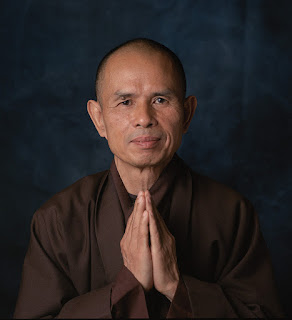
Farewell Thich Nhat Hanh

Rather than write an original blogpost this week, I instead will allow the words of
Venerable Thich Nhat Hanh to have their place here. This blogsite has frequently quoted Thich Nhat Hanh, most often in relation to his concept of interbeing. Thich Nhat Hanh (who died on 22 January 2022) described interbeing as “the many in the one and the one containing the many.”  In a nod to the oft-quoted Descartes saying about being, Thich Nhat Hanh further expressed interbeing as: “I am, therefore you are.  You are, therefore I am. We inter-are.”

It is a concept fundamental to all of his teachings. It is a concept we dearly need to learn.

Let us read further from the words of this wise and compassionate teacher:


On Walking


·       “The miracle is not to walk on water. The miracle is to walk on the green earth, dwelling deeply in the present moment and feeling truly alive.”

·       “When we walk like we are rushing, we print anxiety and sorrow on the earth. We have to walk in a way that we only print peace and serenity on the earth. Be aware of the contact between your feet and the earth. Walk as if you are kissing the earth with your feet.”


            On Happiness


·       “Whether the moment is happy or not depends on you. It is you that makes the moment happy. It is not the moment that makes you happy.”


            On Silence


·       “Just as the painter uses shadow to highlight forms and shapes, so does silence highlight our words and speech.”

·       “Silence is essential. We need silence, just as much as we need air, just as much as plants need light. If our minds are crowded with words and thoughts, there is no space for us.”


            On Compassion


·       “To love our enemy is impossible. The moment we understand our enemy, we feel compassion towards him or her, and he or she is no longer our enemy.”


            On Politics


·       “It is not correct to believe that the world’s situation is in the hands of the government and that if the presidents would only have the correct policies, there would be peace. Our daily lives have the most to do with the situation of the world. If we change our daily lives, we can change our governments and we can change the world.”


Thank you, Thich Nhat Hanh, for all your teachings and offerings to us and the world. Your words are of far greater significance that any eulogy that I may be able to offer.

With blessings. 

Wednesday, 28 April 2021

Now!

One of the most common chants heard during a protest rally is that of, “When do we want it?” with the habitual response of, “Now!”

Certainly, chants and call-response can be energising for rally participants.  Some chants can capture an entire message in a few words.  However, chants can also play on our minds, turning neurons on or off, so that the message is an internal one as much as an external one.

For those of us seeking social justice the response of “Now!” may be disrupting our equanimity.  Now! yells out impatience.  Now! calls out frustration and anger.  Now! shouts out a different message to that of the “power of now.”

The concept of the power of now has been popularised by Eckhart Tolle’s multi-million selling book of that title.1  Tolle’s basic teachings are not new; in fact, they are centuries old.

The basic premise of living in the present moment (“the now” as Tolle refers to it) is to be mindful of our inner and outer worlds.  We experience the outer world through our five “external” senses.

With these five senses we can take notice of our surroundings.  Many of us, however, navigate our daily lives with little awareness of our surroundings.  We get caught up in our thoughts, with most of those thoughts either: remembering what has happened in the past, or planning our future.  We are not present.

Being present also teaches us patience.  The future does not beckon us with a sense of urgency.  We are simply present, and time is something we experience with patience.  

We also sense the outer world via our “inner” senses, such as instinct, intuition, and feelings.  Once again, if we are present, then we allow ourselves the chance to recognise what is going on inside.  We notice our feelings; the sometimes small sensations in our body.

Why is this important?  Or, how is this beneficial?

Eckhart Tolle puts it this way:

“When you act out of present-moment awareness, whatever you do becomes imbued with a sense of quality, care, and love – even the most simple action.”

Okay, so what does this have to do with the call-response rallying chant, “When do we want it?”

If Tolle is correct in suggesting that being present imbues each action with quality, care, and love, then a chant of impatience would seem to be contrary to those values.  And… if those values are not present in the world we wish to see, then surely, we need to re-think our vision.

But it’s just a chant, I hear.

Yes, it is a chant.  Yet, as alluded to above, the message in the chant is one we tell ourselves as much as what we want others to hear.  Neuroscience has been telling us for many years that our internal messages change the way we think.  When we tell ourselves that we are stupid, or a genius, then we become stupid, or a genius.  Messages are powerful.  The ones we tell ourselves perhaps the most powerful of all.  The more we tell ourselves these messages the stronger the neural links that enforce the message and our belief in the message.

The message of “Now!” tells us over and over to be impatient, to remain frustrated and angry when “Now!” is not answered.

We need to find other messages to tell ourselves.  We need to find other ways to express our desires for greater social justice.  We need to switch from a “Now!” mind-set to a Power of Now mind-set.

That calls for patience – a very present-centred attribute.

Note

1. Eckhart Tolle, The Power of Now, originally published by Namaste Publishing, Canada, 1997.

Wednesday, 26 August 2020

C.O.V.I.D.

The past few months have brought us not only pandemic but also a large degree of pandemonium.

In that time I have read, and listened to, politicians, experts, and friends telling me their thoughts, ideas, and mostly, their “knowledge.”  Some tell me Covid-19 is a deadly virus and we need to lock-down, keep our physical distance, wear a mask, and listen to experts and authorities.  Others tell me it is all a hoax, or at least not as harmful as we are told.  Still others tell me that the reaction from authorities is an over-reaction and that personal and individual liberties are under threat.

I do not wish to enter into a never-ending, continuous cycle of claim, counter-claim and ultimately futile conversation.  I acknowledge I have no knowledge, no background study or education, in any of this.  Hence, I can offer no opinion on the rights/wrongs of the measures taking place.  I do, however, know how I can act in the world at this time. 

Thinking of how to act I arrived at this C.O.V.I.D. attitude and understanding:

C is for Compassion.  There has been a lot of anger, blame-gaming, and name-calling by many on all sides during this time.  Compassion allows me to step back from these cul-de-sacs and allow me to have compassion for those who have had loved ones die.  I can find compassion for those embroiled in accusations and counter-accusations.  Furthermore, I have compassion for myself, for my own fears, uncertainties, and weariness.

O is for Observing, especially observing emotional responses.  I notice in others, and in myself, that many of our emotional responses arise from a place of fear.  For some it is a fear of illness or even death – of themselves or a loved one.  For some it is a fear of loss of work and hence, loss of income.  Yet others fear the loss of personal, or individual, liberty.  I can observe all of these fears arising in my own reactions and thoughts.

V is for Valuing each moment.  When I meditate, or remind myself of the practice of Mindfulness, my emotional state shifts towards ease and I can enter a zone of contentment, accepting what is without judgment.  Valuing each moment allows me to be present with my own feelings and also present to the particular engagements I may have with others from moment to moment.

I is for Inter-being.  Inter-being is a term coined by the Buddhist monk Thich Nhat Hanh who (with a nod to Descartes) expresses it as: “I am, therefore you are.  You are, therefore I am.  We inter-are.”  When I try to fully understand this, it becomes extremely difficult, if not impossible, to point fingers, name-call, or describe others as fools or idiots, meanwhile suggesting a woke1 attribution to myself and those who think like me.  Furthermore, the notion of inter-being does not stop with humanity; it extends to the whole planetary system.  Thus, the ways in which we have treated (mis-treated is more apt) nature has profound repercussions for us.  We cannot isolate ourselves from nature, and in our attempt to do so (an enterprise we have been on for centuries) we disrupt the intricate networks so much that something, somewhere, is going to give.  Now that it has – we don’t like it.  (I’ll just leave that last sentence hanging.)

D is for Death.  Stephen Jenkinson2 describes our western-styled culture as “…death-phobic and grief-illiterate.”   Death-phobia leads to death-denial and death-fearing.  We do all in our power to put off death and keep living, even if by keeping living we are no longer living.  Yet, as we know, and Buddhism reminds us, everything is impermanent.  Everything passes.  Yet, our aversion to death ironically means we approach life with impunity.  Perversely, our refusal to face death means we fail to live life fully.  Covid-19 brings us, if we are willing to allow it, face-to-face with our mortality.  And, being grief-illiterate we fail to recognise the love that is part and parcel of grief, slipping more easily into anger or despair.

Each of these five actions/attitudes are inter-connected, and the reader should treat them that way.  In doing so, you will discover your own meanings and connections.

For me, these five interconnected attitudes allow me to act in the world during a time of chaos, misunderstandings, confusion, and doubts.  Ultimately, how I act is of far more importance than my opinion on the rights and wrongs of the debates on Covid-19.

Note:

1.     Woke is a term borrowed – or stolen – from the Black Lives Matter movement, and essentially means to have an awareness of racial and social justice issues

2.     Stephen Jenkinson, Die Wise: A Manifesto for Sanity and Soul, North Atlantic Books, Berkeley, 2015

Monday, 2 December 2019

The Horizon Calls

Recently I had cause to pass through Sydney.  I arrived by train and had five hours before my connecting train.

As I wandered the inner-city streets looking for somewhere to purchase dinner and to relax, I watched my fellow human beings.  Many seemed stressed.  Half of them seemed to have a mobile phone in their hands connected to ear-plugs.  Others were in a hurry.  And, it was noisy.

After a couple of hours I noticed my own sense of calmness begin to diminish, replaced by a rising uneasiness.

Then I noticed something, or more correctly, failed to notice something.  I could not see the horizon.

Everywhere I looked were buildings, most of them high-rise.  My view, if any, of the sky, was comprised of a narrow strip between the roof-lines of the buildings on either side of the street.

No horizon.

Where I’d come from earlier in the day I had always been able to see the line between sea and sky, or the outline of Ngali (Old Man Dreaming as the mountain range is known to the local Gumbaynggirr people.)

On any given day I could see the horizon.

I was struck by the thought: is our psyche, or our soul, nourished by the sight of the horizon?  When we are able to see the boundary between Father Sky and Mother Earth are we, somehow, more grounded in who we are and what we are part of?

Whether it be a fairly continuous line, as between sea and sky, or one that is fractalised, such as by trees and mountains, the horizon always calls to us.

The horizon calls us to notice our Sky Father and our Earth Mother.  The horizon calls us to remember our links to sky, to sea, to forest, to mountain.  The horizon calls us to seek our soul, especially at the time of day when the sun dips below the western horizon.  The west is metaphorically the place where we enter the darkness and the mysteries of soul.

Then, in the morning, the sun rises above the eastern horizon, bringing brightness, wonder, and frivolity to our lives.

As I write this the sun has set in the city, but I did not notice it – because I cannot see the horizon.

So, next time you gaze at the horizon, give thanks that you can, and listen to how it calls you.

Monday, 5 August 2019

A More Beneficial A.I.

The world is full of acronyms, and A.I. is one of the more recent.  I guess most people when confronted with the acronym A.I. will think Artificial Intelligence.

Artificial Intelligence though, has risks and harmful effects.  Elon Musk (who you think would know something about A.I. with his electric cars, spaceships and Mars project) has called A.I. our biggest existential threat and that
“With artificial intelligence we are summoning the demon.”1
I’ve been searching for a more beneficial A.I. and I’ve found it.

A.I. in my world stands for Arboreal Immersion.

Arboreal means relating to trees or resembling the form of a tree, especially its branching patterns.

Arboreal also means inhabiting or frequenting trees.  This is the sense with which I mean the term  A.I. – Arboreal Immersion.

A.I. means to immerse oneself within trees, in a forest.

You may recognise this idea in its more common term – Forest Bathing.

Forest Bathing is the English term given to the Japanese word Shinrin-yoku, where the practice began in the 1980s.

Of course, the benefits of nature and being in a forest setting have been understood by many cultures for many thousands of years.  However, the specific practice and study of Shinrin-yoku is recent.

Forest Bathing (Arboreal Immersion) involves entering a forest slowly and quietly, with no intention to get anywhere.  The idea is to simply immerse oneself in the forest and open ones outer senses to the surroundings.  What do you notice?  What do you see, hear, smell, touch, taste?  Arboreal Immersion is not an intellectual practice of identifying species, nor is it a setting in which to display or increase our knowledge.

It is simply a container in which we allow our senses to just – sense.

We also open ourselves to our inner senses.  We allow nature to access our inner nature.  What do we intuit from the forest?  What feelings and emotions are stirred inside us?

Over the course of the past few decades there has been a lot of research carried out with much of that research showing the tremendous benefits of Forest Bathing.  Benefits that include:
  • assisting in mental health disorders, including ADHD, anxiety, and depression.
  • helping to mitigate migraines,
  • overcoming obesity, musculoskeletal complaints, and respiratory diseases,
  • increased feelings of gratitude and wonder,
  • a deeper sense of relaxation (mental and physical).
In our hurly-burly, go-go-go, daily lives our sympathetic nervous system (the one that kicks in as a fight/flight/freeze response) is constantly on edge, just waiting nervously to be set in motion.  When continuous, this is an unhealthy state and keeps our heart rate on constant alert.

Forest Bathing helps to settle this sympathetic system so that our parasympathetic nervous system can restore our “natural” state.

Planetary Benefits

Of course, the benefits of Forest Bathing go well beyond the individual benefits.  Jacques Yves Cousteau commented that
“People protect what they love.”
People who spend time Forest Bathing come to love the forest and nature; and thus come to feel more protective towards nature and forests in particular.

The benefits of forests are well known in terms of the carbon/oxygen cycle.  If we love the forest, we will protect the forest, and in doing so will protect the whole planet, and ourselves.

Yes, Arboreal Immersion has many benefits for individuals, communities, natural systems, and the planet as a whole.

I prefer the natural benefits of this form of A.I. rather than the artificial dangers of the other form of A.I.

Notes:
1. The Washington Post, 24 October 2014.