Pages

The name of this blog, Rainbow Juice, is intentional.
The rainbow signifies unity from diversity. It is holistic. The arch suggests the idea of looking at the over-arching concepts: the big picture. To create a rainbow requires air, fire (the sun) and water (raindrops) and us to see it from the earth.
Juice suggests an extract; hence rainbow juice is extracting the elements from the rainbow, translating them and making them accessible to us. Juice also refreshes us and here it symbolises our nutritional quest for understanding, compassion and enlightenment.
Artificial Intelligence (AI) is not used in the creation of the items on this blog.
Showing posts with label Anti-War. Show all posts

Wednesday, 5 November 2025

Known For All The Wrong Reasons

One of 500 Dafur refugee children's drawings
from the Waging Peace collection
Pol Pot, Stalin, Hitler, Idi Amin, Franco, Kai-Shek, Mao, Hussein – all well-known names. Most likely though, they are known for the wrong reasons. Asked to associate single words with any of these names and many people would come up with a list looking something like this: dictator, despot, genocide, holocaust, brutal etc.

We know their names because of the atrocities committed under their rule.

Stalin is estimated to have had 40-60 million killed during his regime.

Mao Tse Tung had somewhere between 45 million and 75 million killed whilst in power.

During Hitler’s Reich the number of deaths is estimated at 17-20 million.

Chiang Kai-Shek murdered about 10 million.

Approximately 2 million were killed during Hussein’s rule. Pol Pot’s Cambodian rule killed a similar number.

The number killed during Idi Amin’s reign is indeterminate but estimated at between 100,000 to 500,000. Franco, in Spain, is responsible for about 400,000 deaths.

Those eight names, all from the 20th century, were responsible for at least a conservative estimate of 116 million deaths. The death toll could have been as high as 170 million. And that number is only by those eight. Others that could be mentioned are: the dictator Milosevic, and the genocides of Rwanda, Dafur, Armenia, and the Rape of Nanking.

More than 116 – 170 million wrong reasons for knowing their names.

In 1948 the Genocide Convention was drafted and gained 153 state parties to it (as of February 2025.) The Convention defines genocide as the ‘… intent to destroy, in whole or in part, a national, ethnical, racial, or religious group…’  The Convention includes in the rubric of genocide not simply outright killing, but also the causing of bodily or mental harm, deliberately imposing conditions of life that will bring about destruction, preventing births within the group, and forcibly transferring children from the group to another group.

When genocide is considered in the light of this Convention, then the total numbers given above are likely to rise by a considerable number of orders of magnitude.

This definition also enables us to recognise a number of other historical events as genocide. The colonisation (including slaughter) of native Americans by European invaders from the 16th century onwards, the Atlantic slave trade, the stolen generation in Australia.

Genocide did not end with the signing of the Genocide Convention, and genocide did not end with the shift from the 20th to the 21st century. Genocide is continuing.

We can name the names of those contributing to genocide today.

They also will be known for all the wrong reasons when the history of the 21st century is written.

Wednesday, 15 January 2025

Castles, Forts, and Walled Cities

Imagine you were set down in a region of the world where you had no idea where you were, no idea of which country or indeed even which continent. As you wander about you notice that there are many castles, forts, and walled cities dotted throughout the countryside.

What would you deduce from this about the occupants of this region?

One thing that you might infer is that warfare is a recurrent activity.

Such a situation is the reality for one specific part of the world.

A plot of the world’s castles, forts, and walled cities is a graphic illustration. Around 98% of all the castles, forts, and walled cities of the world are located in the region of the world to the west of the two big rivers of the Tigris and Euphrates, and to the north of the Mediterranean Sea. Many of the remaining 2%, although located in other parts of the world, were built following European/western colonisation of these areas. For example, USA has more than 300 castles, all of them built since the first European colonisers arrived.

This is the region of the world in which warfare took hold in a significant and meaningful manner.

It is often claimed that warfare is an innate human trait. Humanity has been engaged in warfare since time began it is said. If not that long ago, then at least over the past 15,000 to 20,000 years.

Yet, such an assertion is a Eurocentric one. There remains an assumption that because something has been experienced by, and applied by, those of European descent then it must relate to the whole of humanity.

But, as the example above shows, this is clearly not the case. Indeed, Europe is atypical in the building of castles, forts, and walled cities. Europe is also atypically warlike.

So, what was going on in the hearts and minds of Europeans – especially the males of that region?

Native Americans have an answer. They call it wetiko1 which Jack Forbes2 defines as the disease of cannibalism without any sacredness and no respect for the cycle of life and death.

Paul Levy, in his book simply titled Wetiko3, describes wetiko as, ‘A contagious psycho-spiritual disease of the soul, a parasite of the mind… (that) covertly operates through the unconscious blind spots in the human psyche, rendering people oblivious to their own madness and compelling them to act against their own best interests.’

Locating the emergence of warfare within western culture does not mean that violence did not occur in other parts of the world. However, as Jack Forbes points out, ‘Non-wetikos may, at times, be cruel, but their cruelty is individual and sporadic, not part of a system of cruelty.’4 Furthermore, Jack Forbes recognises that not all Europeans show wetiko tendencies, but that European culture is the major carrier of the wetiko disease.

That wetiko is a systematic psycho-spiritual disease and is unconsciously carried by one identifiable culture is what makes it so pernicious. It seeps and creeps into the psyche and belief systems of individuals and societies within that culture. Wetiko manifests, as Paul Levy notes, ‘as a cannibalising force driven by insatiable greed, appetite without satisfaction, consumption as an end in itself, and war for its own sake, against other tribes, species, and nature, and even against the individual’s own humanity.’

Wetiko, as Forbes and Levy describe it, is a major contributor to warfare.

And, castles, forts, and walled cities illustrate graphically where it originated.

Notes:

1. The word appears in many native North American languages, for example: wendigo, windego, windago, windiga, wentiko, wijigo, windagoo, and many others, indicating that the concept was widely known throughout the continent.

2. Jack Forbes was a prominent author, activist, and historian. Although identifying as of Powhatan-RenapĂ© and Lenape descent he did not enrol in any native American nation.

3. Paul Levy, Wetiko: Healing the Mind-Virus that Plagues Our World, Inner Traditions, Rochester, Vermont, 2021

4. Jack D. Forbes, Columbus and other Cannibals: The Wetiko Disease of Exploitation, Imperialism, and Terrorism, Seven Stories Press, New York, London, Melbourne, Toronto, Revised Edition, 2008. First published 1992.


Thursday, 12 December 2024

Lest - Book Review

It has been said that the first casualty in war is the truth. Author Mark Dapin in Lest,is keen to ensure that the casualty list grows no longer. Before proceeding further it is important to clarify for readers of this review that Lest is a book about the myths surrounding Australian military actions.

This is not an anti-war book, nor is it a book glorifying war. Even the author himself is ambivalent to an extent. Of Australian involvement in Afghanistan he writes that ‘had I been a bit younger, a lot braver, and considerably more capable, I would have considered joining the military myself.’ A few pages (and two years) later he tells us that ‘I and about 200,000 other people marched in Sydney against the looming Iraq War.’ Dapin’s openness and honesty in this revelation of ambivalence is refreshing and allows the reader to feel an empathy with the author – he is just like us; a bit uncertain, a bit conflicted, and wholly human.

Perhaps the most oft repeated phrase in Lest is ‘it did not happen,’ although he does once, in a pique of anger, use a more emotive phrase. He relates an episode of when he was interviewed on radio and a caller claimed that Vietnam vets were not allowed to march on Anzac Day. ‘That’s nonsense,’ he rails.

Time and time again Dapin cites an event and then shows that it is an entirely imagined happening. Whether it be bands of women handing out white feathers, or returning Vietnam soldiers being spat upon; with meticulous research Dapin shows that such incidents simply did not happen.

Most Australians, and New Zealanders, will be aware of the wars referred to in the book – World Wars 1 and 2, Vietnam, Korea, Afghanistan, and Iraq. Dapin devotes a whole chapter to one war that most Australians, and New Zealanders, will have never heard of – the Emu Wars! Yes, it seems that emus (those flightless birds) were declared war upon in Western Australia in 1932. Myths aplenty arose amongst the feathers and dust of this war, although Dapin makes no mention of any myths created by the emus themselves.

Most of the first half of the book deals with myths from the First World War, with particular reference to ANZAC2 war myths. Australia and New Zealand both memorialise Anzac Day every year on 25 April, the day in 1915 when troops from these two countries (and others of the Allied forces) first stormed, and then retreated from, the beaches of Gallipoli in Turkey.

Perhaps no other war event in Australian history has generated as many myths as those resulting from that failed campaign. Today, thousands of Australians and New Zealanders also storm the beaches of Gallipoli on 25 April each year to remember the events of 1915, often leaving litter behind. Dapin is bemused by this. ‘Exactly why travellers might choose to do this, more than a century after the disastrous military campaign and the Anzac evacuation, is a source of much faux-bemused debate among scholars,’ he writes.

Yet, as Dapin points out, this failed campaign has come to be so mythologised that many today claim that 25 April 1915 was the birth of Australian character and identity. Yet, many of the stories emerging from the sands and cliffs of Gallipoli did not happen according to Dapin, and ‘What was born on 25 April 1915 was a myth.’

Lest is a reference to a phrase intoned daily in Returned Service League’s rooms all over Australia. The full phrase is ‘Lest we forget’ and follows a reading of the fourth verse from a poem written in 1914.3 The fourth verse refers to the young people killed during the war and ends with the lines: ‘At the going down of the sun and in the morning/We will remember them.’

Mark Dapin has done a splendid job in distinguishing fact from myth, truth from falsehood, in the wars Australia has been involved in.

Lest ensures that the myths are laid bare, lest we forget what really happened.

Notes:

1. Mark Dapin, Lest: Australian War Myths, Scribner, Cammeray, NSW, Australia, 2024

2. ANZAC stands for Australian and New Zealand Army Corps

3. Laurence Binyon, For The Fallen, first published in The Times in September 1914.

Tuesday, 18 June 2024

War Is Not Healthy (Song For an Unknown Foe)

When I was a teenager and young man the Vietnam War was raging and coming to its final end. I participated in many anti-war marches and rallies. One of the most prominent posters of the time read: “War is not healthy for children and other living things.”

The etching upon which this poster was based was created by Los Angeles printmaker Lorraine Art Schneider in 1965. She donated the etching to a women’s anti-war group called Another Mother For Peace. The poster and sentiment rapidly permeated the large anti-war movement around the world.

The sentiment in this etching has remained with me ever since. Over the years I have discovered just how many ‘living things’ are encompassed by the words.

Amongst those ‘other living things’ are the soldiers themselves. Many came back from wars traumatised men. Many still do from the wars around the world today. Today we know this as Post Traumatic Stress Disorder (PTSD.) During World War 1 it was known simply as shell-shock. Shell-shock could strike down men on all sides.

I tried to capture this trauma, pain, and sorrow in a poem titled Song For An Unknown Foe. It is written from the perspective of a German sniper in World War 1.

Today I shot a man I did not know
Though I shot him through the head
Straight through my heart that bullet sped
Leaving me in pain and deep sorrow.

Lying in that god forsaken muddy field
Thousands call it, name it, no-mans-land
Yet, in this confused and cratered land
Lies many a man, his guts and bones revealed.
 
And now another son I’ve taken from this earth
For ‘twas my ’pon that vile trigger
Stole from him his vitality, vim, and vigour
In this wretched war of little worth.
 
Now I hear the Generals propound
‘He did his duty, he did it well’
Yet no pride have I, no chest to swell
No honour in that duty have I found.
 
When I awake with each breaking dawn
Consider that foe whose name I know not
All those others with each practiced shot
            I’ll picture him lying in a soldier’s lawn.’

Thursday, 9 November 2023

Eleven, Eleven, Eleven, Eleven

Part of painting by John Thiering
(used with permission)
In two days time some nations of the world will celebrate the 105th anniversary of Armistice being the ending of World War 1 in 1918. The nation of my birth (New Zealand) and the country I now live in (Australia) will be two of those.

Dubbed the war to end all wars WW1 was a war that should never have happened – if indeed, any war should ever happen. The phrase came from a series of articles by H G Wells published in London newspapers soon after the war began. The articles were later compiled into a book with the title The War That Will End War.

But, as we sadly know, it didn’t end war. Nor did it end the arrogance and stubbornness of those directing that (and any) war.

When we consider Armistice Day one number comes to mind – the number Eleven. The ceasefire in WW1 took place at the 11th hour of the 11th day of the 11th month in 1918.

There is a further little known eleven that can be added to those elevens. On the last day of the war (11th November 2018) there were around eleven thousand casualties; dead, missing, or injured on all sides.

11,000!! On the last day!

Surely, that is the height of lunacy. Knowing that the war was ending, 11,000 soldiers still suffered, with a couple of them within just one or two minutes of the ceasefire.

How many lives could have been saved (on all sides) had the commanders not been so bullish and arrogant?

By October 1918 German commanders had realised that continuing the war was futile and that they had all but lost the war. Consequently, on 5 October the German government sent a message to President Woodrow Wilson seeking to negotiate terms based on Wilson’s Fourteen Points.1

However, the British, French, and Italian governments declined to accept this offer of truce, nor did they accept all of Wilson’s Fourteen Points.

The war continued on.

With these offers not being sufficient for the Allied Forces, Wilson then demanded that negotiations would not take place unless the Kaiser abdicated. This demand was deemed unacceptable by Erich Ludendorff (chief policy maker for the German military and government.)

The war continued on.

Finally, it was not to be the Allies or Ludendorff who opened the way towards Armistice. It was the German people themselves, and principally the sailors in the German navy.

The German command issued an order on 24 October 1918 designed to engage the British navy in an all-out climactic battle.

German sailors responded with an emphatic No! Revolts took place first in Wilhelmshaven on 29 October and spread to Kiel (opening to the Baltic Sea) on 3 November. The sailors’ example quickly extended all along the coast and to large cities such as Hanover, Frankfurt, and Munich.

The German people had had enough of the war and their Kaiser. The German Revolution had begun. Kaiser Wilhem III abdicated on 9 November.

An Armistice could now be negotiated.

At 5am on the 11th November, a time for a ceasefire was set for 11am.

But still, the war continued on.

The belligerent and obdurate minds of military commanders meant that 11,000 were killed, went missing, or were wounded in the final hours before 11am on the 11th day of the 11th month. The Americans in particular were commanded to press on right up until the 11th hour, resulting in almost one-third of those 11,000 being American personnel.2

Lest We Forget; Best We Learn

Armistice Day is sometimes referred to as Remembrance Day. We often hear the refrain Lest we forget on this day. We read it too on WW1 memorials in many parts of the world.

Knowing what happened in WW1, and in all other wars, the refrain Lest we Forget and simply remembering is insufficient. We need to supplement it with a further three-word refrain.

Best We Learn.

Notes:

1. President Wilson’s Fourteen Points were 14 statements of principle to underpin peace negotiations. They included German evacuation of Russia, Belgium, France, Romania, Serbia, and Montenegro, the establishment of the nation of Poland, freedom for the Austro-Hungarian people, sovereignty for Turkey, a re-adjustment of the border with Italy, a reduction of armaments, and freedom of navigation on seas outside of territorial waters.

2. The commander of the American Expeditionary Forces during WW1, General John Pershing, later had to face a Congressional hearing to explain why there were so many casualties when the hour of the Armistice was known in advance.

Thursday, 15 June 2023

Why Do Men Like War Stories?

Two recent scenarios had me pondering this question.

Scenario 1: Recently I attended a Readers and Writers Festival and bumped into a man I know. I asked him what talk he was going to attend next. He told me he was going to a talk given by a prominent Australian male author who had just published his most recent book, about a Vietnam War battle in which Australian forces had participated. This author has found a niche in which he has now published a number of books about battles involving Australian forces in many parts of the world. My colleague said he was going to go because he “was conscripted” during the Vietnam War, although he had not been sent to Vietnam. Beside him, his partner gave me a look that seemed to suggest, “Men!?” I watched the queue for the talk to form outside the venue and noted that around 80% or more were men.

Scenario 2: A couple of months earlier I was at a regular men’s group meeting at which the visiting speakers were a man and a woman from a reducing men’s violence programme. After their presentation and as soon as they had left the room, one of the men in our group bemoaned what he perceived as the programme being one that blamed men for domestic and family violence, whereas, he asserted, women were also capable of violence in domestic situations. Although the man in Scenario 1 is also a member of this men’s group, it was another man complaining here.

The first of these two scenarios raised the question for me: why do men like war stories?

The second scenario may help to provide an answer.

Let me explain.

There is a mystique around war, an almost romanticised narrative of heroism, glory, and bravery attached to war. Men seem more attracted to this potpourri of ideals than do women.

How can we account for this fascination with war stories? There are at least four possibilities. 1. Is it genetic (or epigenetic)? 2. Does evolution play a role? 3. Is it cultural? 4. What about our psycho-social development?

Is there a gene for violence that is more likely to attach to the Y chromosome? The research and evidence for this appears imprecise and ambiguous. Could it be epigenetic rather than genetic? Again, the evidence is mixed, although there are indications that our environment and our behaviour are closely correlated with “turning on” certain genes – like a switch.

Perhaps there is an evolutionary factor at play? Our closest cousins in the Hominidae family – chimpanzees and bonobos – provide us with an answer both for and against. Both these apes continue to live in Central Africa, with chimpanzees habiting a bigger range than their evolutionary cousins. Chimpanzees can be quite aggressive and violent, whereas bonobos show a definite pacifist disposition. Interestingly, chimpanzee bands are ruled by males, and bonobos by the females.

Did we (especially men,) then, follow an evolutionary path that closely resembled that of chimpanzees and shunned that of the more egalitarian and nonviolent bonobos? If evolution is a determining factor, is the path the bonobos took still open to us?

What about culture? Skirmishes between small groups or tribes seem to have taken place within many cultures of the world. However, large-scale warfare appears to have arisen only once societies began to grow in size and become more complex. Indeed, the title of ‘most aggressive warring culture’ can arguably be placed upon the collective heads of the Yamnaya people who strode out of the Pontic-Caspian Steppe (in eastern Europe) and rampaged throughout Europe, reaching as far as the Iberian peninsular and the British Isles around 5,000 to 4,000 years ago.1 Historically we might conclude that European culture has indeed promulgated warfare more often than other cultures, via the colonisation process that began in the 15th century.

Another possibility is one raised only recently within the eco-psychology movement. It has to do with our human development journey from birth to death. Many psychologists, sociologists, educators, and others have attempted to map out this developmental journey. One of the maps that makes the most intuitive sense is that suggested by Bill Plotkin.2 Plotkin draws on the natural world for inspiration and posits an 8-stage journey. Sadly, westernised cultures, collectively as well as individually, according to Plotkin, are mostly stuck in a patho-adolescent version of Stage 3. This unhealthy version of late adolescence is characterised by egocentrism, narcissism, greed, insecurity, continuing violence, materialism, addictiveness, and little capacity for empathy.

I have posed these four possibilities as questions, with little attempt to provide answers. I will attempt to do that now, in considering Scenario 2.

The perpetration of violence in westernised societies is highly gendered. Men are far more likely to be the offenders in violent crimes. In the Australian State (New South Wales - NSW) in which I live 91% of those committing murder were men, 93% of crimes intended to cause injury were committed by men. In a staggering 98% of sexual assault cases the offender was a man.3

When we consider these statistics, it is hard to maintain a fiction that women perpetrate violence as well. Yes, they do, but look at the figures. Suppose you had been stabbed and losing blood from two stab wounds, 95% of your blood being lost from one stab wound, 5% from the other. Which stab wound would you prefer the paramedics to attend to first?

It is no different with the gendered question of violence. Men are the primary perpetrators. Programmes to address men’s violence must come first, especially in a society that pays little attention to funding preventative programmes.

When I hear a man claiming that men are continually being blamed for violence (and women presumably are equally culpable) then, it seems to me, there are two possibilities. Either, the man does not know the bigger picture and the data involved, or they are hiding and attempting to point the finger elsewhere.

Shifting blame and accusing others is an age-old tactic. It is a convenient veil to hide behind. Alas, when we hide away (either ourselves or, in this case, a matter of concern) it becomes difficult to ask questions, and even more difficult to find answers, and nigh on impossible to institute solutions.

So, my plea to men who like war stories is this. Ask yourself why you do so? Then, ask even more probing questions, such as: where in our culture has this fascination come from? What purpose, if any, does it serve?

Notes:

1. https://www.newscientist.com/article/mg24132230-200-story-of-most-murderous-people-of-all-time-revealed-in-ancient-dna/  accessed 14 June 2023

2. Plotkin, Bill, Nature and the Human Soul, New World Library, Novato, California, 2008

3. NSW Bureau of Crime Statistics and Research (BOCSAR), accessed 14 June 2023

Tuesday, 25 April 2023

Two Young Girls

Artist: John Thiering


The Scene: It is 1919, just a few months after the end of World War 1. Wendy Muller is 6 years old and has just begun the school year in Christchurch, New Zealand. It is playtime, and the teacher has told the class that after play is over, they can each choose a book to read from the school library. 


Natalie was Wendy’s only friend at school. They had become good friends on the first day of school. Each noticed that the other had yellow ribbons in their hair and butterfly hairclips. From that day on the two had been almost inseparable, especially at playtimes and lunchtime. Natalie was waiting for Wendy now.

‘What book are you going to read, Nat?’ Wendy asked as soon as they stepped outside into the sunshine. ‘I’m going to get a Beatrix Potter book. I love reading about animals.’

‘I’m going to find a book about fairies, and goblins, and witches.’

‘Ugh. Witches! No thanks. I don’t like witches. They eat little girls.’

‘Not the good ones. I like the good ones.’

Wendy and Natalie sat on a school bench and watched the boys playing a game of rugby.

‘Why do they do that Nat? Why do boys want to run around, get themselves all dirty, and fall over and graze their knees? I’m glad I’m not a boy.’

‘Me too. My brother’s a boy. And mother tells me Dad was a boy once.’

Wendy gazed at the boys in the yard, then looked at the ground.

‘My Dad’s dead.’

‘How did he die?’ Natalie asked innocently.

‘He was killed in the war. My Mum says a German shot him. But that doesn’t make sense. My Grandfather’s German, and he wouldn’t shoot my father.’

‘Perhaps it was a bad German. My Dad says the Germans were baddies. He says that’s why there was a war. To stop the baddies.’

‘But my Granddad’s not a baddie.’

‘Maybe he’s a good baddie,’ Natalie said.

‘If there are good baddies…’ Wendy hesitated, ‘…then, are there bad goodies too?’

This short scene is an excerpt from my historical novel Ironic Cross.1 In it we hear two young girls deliberating on whether people can be entirely “good” or totally “bad.”

The dialogue is a child’s version of the Alexander Solzhenitsyn reflection on good and evil in his novel The Gulag Archipelago:2

‘The line separating good and evil passes not through states, nor between classes, nor between political parties either – but right through every human heart – and through all human hearts. This line shifts. Inside us it oscillates with the years. And even within hearts overwhelmed by evil, one small bridgehead of good is retained.’

Today (25 April) is ANZAC Day in Australia, and New Zealand. ANZAC is an acronym for ‘Australia and New Zealand Army Corps.’ It is perhaps the most significant public holiday on which a war (and those who fought in that war) is/are remembered in the two countries. On 25 April 1915 Australian and New Zealand forces landed on beaches at Gallipoli (Turkey.) The Allied objective had been to capture Istanbul (the capital of the Ottoman Empire.) However, the campaign was a tragic failure and resulted in almost 57,000 Allied forces being killed, and a similar number on the Ottoman side.

If there was ever a campaign that should have taught us the futility of, the horrors of, the stupidity of, and the suffering of war, then the Gallipoli campaign would be one of them.

Sadly, we did not, and have not, learned anything from that campaign. Indeed, today, ANZAC day is not just a remembrance of Gallipoli, it has become a remembrance for all those soldiers killed in wars that followed World War 1, suggesting strongly that little, if anything, has been learnt.

One of the underlying causes of war is our (human) predisposition towards dividing ourselves into camps of ‘us’ and ‘them.’ This division gets intensified, so that ‘us’ are ‘good’ and ‘them’ are ‘bad’ or ‘evil.’

Such division is a nonsense.

If we are to overcome our easy eagerness for war, then we must listen to the innocence of children, such as Wendy and Natalie above, and heed the wisdom of writers, such as Alexander Solzhenitsyn.

Notes:

1. Ironic Cross can be ordered at https://www.lulu.com/shop/bruce-meder/ironic-cross/paperback/product-vnmeqq.html?q=ironic+cross&page=1&pageSize=4

2. Alexander Solzhenitsyn, The Gulag Archipelego, Harper and Row, New York, 1974.

Monday, 25 April 2022

Feeble Lies

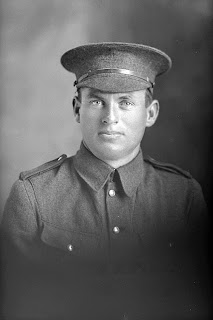
George Herbert Meder 
(killed in action, Northern
France, 10 August 1917)
Today is ANZAC Day. The day commemorates the Australian and New Zealand Army Corps members who served in wars, conflicts, and peacekeeping missions. April 25th is chosen because this was the date (in 1915) on which ANZAC forces landed on the beaches of Gallipoli in an attempt to open up access to the Black Sea. It was their first significant campaign of WW1.

Below I am posting a poem I wrote a few years ago, entitled For The Forlorn. Before doing so there are a few comments necessary. Some may read this as not showing respect or honour towards those who served. One of the most common phrases heard on ANZAC Day is, “We will remember them.” My great-uncle (George Herbert Meder) was killed by a sniper in Northern France – one of 62 members of the NZ Tunnelling Company to lose their lives in WW1. He was 29 years old, slightly older than the average age at which a soldier was killed in WW1 – 27 years. The most common age for a WW1 soldier to be killed was just 19 years. Nineteen years! – their lives were only just beginning. I am remembering my great-uncle and all those other young men and women who were killed – senselessly.

I am not the only one to speak of senselessness. Many of those who took part did so also. In fact, the very last veteran of WW1 to die (in 2009) said of the war that it was “nothing better than legalized mass murder.”1 You can’t get more senseless than that.

Remembering is like a coin that when it is taken out of a purse or wallet only one side is looked at – the side that reads “We will remember them.”

We need to turn the coin over and read what is on the obverse. We will Learn from this.

But, we have so little looked at, let alone read that side.

The title of this blogpiece (Feeble Lies) is a reference to the second line of the poem For The Forlorn. The word feeble means to be lacking in physical, moral, and/or intellectual strength or vigour. I use it to mean that the lies we are told about war are feeble – they lack moral and intellectual vigour. If we are to learn anything from WW1 (remember, it was supposed to be the war to end all wars) then let us learn the lies to begin with.

What are some of these lies? We are fortunate to have the words of some of the participants in WW1, who wrote poems, letters, and even novels about their experiences and their thoughts. I’ll pick out just a few.

Lie #1. Wilfred Owen served in WW1 and was killed in action just one week before the signing of the Armistice to end the conflict. He wrote many poems. His gripping poem Anthem for Doomed Youth asks, in its first line, “What passing-bells for these who die as cattle?” Doomed youth – cattle! That is how he, and others, came to think of themselves.

Lie #2. Owen’s friend, Siegfried Sassoon, met Owen at Craiglockhart Hospital, Scotland, where they both spent time recovering from shell-shock. Sassoon was awarded the Military Cross in 1916 (and later tossed the ribbon into the River Mersey). In 1917 he sent a letter to his Commanding Officer (which was subsequently read in Parliament) in which Sassoon claimed that the war was being “deliberately prolonged by those who have the power to end it.”

Lie #3. The Welsh Christian pacifist Hedd Wyn did not enlist, but was conscripted to fight in WW1 and was killed at the beginning of the Third Battle of Ypres in 1917. One of his most famous poems is simply titled Rhyfel (War). The third stanza of that poem cries out: “Drowned by the anguish of the young/ Whose blood is mingled with the rain.” It is the young that are sent to war. It is the young who die.

The words don’t all come from just the Allied side either. The Germans too, had eloquent poets and novelists who voiced some of the feeble lies.

Lie #4. Perhaps best known is Erich Maria Remarque, who wrote All Quiet on the Western Front.2 That novel includes many poignant quotes, one of which is:

“Why do they never tell us that you are poor devils just like us, that your mothers are just as anxious as ours, and that we have the same fear of death, and the same dying and the same agony – Forgive me comrade; how could you be my enemy?”

How indeed? The positing of the other as enemy is a lie.

Lie #5. Gerrit Engelke, like Wilfred Owen, was killed just days before the signing of the Armistice. Awarded the Iron Cross for bravery, one of his poems is dedicated To the Soldiers of the Great War.  He asks:

“Do you love a woman? So do I.

And have you a mother? A mother bore me.

What about your child? I too love children.

And the houses reek of cursing, praying, weeping.”

It is a lie to label the other side as evil, and “our” side as good.

So, yes, I am remembering. I wish to also remember the 286 young men imprisoned in New Zealand during WW1 because they objected to military service. I remember also that 28 New Zealand servicemen were sentenced to death for desertion (often suffering from shell-shock) during WW1. Five of them were shot, the others imprisoned or sent back to the front lines. In 2000 those five were offered a posthumous pardon by an Act of Parliament.

I also want us to learn.

Now, finally, for the poem – For The Forlorn

They went with songs to the battle, always the young

Straight from school, led to death by feeble lie

They were scared and frightened, names accounted

They fell with their faces condemned from high


They mingle now in mud and blood soaked trenches

They sit alongside fields in No Mans Lands

Many with uncle or cousin over there, locked in fear

Both sides ordered by older and unwise hands


They are never the young, those that plot grow old

Aged men decree and the young they do condemn

At the dropping of the bomb and whistling of the shell

We ought forgive them

Best we desist.

Notes:

1. Harry Patch, the last veteran of WW1 to die, in 2009, died at the age of 111 years, 1 month, 1 week, and 1 day.

2. Erich Maria Remarque, All Quiet On The Western Front, originally published 9 December 1928. It sold 2.5 million copies, in 22 languages, in just the first 18 months after publication.

Tuesday, 21 September 2021

Illiteracy of Nonviolence (updated)


Recently (late September 2021) the Prime Minister of Australia announced a new alliance (AUKUS - Australia, U.K., US) that would see Australia acquiring a fleet of nuclear-powered submarines.  I was reminded of a post I wrote many years ago about the illiteracy of peace.  A high percentage of our literature is devoted to war-making and only a small percentage to peace-making.  


I thought I would re-post that post now.  One of the bookshops mentioned in this post has since closed down. However, another chain bookseller has arrived, so there are still two main bookshops where I live. I did a quick re-count before posting this. The total numbers have changed slightly, but the proportions have not.

Illiteracy of Nonviolence

How peacefully literate are we?  Listening to a recent talk by Stuart Rees1 prompted me to ponder this question.  Stuart Rees had suggested that our literacy of peace was almost non-existent, whereas in matters of war and armed conflict we are extremely literate.

I decided to check.  Where I live there are just two main bookshops.  One is a low-price, middle-of-the-road bookstore, the other is one of the major bookseller chains.

In the first, I counted 113 different books with the theme of war or armed conflict.  There were just four (4) books that could be related to nonviolent means of conflict resolution.  Three were biographies of Nelson Mandela’s life and one was by the Nobel Peace Laureate, Thich Nhat Hanh.

The other bookstore had just one book that I could find that spoke of peace or non-aggressive means of resolving conflict.  Waging Peace is the memoir of a remarkable Australian journalist, social commentator and film-maker.  Anne Deveson wrote the book because:
“…when I went to London in July 2000 to attend a big international conference on War and Peace and I found all the emphasis was on war, rather than peace. In the section where books and articles were on sale, 111 titles were on war, only three on peace.”2
In that bookshop that stocked the one solitary copy of her book there were no less than 81 books (many that had multiple copies) dealing with war and violence.

If that is representative of what is written and what is read, then what chance is there of those leading our nations obtaining a literacy of nonviolence?

Yet, there are a number of examples of nonviolent approaches to conflict.  Additional to those mentioned above we can think of: Gandhi, Martin Luther King Jr., Te Whiti o Rongomai, Leo Tolstoy, Bertrand Russell and the anonymous “Tank Man” in Tiananmen Square.  Before too long we have to do some serious thinking in order to add to the list.

These practitioners and prophets of nonviolent conflict resolution are remembered as much for the fact that there are few of them, as much as for their wisdom and compassion.  They are part of the small number of candles burning in a dark cave of warfare, terrorism and violence.

Tellingly, when asked to think of those associated with warfare then many names spring to mind: Hitler, Churchill, General Patton, Genghis Khan, Alexander the Great, Osama bin Laden, Stalin, Mao Tse Tung, Reagan, Thatcher, Bush (both of them), Mugabe, Idi Amin, Milosevic, Tito, Mussolini, George Custer, Ho Chi Minh, Tony Blair…..  Adding to this list does not take too much intellectual effort.  There are dozens of biographies of each of these adding substantially to the literature of armed conflict.

So where do we go to find the literacy of nonviolence?  I have a number of such books in my collection.  Few of them, though, were found in the average bookshop.  Often they have been sought from specialist bookshops or via determined Internet searches on Amazon and the like.

The other source of nonviolent literacy seems to be in the experiences, writings and learnings of parenting courses, small scale activist groups, mentoring organisations and other community based programmes and projects.  The wonderful insights and learnings from these and other groups do not yet seem to be translating into the mindsets of national leaders.

1. Stuart Rees is the Director of the Sydney Peace Foundation.
2. In answer to an interview question from Stephanie Dowrick (co-host of the Universal Heart Book Club) who asked: Was there any particular moment in which you knew, "I have to write this"?

Wednesday, 26 May 2021

I Ain't Marching Anymore

In 1965 the protest singer Phil Ochs wrote and recorded a song called I Ain’t Marching Anymore – a song about the futility of marching off to war.1  It became one of the songs that Ochs most often played in his concerts.  In it, Ochs sings,

I knew what I was learning,

That I ain’t marching anymore. 

What was Ochs learning?  Was he learning something, not only about the futility of war and his reasons for not wanting to take part?  Was he also learning something about himself, and the act of marching?  Perhaps?  Perhaps not?

I have.  I have learnt something about protest marches.  I have learnt something about marching – and chanting as I march along.  I have learned that marching (and chanting) as a form of protest is personally unhealthy, and possibly even contributing to a world that I do not want.  What follows is my personal reasons for no longer participating in protest marches.  If you, dear reader, wish to withdraw from such marches for similar reasons, then that is your choice.  Here, I am not suggesting that those seeking a more just world discontinue marching.  I do not have the answers.  All I know is what I have learned.  All I know is the impact marching has upon my psyche and my interactions with those around me.  So, with that caveat, here are some of the things I have learned:

·       Marching and chanting tends to be highly confrontational.  It sets up an us versus them mentality.  Yes, perhaps confrontation is needed.  I want to participate in confrontations with the act not with the actor.  Yet, marching (and its associated chanting) too often results in confronting people, other human beings, instead of engaging with the issues.

·       Marching has a militaristic connotation.  For me, militarism is one of the major obstacles in our way towards a more just, and peaceful world.  I do not wish to evoke one of its features in any protest.

·       There has long been debates as to whether the ends justify the means.  I won’t go into a discussion of those debates here, suffice to say that many of us in social justice movements over the past half century or more have come to understand that there is no distinction.  Means and ends are the same thing.  Means are simply ends in the making.  Marching and chanting disregards this understanding.

·       Marching enables the marcher to point the finger elsewhere, to shift the blame.  Yet, we are all participants in, and proponents of, the systems that we wish to change.  As Alexandr Solzhenitsyn (in The Gulag Archipelago) noted, “The line separating good and evil passes not through states, nor between classes, nor between political parties either – but right through every human heart, and through all human hearts.”  We are all culpable to some degree.  Marching tends to suggest that I, as a marcher, bear no responsibility.

·       Marching seems to elicit “boos” and jeers, and shouts of “shame.”  Hurling abuse seems to me to be unbecoming of someone seeking a more humane society.  Verbal abuse is not an element of a society I aspire towards.  I would rather have no part of such abuse.

·       The five statements above could all be summarised by suggesting that marching maintains the myth of separation.  It separates me, as marcher, from the non-marcher and from the “object” I am marching against.  The myth of separation is possibly the single most potent factor spawning the problems we face in the world.

Learning from neuropsychology

Over the past half-century or more our understanding of neuroscience and neuropsychology has grown significantly.  We now understand a lot more about how our mental images and the stories we tell ourselves come to influence our behaviours and beliefs.  And vice versa.

When I add the understandings of neuropsychology to the statements above, I have to conclude that marching has an unhealthy impact upon my psyche and my mental state.  That unhealthy state cannot help but impact upon the world around me.  Hence, I choose to not march.

I ain't marching (off to war) anymore.

I Still Protest

I still wish to place my witness in front of (the literal meaning of protest) issues and problems that I consider to be unjust or wrong.  How do we do that if old forms of protest are unhealthy, and possibly counter-productive?

David Suzuki (the highly respected environmentalist and science commentator) has pondered this also.  In his autobiography he states,

“It is clear that the old ways of confrontation, protests, and demonstrations so vital from the 1960s through the 80s, have become less compelling to a public jaded by sensational stories of violence, terror, and sex.  We need new alliances and partnerships and ways of informing people.”2

I concur with him.  We need to be more creative and find life-affirming ways of testifying our disagreement with policies, procedures, and practices that are dehumanising and destroying the Earth. 

Meanwhile, I will attend rallies, I will listen to the speeches, I will condemn acts of oppression and degradation of the environment.  However…

I Ain’t Marching Anymore.

Notes:

1. Phil Ochs, I Ain’t Marching Anymore, Elektra Records, 1965.  Phil Ochs performed at many protest rallies during the 1960s and 70s.  Sadly, he succumbed to depression and committed suicide in 1976.  I must admit that he may not have agreed with not marching anymore, in the sense I have written here.  If so, then my apologies to you Phil Ochs.

2. David Suzuki, David Suzuki: The Autobiography, Greystone Books, Vancouver B.C., Canada, 2006.