Pages

The name of this blog, Rainbow Juice, is intentional.
The rainbow signifies unity from diversity. It is holistic. The arch suggests the idea of looking at the over-arching concepts: the big picture. To create a rainbow requires air, fire (the sun) and water (raindrops) and us to see it from the earth.
Juice suggests an extract; hence rainbow juice is extracting the elements from the rainbow, translating them and making them accessible to us. Juice also refreshes us and here it symbolises our nutritional quest for understanding, compassion and enlightenment.
Artificial Intelligence (AI) is not used in the creation of the items on this blog.
Showing posts with label Pollution. Show all posts

Monday, 7 September 2026

Dumbest Idea Yet

Eärendil
There have been some weird, crazy, and stupid ideas originating in the minds of humans over the years. The latest I have heard of has to be the dumbest yet.

The California based company, Reflect Orbital, has come up with the idea of putting arrays of mirrors into orbit around Earth to reflect sunlight back upon Earth at nighttime. The company claims that these mirrors will 1. enable lighting after dark and 2. increase the amount of sunlight available for solar panels.

The company’s stated aim is to launch and have operating 50,000 reflector satellites by 2035.

Reflect Orbital was founded in 2021 by an aerospace engineer and a mechanical engineer. In July 2026 the Federal Communications Commission (FCC, an independent agency of the US Federal government) granted the company a license to launch a proof-of-concept satellite to be launched as rideshare with a SpaceX mission sometime this year.

This satellite is to be named Eärendil, a character from Tolkien’s The Silmarillon. Eärendil sails across the heavens with a sparkling jewel bound to his brow. The jewel shines down it’s light and becomes the Morning Star. I wonder what Tolkien would make of Reflect Orbital’s first satellite, let alone 49,999 more of them?

In its decision to grant the license, FCC declared that the project is groundbreaking technology and that testing it is in the public interest. Somehow, the public does not agree. More than 1,800 public comments have been made about the project, with most of these opposed to the idea.

The founders of the company (both engineers) are obviously intelligent beings, yet their idea has to be one of the dumbest yet.

Humans may be intelligent, yet incapable of wisdom. Intelligence might enable us to make or do something. Wisdom enables us to determine whether it is a good or advisable thing to do. This idea of reflector satellites is proof that wisdom does not derive from intelligence.

Let me briefly outline three reasons for this assertion.

  1. Earth-based astronomy would be placed at risk. Astronomers have predicted that 50,000 reflector satellites would make the night sky 3-4 times brighter than present. Large, professional, telescopes may be immune in some way, as the company has said that it can mitigate this risk for these telescopes. But that does not allay the fears of amateur back-yard stargazers and children and youngsters wishing to focus their telescopes on the planets, moons, and comets of the night sky. The sense of wonder inspired by gazing at the night sky will be severely diminished.
  2. It is estimated that 50%-70% of animal species are nocturnal or exhibit some form of nocturnal behaviour. These reflector satellites will hamper their feeding, mating, and sleeping patterns. For some, it will seriously impede their navigational abilities.
  3. The circadian rhythms of humans are likely to be gravely disrupted. Circadian rhythm sleep disorder (CRSD) has been shown to be a factor in bipolar disease,1 depressive disorders in young people,2 and in fatigue, insomnia, appetite loss, irritability, headaches, and other health issues. Long term disruption to circadian rhythms impinges severely the underlying metabolic functions of our makeup. In turn, this can translate into illnesses such as Multiple Sclerosis3 and cardiovascular diseases.4

The day/night cycle has been a naturally occurring one for millions of years. Animal and plant species have adapted to this rhythmic cycle (some have even adapted to rhythms as long as five months or more).

Interfering with this rhythm is asking for disaster.

Reflecting light upon Earth during what is normally nighttime is the dumbest idea yet.

Notes:

1. https://pmc.ncbi.nlm.nih.gov/articles/PMC6812517/  accessed 7 September 2026

2. https://www.thelancet.com/journals/lanpsy/article/PIIS2215-0366(21)00034-1/abstract  accessed 7 September 2026

3. https://www.sciencedirect.com/science/article/abs/pii/S0149763414000104?via%3Dihub  accessed 7 September 2026

4. https://pmc.ncbi.nlm.nih.gov/articles/PMC2657421/  accessed 7 September 2026

Tuesday, 10 March 2026

The Air That I Breathe

In 1974 the British pop-rock group The Hollies released their last major hit. The song The Air That I Breathe reached number 2 on the UK singles chart and number 6 on the US Billboard Hot 100 chart. It charted high in many countries, including number 1 in New Zealand, the Netherlands, and South Africa.

Written by Albert Hammond and Mike Hazlewood, the song was a love song declaring that all the singer needed was ‘the air that I breathe, and to love you.’

There can be no dispute that we all need the air that we breathe.

When the single was released the air that we breathe contained 330 parts per million (ppm) of CO2 (carbon dioxide). This level (330ppm) was the highest level the Earth had experienced for at least 800,000 years. Around 320,000 years ago atmospheric carbon dioxide levels peaked at 300ppm, and then settled back to around 200ppm. Two more peaks, around 250,000 years ago and 120,000 years ago saw CO2 levels reach approximately 280ppm.

Thus, at no time during the existence of us (Homo sapiens) upon the Earth had the atmosphere contained more than 300ppm of carbon dioxide.

Until the 20th century! The proportion of CO2 contained in the Earth’s atmosphere reached more than 300ppm in 1911 and continued to rise continuously thereafter.

By the time the Hollies were stating that ‘all that I need is the air that I breathe’ carbon dioxide levels were around 10% higher than at any time in the evolutionary history of Homo sapiens.

The levels were to go higher, and higher still.

Today (in March 2026), the proportion of CO2 in the atmosphere is 430ppm. 100ppm greater than it was when the song was released. In just over fifty years – two generations!

That may not sound much. 430ppm is 0.043%. Not much, some may claim. And, only an increase of 0.01% between 1974 and 2026. What’s to get concerned about?

We could ask the same of arsenic. Our bodies require arsenic – in tiny quantities. Yet, a very tiny increase in that quantity and the arsenic in our bodies becomes toxic, even fatal. Tiny differences can have significant outcomes. As it is with arsenic in our bodies, so it is with carbon dioxide in our atmosphere.

Most of us know that higher concentrations of carbon dioxide in the atmosphere have a direct bearing on the Earth’s climate systems. We do get concerned about that, although there are still large numbers of sceptics.

We could also get concerned about how increasing CO2 levels in the atmosphere have a direct impact upon our health.

A paper published in January this year stated that, ‘There is mounting experimental evidence that lifetime exposure to these increasing atmospheric CO2 levels can negatively impact the normal physiology of organisms.’1

In typical scientific caution, the authors noted that ‘directly assessing this in humans is very difficult.’

They did, however, warn that if trends in increasing levels of carbon dioxide in the atmosphere continued then our ‘blood bicarbonate levels could be at the limit of the accepted healthy range in half a century.’

Half a century. That is the same length of time that has elapsed since the Hollies sang that ‘all I need is the air that I breathe.’

There is little to no indication that the proportion of CO2 in the atmosphere is likely to decrease within the next half a century.

Let us keep singing, ‘all I need is the air that I breathe.’

Politicians, captains of industry, economists, and others need to hear us singing this song.


Note:

1. Alexander Larcombe & Phil Bierwirth, Carbon dioxide overload, detected in human blood, suggests a potentially toxic atmosphere within 50 years, Air Quality, Atmosphere & Health, 13 January 2026. https://doi.org/10.1007/s11869-026-01918-5 accessed 8 March 2026

Thursday, 16 October 2025

Five Worst Inventions

Berlin Wall
A few days ago I was taking my (almost) daily walk along the beach, allowing the water to wash around my feet, ankles, and calves. I listened to the waves lapping upon the shore and the sound of gulls flying overhead. The sounds and sights were pleasant and calming.

As I continued walking and paddling I noticed a man coming towards me holding a mobile phone in front of him, peering at it. When we passed I waved and offered a cheery “good morning.” There was no reaction, he continued on, not seeming to notice his surroundings or my greeting.

I thought to myself, mobile phones have to be one of the worst inventions we humans have ever made. For the rest of my walk I thought about that, and wondered what would be my “top five” worst inventions? What criteria would I use to make such a judgment?

By the end of my walk I had come up with these three criteria for deciding on the “top five” worst inventions of humankind: 1. That the invention had a negative impact upon the earth and our relationship with nature, 2. That the invention served to increase the separation between us and exacerbate our intolerance of one another, and 3. That the invention worsened our mental health and/or our sense of well-being.

With these criteria in mind, here are my “top five” worst inventions. Please note that these are subjective and you may not agree, and may have a different “top five.” Also, each of these inventions may have their benefits, but, as I see it, the harms are greater. What are my “top five”? In no particular order they are:

Fences. The purpose of a fence is to either keep someone or something in or keep someone or something out. Their main purpose is to divide. Archaeological evidence shows that the first fences, often made of earth mounds, stones, or wood, appeared about 10,000 to 5,000 BCE. They arose in conjunction with sedentary agriculture and functioned to keep predators and scavengers out of crops, or to keep domesticated animals in.

Eventually, because of the transition from hunter/gathering to sedentary living, fences became walls around villages, towns, and cities. They were erected to provide security from opposing groups of humans. They also became markers of a new human feature – the privatisation of land. Take a walk in the countryside these days and how many times do you see a sign on a fence that reads, Keep Out, Private Property?

Walls (simply more elaborate fences) are used commonly to separate and divide. In the last 100 years two of the most well known walls have been erected: the Warsaw ghetto wall erected in November 1940 used to imprison 460,000 Jews in an area of just 3.4 km2, and; the Berlin Wall, erected in August 1961, which divided the city of Berlin and separated families, friends, and lovers. Even today, walls exist in many cities of the world, and their purpose is to divide also. Most of us do not even think of them – they go under the rubric of gated communities.

Fences serve to separate us. They also serve to maintain our dominance over domesticated animals.

Ploughs. Ploughs are also linked to our domestication of plants and crops. Ploughs allow us to turn a diverse area of land into mono-agriculture, which is dependent upon the addition of pesticides, fungicides, and artificial fertilisers to ensure crop production.

The first ploughs seem to be hand-held plough-like devices used by early Egyptians to clear rocky soil. By the 6th millennium BCE oxen were being used to pull early ploughs in Mesopotamia and the Indus Valley.

As time progressed, ploughs became mechanised and automated. Ploughs have enabled huge multinational agriculture companies to wreak havoc upon the land with mono-cultural cropping.

Ploughs and plowshares are often referred to as the goal of pacifist and peace movements worldwide. The phrase, ‘They shall beat their swords into plowshares’ comes from the Bible (Isaiah 2.4). A statue bearing this sentiment is on display in the United Nations Art Collection.

Yet, as Stephen Jenkinson caustically points out, ‘From the land’s point of view, there is no difference between swords and plows.’ 1

Guns. The first guns were invented in China around 1000 AD, following the invention there of gunpowder in the ninth century. Guns spread throughout Eurasia during the 14th century, with the word gun coming to us from the Old Norse word gunnidr meaning war-sword. Hence, guns have been associated with warfare and violence since their inception.

It would be hard to propose a more lethal means of killing another human being (or animal for that matter) than a gun. Since the 14th century guns have morphed into; arquebuses, muskets, pistols, revolvers, machine guns, cannons, artillery, mortars, howitzers, tanks, and the modern-day drones that enable dissociated and anonymous killing.

The ultimate “gun” today is undoubtedly the nuclear warhead. There are well over 12,000 nuclear warheads in the world today, held by nine different countries. Russia and the USA hold the majority of these with more than 5,000 apiece.

Guns have worsened the divide between us.

Automobiles. I tossed up whether to identify this worst invention as the combustion engine or the automobile (utilising the combustion engine.) However, since there are now many vehicles that do not use the combustion engine as its automotive power, I opted for the automobile.

Whether the motive power is the combustion engine or an electric engine (or a combination of both) the automobile has had a terrible impact upon the environment of the Earth. Automobiles take up huge amounts of space in many of the cities of the world. The amount of land devoted to them (roads, streets, car parks) can be as much as 25% of the city’s area. The pollutants that automobiles emit are well known, but what may not be so well known is the weight of vehicles that contribute to the wear and tear of tyres. Some research suggests that tyre wear contributes 2,000 times more particulate pollution than the exhausts. EVs (electric vehicles) are not immune to this, indeed are worse, as the weight of an EV is significantly greater than that of a combustion engine vehicle.

In 2023 I coined the term autobesity to label the problems of automobiles. The blog is accessible here.

Mobile Phones. The mobile phone has only been available commercially since 1983 yet it has probably been responsible for an increase in social isolation, cyber bullying, teenage anxiety and depression, e-waste, environmental degradation, an increase in electricity usage, and a dumbing down of our cognitive abilities than any other such contraption.

When the inventor of the mobile phone, Martin Cooper, was testing out his invention he walked across a street whilst speaking on his phone. He later admitted to a friend that doing so was ‘probably the most dangerous thing I have ever done in my life.’ He is correct. A study in the US in 2009 found that 5,474 people had been killed because of the use of mobile phones in traffic. Repeated studies show that the use of mobile phones are responsible for 25% – 50% of all police-reported vehicle accidents.

I have covered this topic in greater depth in a blog available here.

The Worst Is Yet To Come

One invention that is currently underway could easily be the worst yet. Artificial Intelligence (A.I.) has the potential to exacerbate all other problems, making them worse than they already are (if that is conceivable.)

The godfather of A.I., Geoffrey Hinton, has been warning us for a few years now. In a recent interview Hinton cautioned that ‘If you want to know what life is like when you’re not the apex intelligence, ask a chicken.’ A short (2 min) excerpt from the interview is here, a longer (21 min) clip is here.

Even though he recognises benefits of AI, Hinton warns that ‘unless we do something soon, we’re near the end.’ A chilling thought. The lessons from the other five worst inventions would suggest there may not be much hope of us doing something soon.  

Next week I will post my "Five Best Inventions" list.

Note:

1. Stephen Jenkinson, Come The Romans, on the CD Dark Roads, Orphan Wisdom, 2020

Thursday, 22 May 2025

No Will

Lithium mine
Last week’s blogpiece bemoaned our cultural focus on the future. During the intervening week I found myself guilty of that same error, although not a future of optimism.

In a response to an online post I stated, ‘Unplanned collapse is what will happen…’ Another commentator rightly pulled me up on that comment.

Unplanned collapse is not a future event or possibility. Collapse is already here, although some of us, like me, are not experiencing its full fury. A quote from science-fiction writer, William Gibson, is that, ‘The future is already here – it’s just not very evenly distributed.’ The word collapse can easily be substituted in that quote for the word future.

Collapse (environmental and social) is underway in many parts of the world. Inhabitants of Pacific islands are experiencing the effects of climate change. The island nation of Tuvalu, for example, is a tragic example. It is being subjected to rising sea levels and more frequent and more severe cyclones and storms. Cyclones further erode the shoreline of the nation’s islands, exacerbating sea level rise.

Elsewhere in the world we see social breakdown, with war being the most glaring example. The five most devastating warfare sites in the world in 2024 were the Ukrainian-Russian war, the Palestine-Israel war, and the civil wars in Myanmar, Sudan, and Ethiopia.

Then there are the other instances. The ones that are out of sight, out of mind. Mostly they are out of sight because they are in countries the mainstream media are not interested in. They are out of mind because if we in the rich, industrialised, nations considered them they would disrupt our cosy, comfortable lifestyles. Mostly, too, these cases are ones that exist so that we can continue to live in a way that believes that collapse will occur in the future.

Let me explain and offer examples of such instances.

In the rich, industrialised, nations we have become aware of climate change and the forces generating it. As a result, we are keen to reduce carbon emissions. However, we only want to do so if it means we do not have to change our consumerist, exploitative, and extractive behaviours.

Yet, if we look closely, these behaviours continue at the expense of local communities (e.g., copper mining in Congo, and lithium mining in the Atacama Desert) and also local ecosystems (again, for example, lithium mining in the Atacama Desert).

The American ethnobotanist, Terence McKenna addressed this inclination towards an out of sight, out of mind outlook when he announced that;

‘The apocalypse is not something which is coming. The apocalypse has arrived in major portions of the planet and it’s only because we live within a bubble of incredible privilege and social insulation that we still have the luxury of anticipating the apocalypse.’

So, I guiltily acknowledge that when I write that “the collapse will happen,” then I am writing from a privileged view and from a position of insulation.

If I, and millions of others in the rich, industrialised nations, continue to live in a bubble (as McKenna refers to it) then we do so by consigning millions of others to suffer collapse right now, not in some anticipated future.

Tuesday, 16 July 2024

What Noise Annoys An Oyster?

When I was a boy one of the songs I often heard on the radio (a precursor to the iPhone) was by Max Bygraves – What Noise Annoys An Oyster? It was just a humorous ditty with a catchy tune I could sing along to. The song answered its own question. ‘A noisy noise annoys an oyster most.’

What that noisy noise was is not elaborated upon in the song.

Recently, I have begun pondering the source of noisy noises. What constitutes a noisy noise? Moreover, what is the noisiest noise? There would appear to be at least two ways to answer the first of these.

A noisy noise could be the loudest noise.

Or, a noisy noise could be one that is unrelenting. One that keeps nagging away at your eardrums.

I did some research. The loudest natural sound is that of the Blue Whale, whose mating call can be as great as 188 dB (decibel) and heard from hundreds of kilometres away underwater. The loudest sound ever in recorded history is said to have been the Tunguska Meteor in Siberia in 1908. This meteor exploded some 5 – 10 km above the Earth’s surface, so leaving no impact crater, but emitted a noise of 300 dB or more. The Krakatoa eruption in 1883 produced a similar noise level and was heard 2,000 km away. Sailors within 60 km had their eardrums shattered, and thousands of people close by were killed. In comparison, an earthquake of magnitude 5 on the Richter scale can be as much as 230 dB.

All these are sudden events of relatively short duration – although I have not checked how long the mating season is for a Blue Whale.

They are also all extremely loud. A level of 85 dB is often quoted as the maximum level of toleration for a human before hearing damage is done. Normal human speech is around 55-65 dB, and a human scream can be from 80 – 120 dB. Upper safe noise levels for humans are usually set at around 75 – 80 dB.

But, what of continuous and unrelenting noise?

Unsurprisingly perhaps, the species on Earth that is the noisiest in this regard is us. We humans are incredibly noisy. Most of that noise is not from our voices, but from our technology.

Household technologies such as vacuum cleaners and dishwashers are close to the safe threshold for humans, at around 70 – 75 dB.

Other everyday technologies however are above the safe zone. Consider a few examples: Leaf blower 80 – 90 dB., lawn mower approx. 95 dB., and chainsaws around 105 dB. No wonder your ears hurt each weekend when the neighbourhood starts mowing lawns, blowing leaves around, or cutting up firewood.

Yet, even these are not our noisiest creations. A pneumatic drill for example produces 110 dB. Our city streets are extremely noisy. A car horn registers 120 dB as does the siren of an emergency vehicle. Sporting events and music concerts have levels of up to 110 dB. Go out to an airport and you’ll hear a jet aircraft take off at 130 dB.

City dwellers are beset by a continuous noise level of 60 dB or more. This constant noise level is enough to lift blood pressure and raise heart rates above normal levels. Chronic noise of this level can elevate stress levels, cause loss of concentration, and be a factor in sleep deprivation. Simply put, living in cities can be unhealthy for you.

Sadly, unhealthy noise levels are not restricted to cities.

What of the other life forms on this planet? Does the ever-present noise generated by humans have an impact?

It sure does.

Our noisy noise detrimentally affects the mating, communication, and navigation patterns of many animals. Even supposedly protected nature areas are not immune to the presence of human noise. Noise levels can be 2 – 10 times the normal background noise levels in these areas.

The effect of human noise upon animals has only recently begun being studied and analysed. However, already the damage is being witnessed. A 2019 research paper looked at data from more than 100 species (including amphibians, arthropods, birds, fish, mammals, molluscs and reptilians.)1 The paper concluded that: ‘We found clear evidence that anthropogenic noise affects a wide range of species from a variety of different taxonomic groups.’

Disturbingly, the researchers noted that, ‘it is likely that we underestimate the effect of noise.

The oyster in Max Bygraves’ song was correct. Noisy noises do annoy oysters – and just about every other animal (including us humans) on the planet.

Note:

1. Hansjoerg P Kunc and Rouven Schmidt. The effects of anthropogenic noise on animals: a meta-analysis, The Royal Society: Biology Letters, November 2019. https://royalsocietypublishing.org/doi/10.1098/rsbl.2019.0649 accessed 16 July 2024

Tuesday, 1 August 2023

Understanding Overshoot

This year’s Earth Overshoot Day falls on 2 August. But, what is it? 

When I tell people about Overshoot Day, or ask them about it, I find that very few people know about it, and even less understand the concept – including many concerned about climate change or the state of the Earth’s ecosystems.

Environmental scientists define overshoot as demand exceeding regeneration. What does that mean in layperson’s language?

How about an analogy.

Suppose at the beginning of the year (on 1 January) you have capital of $1,000. During the year you spend $200. Suppose your investments give you a 10% return, giving an income during the year of $100. At the end of the year (31 December) you will have $900 ($1,000 - $200 + $100.)

Now suppose you do exactly the same the following year, only this time you start with $900 (the amount you had left at the end of the previous year.) Again, you spend $200 and get a 10% return on investments. What are you left with at the end of this second year?

$790.

Your investments give you an income of $90 (10% of $900) and you spent $200. Thus, you have $900 - $200 + $90 = $790.

If you continue doing the same thing year after year then you can easily see that your capital base will diminish each year, and eventually you will have none of it left.

This is overshoot. You are spending more each year than you are making.

It is easy to envisage a theoretical date during the year upon which your spending surpasses your income. For the first year this would be 9/10ths of the way through the year – 25 November. All money you spend after this date puts you into “overshoot.”

So, how does this relate to Earth Overshoot Day?

Think of the amount you spend ($200) as being a metaphor for the quantity of materials and resources that humans extract from the Earth plus the volume of waste (pollution) we pump back into the Earth.

Now consider your return (10%) as representing how quickly the Earth can replenish the materials and resources extracted, plus how long it takes for the Earth to repair from the waste and pollution.

In a nutshell, that is what Earth Overshoot is. It is the difference between the extraction and pollution rates of humans and the ability of the Earth to restore and repair. This difference has been negative for more than 50 years.

Just as with the theoretical financial situation it is possible to calculate the extraction and waste production rates; it is also possible to calculate the restoration and repair speeds. Using these figures calculating a symbolic date for Earth Overshoot becomes workable.

This year it is 2 August.

Earth Overshoot Day has been calculated for every year since 1971 when it was calculated to land on December 25th.

Returning briefly to the financial analogy above: this date would represent having spent as much as was earned by Christmas – leaving just one week to either go without, or dip into your capital.

Sadly, since 1971 we have been experiencing Earth Overshoot Day earlier and earlier in the year.

The importance of Earth Overshoot Day cannot be overstated, as it is our overshoot that is the fundamental driver of all our environmental (and increasingly, our social as well) woes. Climate change is the issue that gets most attention, yet climate change is only one of a myriad symptoms of overshoot. Other symptoms include; species extinction, deforestation, land/soil loss, desertification, plastic pollution, air quality pollution, litter and rubbish, toxic waste issues, and water pollution.

William R Catton, Jr., is recognised as having written the foundational study on overshoot in his classic 1982 book Overshoot:The Ecological Basis for Revolutionary Change.1 In that book Catton noted that since the European colonisation of the world the world has been living in what he termed the Age of Exuberance.

The Age of Exuberance saw the massive increase in technology which, along with the extraction of fossil fuels, resulted in enormous increases in the ability of humans to exploit the world. The Age of Exuberance also suggested that resources and human innovation were limitless and there was no stopping human “progress.”

Now, the exuberance is fading rapidly, and we are finding that we cannot continue extracting, exploiting, and polluting. As Catton puts it, ‘technology (has) come to enlarge our resource appetites instead of our world’s carrying capacity.’

We cannot keep feeding our appetite at the rate we are doing. We are growing fat and the kitchen cupboard is becoming bare.

Note:

1. William R Catton, Jr., Overshoot:The Ecological Basis for Revolutionary Change, University of Illinois Press, Urbana and Chicago, 1982.

Tuesday, 14 March 2023

Autobesity

Artist: Dave Derret
(used with permission)
Obesity for a human is not good for human health.

Autobesity is not good for the Earth’s health.

A comment relating to a recent “New Yorker” article1 on SUVs suggesting that that this was a case of “car obesity” prompted me to coin the word autobesity to label one of the world’s most pressing environmental health problems.

A standard measurement of how underweight or overweight a person is uses the Body Mass Index (BMI.)2 The most extreme score used to be known as morbid obesity (although now it is referred to by the less emotive term obese (class III).)

If such a measurement were to be applied to our use of vehicles (Perhaps an AMI – Automobile Mass Index) then we would have to make the diagnosis that we are suffering morbid autobesity.

Autobesity has become steadily worse since WW2, and morbidly so in the past 7 years. In 2015 there were 618 million vehicles in the world. In the seven years since then that figure has more than doubled to an estimated 1,446 million (yes! – that is 1.446 billion.)3 We went from autobese to extremely autobese to morbidly autobese in just a few years.4

Autobesity (as with human obesity) carries with it harmful health outcomes. As we know, obesity in humans is a risk factor for clogged arteries.

So too, it is with autobesity. Automotive arteries (roads, parking, and right-of-ways (ROWs)) get clogged. Unlike a human body though, instead of removing the blockages, more arteries get built. In rich nations of the world the amount of land relinquished to roads, parking, and ROWs is around 2% of the total land area. In cities, the figure is substantial. New York has 22% of its land area devoted to roads and parking. In London the proportion is 23%, Tokyo 24%, and 25% in Paris. Between one-fifth and one quarter of the land in the world’s major cities is set aside for automobiles.

That is autobesity.

Other harmful effects of autobesity are well known, such as the poisons and pollution emitted from vehicle exhausts – i.e. CO2, nitrous oxides, benzene, fine and ultra-fine particulates etc.

What may be less well known, however, is that these emissions (due mainly to increased exhaust regulations around the world) are not the most harmful feature of vehicle use.

Tyre wear is responsible for around 2,000 times more particulate pollution than are exhausts. These particulates include Greenhouse Gases (GHGs)5 and toxic compounds (including carcinogens.) These seep into all parts of the body of the earth – air, water, and soil.6

As with human obesity, the weight of the vehicle contributes to this problem. To add to the issue of soaring numbers of automobiles, the weight of automobiles has also increased. In 1908, when Henry Ford began producing the Model T Ford, the heaviest of his vehicles weighed 750 kg. The average vehicle weight today is 1,800 kg. What is more, vehicles are getting heavier (contributing further to tyre wear), and likely to put on even more weight if EVs (Electric Vehicles) become more prevalent (as EV proponents predict and promote.)

Because of the battery in an EV, an average EV weighs around 30% more than an equivalent fossil-fuelled vehicle. In terms of our autobesity, EVs are not helping.7

Although EVs reached 10% of global vehicle sales in 2022, they are not replacing vehicle stock – but adding to it. Between 2015 and 2020 the total number of EVs in the world increased from less than one million to 10.2 million. Impressive – maybe? However, in the same period the total number of vehicles in the world rose from 618 million to over 1,100 million. That is just one EV for every 50 or so conventional vehicles.

What Are We Doing About Our Autobesity?

Not much, is the short answer.

A doctor, cardiologist, or other medical professional will usually prescribe a combination of diet and exercise for a person suffering obesity.

Shouldn’t we adopt a similar regime with autobesity?

But we aren’t. A significant proportion of vehicle trips are short, very short. In the U.S. 60% of all car trips are less than 10km in length. In Australian cities the distance varies from city to city, with between 30% - 60% being less then 5km in length. Melbourne takes the lack of exercise to the extreme, with 47% of vehicle trips being less than 2.5km long.8 

All these distances are easily achieved by walking or using a bicycle.

Our autobesity is now morbid and epidemic (at least in the rich nations,) so much so that (as with obesity) it is propelled by addictive mechanisms. Replacing one type of vehicle with another (EV, hybrid, hydrogen fuelled, or whatever) will not reduce our addiction, and hence autobesity will continue to harm the planet.

Many working in the addiction field tell us that abstinence is a crucial factor in helping addicts to overcome their addiction and then maintaining a more healthy lifestyle.

It is now clear that autobesity is no different.

Only total auto-abstinence will help to heal the harm caused by autobesity.

Notes:

1. Elizabeth Kolbert, Why S.U.V.s are Still a Huge Environmental Problem¸ The New Yorker, 3 March 2023, https://www.newyorker.com/news/daily-comment/why-suvs-are-still-a-huge-environmentalproblem?fbclid=IwAR1XA_xJ0BBu5lQiV6tx17vdNdokwBC1kXVsrMRvq3VvrgHT7OCxJQS_umo accessed 13 March 2023

2. A person’s BMI is calculated by dividing their weight (in kg) by the square of their height (in metres.

3. Source: PD Insurance, 22 April 2022, https://www.pd.com.au/blogs/how-many-cars-in-the-world/ accessed 13 March 2023

4. If you line up all the world’s vehicles bumper-to-bumper around the Earth’s equator they would encircle the Earth more than 160 times!

5. Laura Kokko, Greenhouse Gas Emissions from Tyre Production, M.Sc. thesis, Tampere University of Technology, February 2017

6, https://www.theguardian.com/environment/2022/jun/03/car-tyres-produce-more-particle-pollution-than-exhausts-tests-show accessed 13 March 2023

7. Research at a Netherlands University shows that EVs are contributing significantly to the deterioration of road surfaces. https://www.brusselstimes.com/61738/heavier-electric-cars-wear-out-roads-faster accessed 13 March 2023

8. https://www.vichealth.vic.gov.au//media/ProgramsandProjects/PlanningHealthyEnvironments/Attachments/vhtransch3.pdf?la=en&hash=BD49C15BA932B97CF11275C5EE7CEA85A17176F3 accessed 14 March 2023. Although this paper is from 1999, there is little reason to believe that the proportions have changed. If anything, personal observation suggests the figure may now be more dire.

Monday, 12 December 2022

Startling Starlight

Photo: Petr Horálek
Have you recently looked up at the night sky? If you have, and you are aged over about 40 years, you might be forgiven for thinking to yourself: Where is it?

Where has the night sky gone? Where is that thing called the Milky Way?

It is estimated that today over 80% of the world’s population live in “skyglow” (diffuse, scattered skylight attributed to scattered light from ground sources.) That means that four out of five people in the world do not or cannot see the night sky in its full, natural, startling, brilliance. Furthermore, in some parts of the world this percentage is significantly greater. In the US and Europe, the figure is 99%.

That Milky Way mentioned earlier. It is hidden to more than 2/3 of the world’s population.1

Losing this experience and being unable to see the stars has enormous consequences for us (humans) as well as for the non-human species that share this planet with us.

For well over 99% of our time on Earth as Homo sapiens we lived without light pollution. Our bodies, behaviours, psyches, and emotional states adapted to the circadian rhythm of life. Essentially, that rhythm is: day is light, night is dark.

However, over the past 100 years or so we have seriously disrupted that circadian rhythm. This has impacted our health and wellbeing.

Melatonin is necessary for our health. Melatonin is produced in our bodies in response to the circadian rhythm of life and helps to regulate and maintain our immune system.

When the circadian rhythm is disrupted, so too is our supply of melatonin.

[Could there be a correlation between the rise of diseases that our immune system would normally deal with and the disruption of our circadian rhythms? I am not in a position to be able to answer that, but the question is certainly worth asking.]

Not only is night light pollution disruptive of our health and harmful to wildlife, but it is also an enormous contributor to the world’s increasing electricity consumption. Visual Capitalist (whose aim is to help cut through the clutter of data in the world) claims that lighting makes up 19% of the world’s total electricity consumption.2 Presumably, night lighting is a significant proportion of that 19%.   

Why? Why do we light up our cities at night? Why do we think that lights at night are a good thing?

Many will claim that night lights reduce crime and make us safer.

Yet there is little, if any, evidence to support this. Indeed, some research suggests entirely the opposite.

Research in England and Wales concluded that there was, “little evidence of harmful effects of switch off, part-night lighting, dimming, or changes to white light/LEDs on road collisions or crime in England and Wales.”3

Indeed, research in Chicago found a 21% increase in offending following the installation of lighting in Chicago’s streets and alleys.4 This staggering figure seems counter-intuitive, until it is pointed out that lights at night (when there are fewer people around) make victims and property easier to see!!

Re-startling

The increasing light pollution of our world is not good news for those of us who wish to be startled by starlight.

Our sense of place in the world, our identity of belonging to the Earth, is promoted and stimulated by our wonder, our awe, and our ability to be startled by nature.

When we lose that ability to be startled by one half of our ecosphere (the night sky) then we lose our sense of wonder. We lose who we are as humans.

Let’s turn off the lights and learn to be star-tled again.

Notes:

1. Fabio Falchi et al. The New World Atlas of Artificial Night Sky Brightness, Science Advances, 10 June 2016, Vol 2 Issue 6.

2. https://www.visualcapitalist.com/anatomy-smart-city/  Accessed 12-12-22

3. Rebecca Steinbach et al., The effect of reduced street lighting on road casualties and crime in England and Wales: controlled interrupted time series analysis, Journal of Epidemiol Community Health, 2015;69:1118–1124. doi:10.1136/jech-2015-206012

4. Erica Morrow & Shawn Hutton, The Chicago Alley Lighting Project: Final Evaluation Report, Illinois Criminal Justice Information Authority, April 2000.

Wednesday, 16 November 2022

Will Gaia Throw A Party?

Sometime on the afternoon of 15 November 2022 (GMT) a baby was born somewhere in the world.
That baby became the 8 billionth person upon this planet.

There are now as many people alive upon the Earth as the total cumulative number of humans to have ever lived during the first 150,000 years of human (Homo sapiens) existence.

It took virtually all the time we have existed upon this planet to reach the first one billion living human beings. We did so in 1804 – slightly over 200 years ago.

We then rapidly populated the Earth, adding the next six billion to reach seven billion around late 2011-early 2012.

Then, in a little more than a decade we added one billion people. One decade! It had taken us most of 200,000 years to reach our first one billion.

Do you think Gaia1 will throw a party to celebrate?

Let’s look at some of the things we humans did on that day (the day on which the 8 billionth human arrived) to acknowledge the birth. Note: these figures are just one days worth.

  • Almost 250 million tons of resources were extracted from the Earth.
  • 5.8 million tons of waste was dumped.
  • 118 million tons of CO2 was emitted.
  • Slightly less than one million tons of meat was consumed…
  • Requiring 15 million tons of water to produce that meat.
  • Almost 80,000 ha (800 sq. km) of forest was cut down (roughly the area of Barcelona, Spain, and more than the area of Beijing, China.)
  • Almost 14 billion plastic bags were produced, and less than 1% were recycled.
  • 137,000 tons of e-waste was thrown away.
  • 1.1  million tons of hazardous waste was produced.
  • 1,200 people were murdered by another person, with 650 of those killed with a gun.

Somehow, I don’t think Gaia is going to invite us to a birthday party anytime soon.

Note:

1. Gaia is the personification of the Earth in Greek mythology. Gaia is also the name James Lovelock gave to his hypothesis that the Earth acts as a superorganism and is a dynamical system regulating the biosphere and maintaining life.

Tuesday, 11 January 2022

Stop Digging

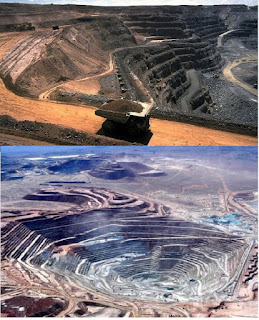
Mining for coal (top)
& lithium (bottom)
When you are in a hole that you want to get out of then the first thing to do is: Stop digging!

And, we are in a hole. We dug it ourselves.

This hole we have dug is both a metaphorical one and a physical one.

The metaphorical hole includes (inter alia): pandemics, mass extinction, deforestation, war, terrorism, fisheries depletion, plastic garbage, e-waste, noise and light pollution, food shortages, soil loss, and – yes – the issue du jour (possibly du siècle): climate change.

It is a deep hole. Furthermore, as each of these components intensify, the hole gets bigger, deeper, and more difficult to get out of.

Whatsmore, this metaphorical hole has a physical counterpart. We have been digging holes for centuries. Evidence of Roman copper mines are still visible in Europe. We have been digging for copper, gold, silver, tin, and other elements for many years.

With the coming of the Industrial Revolution we began to also dig for coal, oil, and iron ore in huge measure. The machines we created from such exploitation enabled us to dig even larger holes in our search (some would say – greed) for the energy fuels of the economies of the world.

For a long time we could see the environmental damage these holes were doing. We could see the pollution of nearby water systems. We could see the smoke-filled skies. We could smell, and taste, the stench that came from the digging of these holes.

Then, in the second half of the 20th century we also began to notice the unseen damage these holes (and what we extracted from them) did. We began to notice the build-up of carbon in the atmosphere, and the warming of the oceans and the air.

But, still we dug. Still we damaged local ecosystems. Still we polluted waterways. Still we disrupted local, often indigenous, communities.

We continued to dig physical holes. We continued to dig our metaphorical hole.

We started to think that we needed to do something about one aspect of that metaphorical hole. We began to think we should do something about the carbon build-up.

In that single-minded focus we began to think we should stop digging for coal, oil, and gas.

We thought we should do something different.

We thought we should dig for lithium, nickel, cobalt, titanium, silicon, boron, and the other elements required for “alternative” energy.

But, we are still digging.

We are still polluting water systems. We are still disrupting ecosystems. We are still destroying bird and animal habitats. We are still dislocating indigenous communities.

Let’s go back to first principles: Stop Digging.

Wednesday, 27 October 2021

Is Our Commuter Hierarchy Upside-Down?

In 1865, the U.K. Locomotive Act required, in the case of multiple-wagoned road vehicles, that a man bearing a red flag walk at least 60 yards in front of the vehicle. Furthermore, vehicles were restricted to 4 m.p.h. in the countryside, and 2 m.p.h. in cities.

Since this and other restrictions were lifted towards the end of the century, our commuter hierarchy has been turned on its head.

No matter where we go (in cities or in countryside) it is hard to escape the realisation that the car is king. Roads are designed primarily for the private motorcar. Footpaths are shunted off to the side, if they exist at all. Cycleways are often an after-thought.

The hierarchy nowadays is clearly the car is at the top, followed by the cyclist, with pedestrians at the bottom of the pyramid of privilege and right-of-way.

Yet, if we think in terms of vulnerability then, surely, we have the hierarchy upside-down.

Consider a collision between a private car and a cyclist, or a private car and a pedestrian. We all know who is going to come off worst.

The physics alone should tell us. Damage done in a collision can be attributed in big part to the kinetic energy (KE) of the colliding bodies. KE is easily computed if we know the mass (m) of the body and the velocity (v) at which it is travelling.1 Kinetic energy is measured in Joules. The greater the number of Joules, the greater the energy. Consider these measurements:

The average mass (weight) of a private car is 1300 kg. Suppose a car is travelling at 50 km per hour (13.9 metres per second) then the kinetic energy of the vehicle is approximately 125,000 Joules (J). Travelling at 30 k.p.h. (8.3 metres per second (m.s.)) turns out to be approximately 45,200 J.

A male cyclist, on the other hand, weighing 87 kg (the average weight for an adult Australian male) and cycling at 20 k.p.h. has a kinetic energy of approximately 1,400 J. At 25 k.p.h. the kinetic energy is over 2,200 J. For an average Australian woman, the equivalent kinetic energy is 1,200 J and 1,900 J respectively.2

Now, consider a pedestrian, walking at 5.5 k.p.h. (1.6 metres per second). The kinetic energy of an average Australian male pedestrian is about 110 J. For an average female pedestrian, the kinetic energy is about 90 J.

Damage

Imagine a car with a kinetic energy anywhere from 45,000 J to 125,000 J colliding with a cyclist with between 1,200 J and 2,200 J. Who is going to be damaged the greatest?

What about a pedestrian with kinetic energy of only around 100 J?

Surely, if we are serious about lives, potential damage, and harm, then we should be upending our commuter hierarchy. The car is king does not make sense in terms of vulnerability.

It Doesn’t Make Sense in Other Ways

Nor does giving the private vehicle its high esteem and privilege make sense in other ways.

The private vehicle is possibly the most environmentally damaging piece of technology that an individual can own. We have known for decades the damage from exhaust fumes. We know too the damage that the road network has on local ecosystems, as well as the sheer amount of land given over to parking and roading that our addiction to the motor-vehicle requires.

Plus, our addiction to the private vehicle as a means of transport has seen our weights rise, so that now obesity rates in some parts of the world are at epidemic levels. We have sacrificed well-being for comfort.

Should we not be thinking it is time to turn our commuter hierarchy up the other way, so that we privilege the most vulnerable? 

Time to bring back the red flag.   

Notes:

1. The formula for those interested is KE = ½ mv2

2. Using an average bicycle weight of 8 kg. The kinetic energy will vary from person to person. Significantly, for a child the kinetic energy is much less.

Wednesday, 10 February 2021

Three E.V. sites

Lithium mine, Australia
E.V.?  It could stand for Electric Vehicle.  It could also mean Environmental Vandalism.  Or, it could indicate both.  There is a connection.  But first, let us check out three sites of Environmental Vandalism.

1. Bolivia, Argentina, Chile.

Within the borders of these three countries is an area known as the Lithium Triangle.  So called because within this triangle can be found over 50% of the world’s lithium reserves. 

Current global lithium reserves are estimated to be around 80 million tonnes.  Bolivia contains 21 million tonnes, and Argentina and Chile contain 17 million and 9 million, respectively.

The Lithium Triangle is one of the driest places on earth, and that creates potential for massive environmental disaster from lithium mining.  Extraction of lithium in this area requires huge amounts of water (500,000 gallons for each tonne of lithium extracted.)  In the Sala de Atacama region of Chile lithium mining takes 65% of the regions water.  That is a massive load on a very dry region.  This has (as can be expected) a devastating impact on the local farmers.

Furthermore, toxic chemicals are needed to process this lithium.  Spills and leaching contaminate water systems, harming local ecosystems. 

The problems are not confined to environmental ones.  In November 2019, a coup (sometimes referred to as the Lithium Coup) in Bolivia toppled the Evo Morales government.  Within months it became apparent that the coup had been assisted (if not organised) from with the US government.  In July 2020 Elon Musk was accused, via twitter, of being a leading figure in assisting the coup, because he wanted access to the lithium reserves.  Musk blatantly tweeted in response; “We will coup whoever we want! Deal with it!”1  This is the man behind the batteries for a large proportion (17%) of the world’s E.V.s (electric vehicles.)

Such arrogance does nothing to suggest any respect for sovereignty, nor for the earth.   

2. Tibetan Plateau

In May 2016 hundreds of protestors in the city of Tagong, on the edge of the Tibetan Plateau, threw dead fish onto the streets.  The dead fish had come from the Liqi River where toxic waste from the Gazizhou Rongda Lithium mine wreaked havoc.2  It had not been the first such instance, with similar episodes stretching back to 2009.

This mine is operated by one of the world’s biggest suppliers of lithium-ion batteries.

3. Western Australia

In 2020 Rio Tinto Group was widely condemned for blowing up and destroying 46,000-year-old sacred (and archeologically significant) caves in the Pilbara region of Western Australia.

The Puuta Kunti Kurrama people and Pinikura people who have maintained a respectful relationship with the land on which these caves exist received an apology from Rio Tinto.  Tellingly however, the apology did not apologise for the destruction of the caves, stopping short by apologising for the “distress caused.”3

In an attempt to mend the relationship damage done Rio Tinto appointed a person to oversee this process.  However, only some six months later this person was removed from that role.  The Puuta Kunti Kurrama people and Pinikura people - via the PKKP Aboriginal Corporation - have viewed this as an insult.  At the beginning of February 2021, the Chief Executive of PKKP signed a letter to Rio Tinto questioning whether trust in Rio Tinto could ever be realised.  The letter went on to say:

“… every action by Rio Tinto to date, including the latest announcement under your leadership rings hollow…PKKP is reluctant to participate in a relationship of this nature any longer.”

E.V. (Electric Vehicles)

There is currently a push to produce E.V.s world-wide.  The supposed benefit of these vehicles is that they emit less carbon dioxide (CO2) over their lifetime than do fossil-fuelled vehicles. 

Sounds good doesn’t it?  Well, not really.  As the first two examples above show, the environmental damage from the mining of lithium can be disastrous. 

All three examples highlight the harm and hurt done to local, often indigenous, peoples by mining corporations.  Even though Rio Tinto were not mining for lithium (they were mining iron ore) the lack of trust in such mining giants is readily apparent.  Can we expect them to be trustworthy simply because they are mining minerals that are used for “renewable” purposes?

Questions are being raised within all three of these regions.

Guillermo Gonzalez, a lithium battery expert at the University of Chile, suggests that “This (lithium batteries) isn’t a green solution – it isn’t a solution at all.”4

A Tibetan website declares that “Green transport in one place should not come at the cost of environmental and social damage in another.”

Questioning from the Puuta Kunti Kurrama people and Pinikura people has already been quoted.

The push for EVs (electric vehicles) leads to environmental damage, social disruption, and a neo-colonisation of indigenous peoples.  Electric vehicles do nothing to enhance our relationship with the earth.

It is not the fuel of transportation that we should be focusing upon.  We should be asking questions about transportation itself.  Whatsmore – we should have been asking such questions some time ago.  If we had, we may well have arrived at more suitable answers.

Notes:

1. 


2. Washington Post, 26 December 2016.

3. https://www.riotinto.com/en/news/releases/2020/June-statement-on-Juukan-Gorge  Accessed 9-02-2021

4. https://www.varsity.co.uk/science/20401#:~:text=In%20a%202009%20interview%2C%20Guillermo,not%20a%20solution%20at%20all.%E2%80%9D  Accessed 9-02-2021