Pages

The name of this blog, Rainbow Juice, is intentional.
The rainbow signifies unity from diversity. It is holistic. The arch suggests the idea of looking at the over-arching concepts: the big picture. To create a rainbow requires air, fire (the sun) and water (raindrops) and us to see it from the earth.
Juice suggests an extract; hence rainbow juice is extracting the elements from the rainbow, translating them and making them accessible to us. Juice also refreshes us and here it symbolises our nutritional quest for understanding, compassion and enlightenment.
Artificial Intelligence (AI) is not used in the creation of the items on this blog.
Showing posts with label Mining. Show all posts

Thursday, 19 March 2026

First, Do No Harm

Hippocrates
This phrase – First, do no harm – is a translation of the Latin Primum non nocere and is often thought to be part of the medical Hippocratic Oath. The phrase does not appear explicitly in the Hippocratic Oath. The Greek philosopher and physician, Hippocrates, writing in the 5th – 4th centuries BCE did include phrases that come close to the famous phrase. In his collection of works he exhorted physicians to ‘do good, or to do no harm.’ In early versions of the Hippocratic Oath he asked the physician to promise ‘to abstain from doing harm.’

While the precise source of the phrase, First, do no harm, is lost to history, students of bioethics will recognise it as a fundamental principle found throughout the world.

Although the phrase is primarily found in bioethics and perhaps hanging on the wall of your family doctor, the phrase could be applied to other areas of our lives, especially to environmental ethics.

If there is a primary and essential principle in how we behave towards the environment, that principle should be First, do no harm.

Sadly, it doesn’t seem to be applied. Two possible, inter-locking, reasons for this might be the following:

  1. Much environmental harm takes place far from our gaze, so that the harm is out-of-sight and out-of-mind.
  2. Our cultural conditioning tries to steer us clear of uncomfortable images and experiences, so that we often do not look beyond our immediate comfort and convenience.

The author and cultural critic, Vanessa Machado de Oliviera, summarises this second reason explicitly in her outstanding book, Hospicing Modernity. She writes that, ‘Modernity conditions us to … gravitate toward what validates our ego-logical desires for the 6 “Cs” of comfort, convenience, consumption, certainty, control, and coherence.’1

When environmental harms are out-of-sight, out-of-mind then our ego-logical desires are satisfied and we do not have to face discomfort.

Perhaps two examples will help to clarify these ideas. The first example is straight-forward and the harm is out-of-sight after the product has been used. The second example is controversial and the harm is out-of-sight before the product is used.

Example 1: Plastic pollution. We all know that non-recycled plastic harms the environment. A lot of this plastic ends up in the oceans – out-of-sight, out-of-mind. Around 11-12 million tonnes of plastic end up in our oceans every year and the amount is growing. That’s approximately 2,000 garbage truckloads per day! Most of it is single-use packaging, abandoned fishing gear, or synthetic textiles.

One of the regions where a lot of plastic ends up is in what is known as the Great Pacific Garbage Patch, an area in the middle of the Pacific Ocean roughly twice the size of Texas, containing 1.8 trillion2 pieces of plastic.

Plastic pollution is an ever-increasing problem. In 1950 about 2 million tonnes of plastic was produced. Nowadays more than 450 million tonnes are produced annually, and growing. In the first two decades of this century the amount of plastic produced per year more than doubled.

We use plastic for our convenience and comfort (as Machado notes) and then when finished with it is discarded and the harm to the oceans occurs away from our gaze.

Example 2: Electric Vehicles (EVs). This example is more controversial because many (even within the environmental movement) promote EVs as one of ways in which carbon dioxide emissions can be reduced, thus helping to “solve” the climate crisis.

However, the climate crisis is not the environmental crisis. Climate change is a symptom of the much broader environmental crisis. The production of EVs require the mining of rare earths and other elements, such as lithium and cobalt. The mining of these takes place well away from the gaze of those purchasing EVs.

Although out-of-sight and out-of-mind, the mining of these elements does major harm to the ecosystems in which the mines are located. Admittedly, the harm done on a world-wide scale may not be as significant as the harm wrought by carbon emissions.

But, that is not the point. The harm done to local ecosystems can be significant, and often is. The harm perpetuated is out-of-sight and out-of-mind and thus does not disturb our westernised comfort and/or convenience.

Just one of those elements – lithium – is mined mostly in sensitive ecosystems and on or near the lands of indigenous people.

The production of one tonne of lithium (enough for 100 batteries) requires approximately 2 million litres of water – water that is crucial to the ecosystem that it is extracted from. Chile holds more than 50% of the world’s deposits of lithium has seen up to 65% of the region’s water used for lithium extraction.

Zulema Mancilla, a member of an indigenous community living in northern Chile has been opposing lithium mining in the area and says that ‘We have serious problems with water’ because of mining companies. She goes on to say, ‘We will never be happy about people coming to pollute and extract the natural resources of our territory.’3

If flamingos could speak to us, they would no doubt concur with Mancilla. A 2022 study found that flamingos were slowly dying as a result of lithium mining in Chile.4

Whether in Chile, or elsewhere in the Lithium Triangle, or in the Australian outback, or Thacker Pass in Nevada, the extraction of lithium does immense harm to the flora and fauna of ecosystems, and greatly disrupts indigenous communities.

But, this harm is out-of-sight and out-of-mind.

Tragically too, the production of EVs has not decreased the amount of carbon emissions in the private vehicle sector. The only event to reduce emissions came in the form of the coronavirus, but following that emissions bounced back quickly, and are now at higher levels than before the pandemic.

The principle of First do no harm is not being applied.

If we truly do want to first do no harm, then we must cast our gaze much wider so that we are looking at what is out-of-sight. Plus, we must overcome our westernised, Euro-centric, desires for convenience and comfort. Other communities (both human and non-human) suffer harm because of these desires.

Notes:

1. Vanessa Machado de Oliveira, Hospicing Modernity, North Atlantic Books, Berkeley, California, 2021

2. A trillion is 1,000 billion. Thus 1.8 trillion pieces is 1,800,000,000,000 pieces.

3. https://www.ohchr.org/en/stories/2026/02/resisting-age-lithium-right-healthy-environment-indigenous-territories-chile  accessed 18 March 2026

4. https://royalsocietypublishing.org/rspb/article/289/1970/20212388/79366/Climate-change-and-lithium-mining-influence  accessed 18 March 2026


Thursday, 22 May 2025

No Will

Lithium mine
Last week’s blogpiece bemoaned our cultural focus on the future. During the intervening week I found myself guilty of that same error, although not a future of optimism.

In a response to an online post I stated, ‘Unplanned collapse is what will happen…’ Another commentator rightly pulled me up on that comment.

Unplanned collapse is not a future event or possibility. Collapse is already here, although some of us, like me, are not experiencing its full fury. A quote from science-fiction writer, William Gibson, is that, ‘The future is already here – it’s just not very evenly distributed.’ The word collapse can easily be substituted in that quote for the word future.

Collapse (environmental and social) is underway in many parts of the world. Inhabitants of Pacific islands are experiencing the effects of climate change. The island nation of Tuvalu, for example, is a tragic example. It is being subjected to rising sea levels and more frequent and more severe cyclones and storms. Cyclones further erode the shoreline of the nation’s islands, exacerbating sea level rise.

Elsewhere in the world we see social breakdown, with war being the most glaring example. The five most devastating warfare sites in the world in 2024 were the Ukrainian-Russian war, the Palestine-Israel war, and the civil wars in Myanmar, Sudan, and Ethiopia.

Then there are the other instances. The ones that are out of sight, out of mind. Mostly they are out of sight because they are in countries the mainstream media are not interested in. They are out of mind because if we in the rich, industrialised, nations considered them they would disrupt our cosy, comfortable lifestyles. Mostly, too, these cases are ones that exist so that we can continue to live in a way that believes that collapse will occur in the future.

Let me explain and offer examples of such instances.

In the rich, industrialised, nations we have become aware of climate change and the forces generating it. As a result, we are keen to reduce carbon emissions. However, we only want to do so if it means we do not have to change our consumerist, exploitative, and extractive behaviours.

Yet, if we look closely, these behaviours continue at the expense of local communities (e.g., copper mining in Congo, and lithium mining in the Atacama Desert) and also local ecosystems (again, for example, lithium mining in the Atacama Desert).

The American ethnobotanist, Terence McKenna addressed this inclination towards an out of sight, out of mind outlook when he announced that;

‘The apocalypse is not something which is coming. The apocalypse has arrived in major portions of the planet and it’s only because we live within a bubble of incredible privilege and social insulation that we still have the luxury of anticipating the apocalypse.’

So, I guiltily acknowledge that when I write that “the collapse will happen,” then I am writing from a privileged view and from a position of insulation.

If I, and millions of others in the rich, industrialised nations, continue to live in a bubble (as McKenna refers to it) then we do so by consigning millions of others to suffer collapse right now, not in some anticipated future.

Tuesday, 11 January 2022

Stop Digging

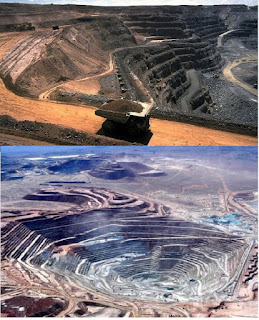
Mining for coal (top)
& lithium (bottom)
When you are in a hole that you want to get out of then the first thing to do is: Stop digging!

And, we are in a hole. We dug it ourselves.

This hole we have dug is both a metaphorical one and a physical one.

The metaphorical hole includes (inter alia): pandemics, mass extinction, deforestation, war, terrorism, fisheries depletion, plastic garbage, e-waste, noise and light pollution, food shortages, soil loss, and – yes – the issue du jour (possibly du siècle): climate change.

It is a deep hole. Furthermore, as each of these components intensify, the hole gets bigger, deeper, and more difficult to get out of.

Whatsmore, this metaphorical hole has a physical counterpart. We have been digging holes for centuries. Evidence of Roman copper mines are still visible in Europe. We have been digging for copper, gold, silver, tin, and other elements for many years.

With the coming of the Industrial Revolution we began to also dig for coal, oil, and iron ore in huge measure. The machines we created from such exploitation enabled us to dig even larger holes in our search (some would say – greed) for the energy fuels of the economies of the world.

For a long time we could see the environmental damage these holes were doing. We could see the pollution of nearby water systems. We could see the smoke-filled skies. We could smell, and taste, the stench that came from the digging of these holes.

Then, in the second half of the 20th century we also began to notice the unseen damage these holes (and what we extracted from them) did. We began to notice the build-up of carbon in the atmosphere, and the warming of the oceans and the air.

But, still we dug. Still we damaged local ecosystems. Still we polluted waterways. Still we disrupted local, often indigenous, communities.

We continued to dig physical holes. We continued to dig our metaphorical hole.

We started to think that we needed to do something about one aspect of that metaphorical hole. We began to think we should do something about the carbon build-up.

In that single-minded focus we began to think we should stop digging for coal, oil, and gas.

We thought we should do something different.

We thought we should dig for lithium, nickel, cobalt, titanium, silicon, boron, and the other elements required for “alternative” energy.

But, we are still digging.

We are still polluting water systems. We are still disrupting ecosystems. We are still destroying bird and animal habitats. We are still dislocating indigenous communities.

Let’s go back to first principles: Stop Digging.

Wednesday, 9 June 2021

We've Dug And Dug

 A few days ago (5 June) was World Environment Day.  One of humanity's most damaging effects upon the environment is our mining.  Every hour of every day we extract more than 10 million tons of biomass, fossil fuels, metal, and minerals from the earth.

In the rich nations this extraction equates to some 20 - 30 tons of material for every man, woman, and child over the course of a year.  For poor nations the rate is around 2 - 3 tons.

This video and poem decries this environmental malpractice.  

When you're getting deeper and deeper into a hole, then surely the best thing to do is - stop digging!

https://biteable.com/watch/3050761/52a01d967022a19704b01e15a7a9cb82