
Pages

The name of this blog, Rainbow Juice, is intentional.
The rainbow signifies unity from diversity. It is holistic. The arch suggests the idea of looking at the over-arching concepts: the big picture. To create a rainbow requires air, fire (the sun) and water (raindrops) and us to see it from the earth.
Juice suggests an extract; hence rainbow juice is extracting the elements from the rainbow, translating them and making them accessible to us. Juice also refreshes us and here it symbolises our nutritional quest for understanding, compassion and enlightenment.
Artificial Intelligence (AI) is not used in the creation of the items on this blog.

Tuesday, 28 December 2021

Farewell bell hooks and Desmond Tutu

Ubuntu
In just eleven days the world farewelled two of its genuinely great people. On 15th December bell hooks (Gloria Jean Watkins) died and then on the 26th Desmond Tutu also died. Both bell and Desmond were known for their opposition to racism, and each stood up for the rights of their people to live with dignity and respect.

Each has left a legacy of wisdom and grace.

bell hooks often spoke and wrote about the connections between racism, patriarchy, economic injustice, and poverty. She saw the connections clearly and spent much of her life trying to show them to the world.

Desmond Tutu often spoke and wrote of the connections between all of us. He, perhaps more than any other South African, brought the concept of ubuntu to the rest of the world. The Zulu concept of ubuntu, Tutu described as:

“The philosophy and belief that a person is only a person through other people. In other words, we are human only in relation to other humans. Our humanity is bound up in one another… This interconnectedness is the very root of who we are.”

We see here a similar message. Desmond Tutu describing our interconnectedness, and bell hooks reminding us that ignoring our connections gives rise to social classifications and thence the intersection between oppression.

Perhaps the most radical offering that each of them gifted to the world was their understanding of the role forgiveness and compassion could play. Radical – because forgiveness and compassion are often seen (by all sides of the political spectrum) as “soft options.” Neither of these two pillars of humanity could be thought of as soft. Let’s hear from bell first.

“For me, forgiveness and compassion are always linked: how do we hold people accountable for wrongdoing and yet, at the same time, remain in touch with their humanity enough to believe in their capacity to be transformed?”

This is a truly radical question, for it shifts us away from a good/evil, right/wrong, me/you, us/them dualism, towards a recognition of our common humanity (faults and all.)

Desmond Tutu grappled with exactly this question throughout his long life (he died at age 90.) His penultimate book, published in 2015, was a collaboration with his daughter – Mpho – titled The Book of Forgiving.1

In that book he outlined a four-fold path of forgiveness, contrasting this with the Revenge Cycle – a never ending continuing cycle of violence, harm, revenge/retaliation, violence…

For Tutu, forgiveness was not just a practice with personal or familial benefit; it also has benefit at world and global level.

Yes, within days of one another the world has said farewell to two of its wise elders.

I will leave the final words to Desmond Tutu.

“We can’t create a world without pain or loss or conflict or hurt feelings, but we can create a world of forgiveness. We can create a world of forgiveness that allows us to heal from those losses and pain and repair our relationships.”

Note:
1. Desmond M. Tutu and Mpho A. Tutu, The Book of Forgiving: The Fourfold Path for Healing Ourselves and Our World, William Collins, London, 2014.

Tuesday, 21 December 2021

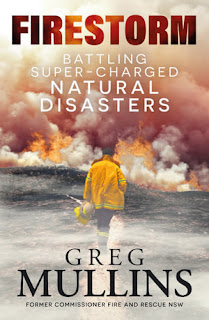
Firestorm (Book Review)

When I was a young boy, I wanted to be a fireman when I grew up. So did Greg Mullins. I didn’t become a fireman, but Greg Mullins did.

Now, Greg Mullins has written a book about his experience as a bushfire fighter in Australia, including being part of the battle against some of the most devastating bushfires in the world.

His book, Firestorm,1 is far more chilling than anything that I went on to write, or to read for that matter. Furthermore, his book is factual. This is no work of imagination. This is not fiction.

This is a chilling account of how bushfires (all around the world, not just in Australia) are becoming more intense, more frequent, with longer “seasons,” and much, much harder to control. With fifty years experience, Greg Mullins asks: ‘Why?’

His answer is simple and to the point: climate change. During a research visit to California in the mid-1990s Mullins was introduced to early scientific papers on climate change by the Captain of the Oakland Fire Department. Mullins has read many papers since, and talked with dozens of experts.

But it is primarily his experience and witnessing of the changes in bushfires that leads him to make the clear connection between a warming planet and these changes.

If Greg Mullins could find a word that means “the unprecedented increase in unprecedented events” then I assume he would have used it in his book. The word – unprecedented – occurs often in his book. And not without reason.

Mullins lists, and expands upon, many of the unprecedented events and patterns associated with bushfires in Australia.

There can few more knowledgeable and experienced bushfire experts in the world than the author of this un-put-downable book. He was the Commissioner of New South Wales (NSW) Fire and Rescue from 2003 until retiring in 2017 (the second longest serving since the service began in 1884.) Since his retirement he has returned to bushfire fighting as a volunteer with the brigade with which he began his long career in 1973.

Greg Mullins has received many awards, including the Australian Fire Service Medal (AFSM) in 2001 and Officer of the Order of Australia (AO) in 2018. He knows what he is talking (writing) about.

In 2019 he was a founding member of Emergency Leadersfor Climate Action (ELCA.) He writes in the book about the founding of this group of former chiefs and deputy chiefs of fire services and other emergency services from throughout Australia. He also outlines their frustration at not being able to take their warning of coming bushfire disaster to the Australian government (and Prime Minister in particular) before the cataclysmic fires of 2019/20 (referred to as Black Summer.2)

The chapter on Black Summer is the central chapter in the book. It tells in grim reality of the devastation of those fires: 24 million hectares burnt; more than 3,000 homes destroyed. Plus, thousands of other schools, shops, and farm buildings; 35 people directly by the fire, and a further 417 killed by the smoke, as well as 4,500 hospitalisations; and up to 3 billion (yes, you read that correct – billion) animals killed. It was – unprecedented.

When Black Summer did occur, Mullins and others were still side-lined (sometimes ridiculed by shock-jock radio hosts and other media commentators). They were told: “This is not the time to talk about climate change.”

If then was not the time, then when is, Greg Mullins could be forgiven for asking. Certainly, his book is an outstanding contribution to the time to talk.

Notes:

1. Greg Mullins, Firestorm: Battling Super-charged Natural Disasters, Viking, Australia, 2021

2. Black Summer began in late July/early August 2019 and continued until May 2020. The statutory NSW Bush Fire Danger Period (bushfire season) runs from 1 October until 31 March. Black Summer extended that season considerably.

Wednesday, 15 December 2021

Excitement Of Life

Today, where I live, marks an easing of restrictions on the wearing of masks in public. At my local café I asked the person who served me how they were. “How are you?” I asked. The reply came back.

“I am very well this morning. We don’t have to wear a mask.”

The barista who served me made a similar comment, then added. “Isn’t it strange that we are excited about something like this, about returning to normal?”

That got me thinking. Yes, it is exciting. Pursuing that thinking, I arrived at the next question:

What gets us excited about life? What makes a normal life exciting? What stirs us, what rouses us to participate in (normal) life?

Literally, excite means to set something in motion in an outward direction. What feelings do we wish to express? What internal emotions are stirred within us that we wish to show to the world?

Excitement in our contemporary world tends to suggest something we are looking forward to eagerly, or that something we have witnessed or experienced brings up feelings of joy, delight, and wonder.

In its literal sense excitement could also be an expression of sadness or even something stronger – revulsion maybe.

Whatever it may be, to be excited is to be able to express our full gamut of emotions. When we do this, we enter our world fully present to what it has to offer, and how we decide to experience it.

So, what excites you? What feelings spread through your body when you first wake from sleep? What emotions do you feel when you interact with another person – perhaps the barista at your local café? What emotions does the aroma of the coffee, or its taste, allow you to experience?

Such excitement is available to us every day, not just those days when we head back to normalcy.

Perhaps I will shift my greeting from one of “How are you?” to one of “What excites you today?”

Friday, 10 December 2021

Politicians Have Won - Again!

Last weekend in the State of Australia in which I live elections were held for local government. As expected, the predictable candidates won again. All of them, every last one of them are – politicians.

When the results come in, there will be some who cheer and others weep. Some voters will be glad, others sad. Many electors may even be mad.

From the complaints, moans, and groans I heard leading up to this election, it appears that this campaign has been little different to others. There have been complaints of cronyism and collusion, all the way up to allegations of corruption.

Could any less have been expected?

When would-be politicians are campaigning for election, money is key. Money buys exposure, and exposure translates into votes.

And it is the poor voter who is left bemoaning the outcome.

During the campaign, and following the casting of votes, I heard such statements as: “I’ll be glad when the election is over,” or “Thank god that’s over for another three years.”

All this is a sad state of affairs for at least three reasons:

1.     The to-and-fro name-calling and allegation and counter-allegation by politicians and their supporters should not be how we conduct our collective decision-making processes.

2.     In response to this, electors feel disappointed, unheard, and sometimes angry. It is as if elections elicit a feeling of angst amongst the electorate.

3.     The desire on the part of many electors that the elections be over-and-done-with as soon as possible sadly belies what should be an engaging part of civic life.

Can this be any different?

Yes, it can – if we think differently. And – if we think systematically.

Donella Meadows was one of the foremost systems thinkers in the world. Her book Thinking In Systems,1 published posthumously, set out twelve leverage points at which to intervene in a system. She ranked these leverage points according to the effectiveness with which change may happen.

According to Meadows, the least effective leverage point was to change the numbers in the system. In terms of our political system, this translates to changing the politicians, changing the individual men and women who sit in parliaments, senates, and Council chambers.

Far more effective leverage points are to intervene at the level of goals, and paradigms. Doing so, requires us to think more deeply about what the purpose of our political system is and what assumptions is it based upon.

At present, we are simply changing the constituent parts. We are doing nothing to change the system. Yet, the system is not serving us. If it were, would there be so much angst around election time?

Our present mechanism for selecting those who are charged with making our collective and social decisions rests upon elections. What if we no longer used elections for that purpose?

What if we used random selection instead? What if those making our public decisions were selected like a jury?

“But, but, but…” The objections are many. When distilled, most objections can be encapsulated as: “But, that’s not democracy!”

It isn’t? Well, actually, it is.

Ancient Athens (the “birthplace” of democracy) used a process of sortition to select their decision-makers. Sortition is a system of random selection, and the Athenians used it in preference to elections.

I have written about sortition many times on this blog site, so I will not traverse the topic much further here.2

However, consider this: Would the three negative aspects of elections outline above be reduced under a sortition system?

I suggest, if the question is seriously pondered, and sortition fully appraised, then the answer has to be – “Yes.”

Sortition may not rid us completely of the three sad features, but it could seriously reduce them.

 Notes:

1. Donnella H Meadows (ed. Diana Wright), Thinking in Systems, Chelsea Green Publishing, Vermont, 2008

2. In the “Search this site” box type in the word sortition to be taken to blogs where I explore sortition much more fully.

Thursday, 2 December 2021

Now, Where Did We Put That Monkey Wrench?

A lot of ground-breaking environmentally themed books were published in the early – mid 1970s. Many of them pointed towards a future that was unsustainable if the current “business as usual” model was pursued.

One fictional book narrated the story of reaction against the environmental destruction going on in the Southwestern United States. Edward Abbey’s The Monkey Wrench Gang (published in 1975)1 told the story of an unlikely gang of four that included a river guide, a surgeon, a Jewish feminist, and a Vietnam vet. Their mission was to sabotage and destroy the machinery (bulldozers, trains etc) that were being used to lay waste to the environment.

Significantly, Edward Abbey dedicated the book to Ned Ludd, the semi-mythical weaver in England who smashed a couple of weaving frames in 1779. His name is now synonymous with the term Luddite.

To be called a Luddite today is often taken as a pejorative and derisive term.

Yet, we could ask today, for the sake of the environment; where are you Ned Ludd when we need you? Or, we could give a call out to the Monkey Wrench Gang and plea for their assistance.

More so than in 1779, and even more than in 1975, the world today is beset by techno-addiction: a term coined by eco-psychologist Chellis Glendinning in 1994.2

Much technological invention and innovation has brought us to the life-threatening predicaments we currently face. Sadly, the solutions being offered are more of the same - more technology. And woefully, “green technology” only keeps us trapped within the same techno-addiction.

Healing and Wholing

Technology is implicated in getting us into this mess. Technology is not going to get us out.

We could be like the Monkey Wrench Gang or Ned Ludd and smash technology. However, that would be analogous to an alcoholic who smashes a bottle of beer so that the beer is unavailable, yet walks into a bottle store the next day to buy another dozen bottles.

Like the alcoholic, we need to address our addiction. And that requires a lot of work.

Notes:

1. Edward Abbey, The Monkey Wrench Gang, J.B. Lippincott & Co., New York, 1975

2. Chellis Glendinning, My Name is Chellis and I’m in Recovery from Western Civilization, Shambhala Publications, Boston, Massachusetts, 1994.

Wednesday, 24 November 2021

Don't Resist - Desist

Carl Jung
Those seeking change have, for centuries, resisted the incumbent and prevailing order. All too often this has resulted in little, if any, real change. Sometimes, all that changes are the players, leaving the system itself largely intact.

The reasons for this are many. This blogpiece does not have the space to enter into a full analysis, nor even offer a complete alternative.  What it does do, however, is to pose a question that social change activists may like to consider.

One of the greatest psychologists of the 20th century, Carl Jung, offered this insight:

“What you resist not only persists, but will grow in size.”

Although Jung’s primary work was at an individual level, he was also a shrewd observer of cultural behaviour. He recognised that patterns within individuals are repeated within the wider society – each helping to create the other.

Jung wasn’t the only one to recognise the mutually enlarging relationship between resistance and persistence. We can see a similar concept in Isaac Newton’s famous third law of motion. Often cited simply as action-reaction, this law tells us that when two objects exert a force on each other, then the forces are equal in magnitude, and opposite in direction. Simply put, this suggests that when one object exerts a greater force, then the other object will react by increasing its own force. What one resists, the other persists.

The same is true in our social and cultural settings. An action stimulates a reaction, which then becomes the stimulus for a further reaction.

Certainly, there are things that we must have the courage to say ‘No’ to – racism and sexism are two of the most obvious and blatant.

However, attempting to build an entire alternative system around saying ‘No’ is bound to end in tears, mistrust, and failure.

We may be better to move from a resisting modality to one of desisting. Similarly sounding words, yet a peek into their etymology gives us insight into their quite different qualities. Both receive their verb from Latin – sistere, meaning to stand, or stand firm.

Often the prefix re suggests a going back, or again. It also, as it does here in the word resist, means against (as in opposition to). Hence, resist literally means ‘to stand in opposition to, stand against.’ The word has an obvious oppositional, almost antagonistic, flavour.

What about the word desist? The same verb, i.e., to stand. The prefix de however, gives the word a much different flavour. De is also of Latin derivation and means away from, down from, or off. The word desist then, has the sense of standing away from, or standing apart from.

Quite a different flavour. There is no sense of opposition, yet it retains the sense of firmness, steadiness, and taking a stand. The difference is that one stands in opposition to something, the other stands apart from, standing firm elsewhere. It stands on its own merit, and stands in its own authorship and integrity.

This leads to the question that was foreshadowed at the beginning of this blog.

What would happen if social change movements shifted from resisting to desisting? What if, instead of trying to resist and fight against the system, the system was ignored and by-passed with effort going instead into creating a new system?

What if, instead of buying into systems, we simply stopped purchasing from them? What if we desisted from our consumer role, and became engaged, interactive, and communal citizens?

This is exactly what Buckminster Fuller was advocating, when he advised that:

“You never change things by fighting the existing reality. To change something, build a new model that makes the existing model obsolete.”

Not only is Bucky’s advice likely to be more effectual, just think of the effort and time not wasted on resisting and trying to change a system that is reluctant to change.

Think too, of the amount of angst, anger, disappointment, and torment that could be averted.

If the efforts that go into resisting were instead channelled into desisting, then just imagine the creative opportunities that could emerge.

Is it too late to stop resisting? Is it too late to stand aside from the life-destroying systems that surround us?

Tuesday, 16 November 2021

Bewilderment (Book Review)

Bewilderment1 picks up a theme explored exceptionally well in Richard Powers critically acclaimed 2018 novel, Overstory. Where Overstory told the story of human-nature disconnection mostly from the point of view of nature, Bewilderment explores that disconnection through the eyes of two living, and one dead, human.

Theo Byrne is an astrobiologist wondering about how life may have evolved on other planets. His nine-year old son, Robin, is simply wondering. Yet, his wonderings are profound, and because of this, is ostracised by his classmates.  Alyssa, Theo’s wife and Robin’s mother, who died in an accident, was a lawyer/advocate working with animal-rights NGOs.

The novel is full of irony. Theo is busy looking for life on exo-planets. Meanwhile, Robin is attempting to draw and paint every endangered species in America.

Theo is told by a psychologist that Robin is ‘on the spectrum,’ prompting Theo to respond that we are all on the spectrum – that’s what life is: a spectrum. Theo also wonders why it is that the zealous desire to diagnose psychiatric disorder is not itself a psychiatric disorder.

Powers narrative asks us to view the natural world through the eyes of a nine-year old, and to ask questions that only nine-year-olds seem capable of asking. Bewildering questions.

Together, Theo and Robin, grapple with, and meditate upon Fermi’s Paradox. Named after the nuclear physicist, Enrico Fermi, the paradox asks, ‘where is everybody?’ If the cosmos is full of trillions upon trillions of galaxies, stars, and planets, then life elsewhere must be in abundance, yet there is no evidence. Many explanations for the paradox have been put forward, and Powers skilfully weaves these into the conversations between astrobiologist father and quizzical son.

‘Where is everybody?’ is but one of the bewildering questions explored in Powers’ novel. Thankfully, Powers does not try to answer them, allowing (almost forcing) us, as reader, to ponder the questions for ourselves. Indeed, further, the questions compel those of us who are older to ask, as Theo does; ‘…ten thousand children with Robin’s new eyes might teach us how to live on Earth.’

Indeed, currently on Earth, it is the young people who are asking the pertinent questions, and who are seeing the world through new eyes. Instead of ignoring them or criticising them, we (the older generation) might rather co-explore (as Theo and Robin do) with younger people what these questions mean.

Look up bewilderment in a modern dictionary, and you will get a definition something like this: the feeling associated with being perplexed, confused, baffled. Yes, there are instances of this feeling in Powers’ novel.

However, I suspect that Powers would like us to question where the word bewilderment comes from, and whether it might have something for us to consider in todays world. The preposition be in Old English had the sense of intensifying the verb following. Be can be thought of as making thorough, or complete.  The verb, wilder, has strong connections to the noun wild, and means lead astray, to lure into the wilds. Thus, a thorough understanding of bewilderment takes us to a thorough immersion into the wilds of nature.

Perhaps this is the sense in which Powers has used Bewilderment for his novel’s title? If so, then pondering its full meaning, we might glimpse some answers.

Bewilderment is an easy-to-read book, deceptively simple in its storyline, yet full of bewilderment.

Note:

1. Richard Powers, Bewilderment, Hutchinson Heinemann, London, 2021.