Pages

The name of this blog, Rainbow Juice, is intentional.
The rainbow signifies unity from diversity. It is holistic. The arch suggests the idea of looking at the over-arching concepts: the big picture. To create a rainbow requires air, fire (the sun) and water (raindrops) and us to see it from the earth.
Juice suggests an extract; hence rainbow juice is extracting the elements from the rainbow, translating them and making them accessible to us. Juice also refreshes us and here it symbolises our nutritional quest for understanding, compassion and enlightenment.
Artificial Intelligence (AI) is not used in the creation of the items on this blog.

Wednesday, 6 April 2022

Getting Comfortable With Discomfort

The pandemic did it, didn’t it? Left us in a state of discomfort. Whether we agreed with the restrictions or did not, many of us felt a degree of discomfort.

We are going to feel discomfort moreso.

We may as well get comfortable with the feeling of discomfort.

The consequences of our (largely westernised) profligate lifestyles over the past few millennia (intensified since the Industrial Revolution) have started to become manifest.

We may not all be aware of the consequences, but they are present. More and more, these uncomfortable realisations are reaching a wider consciousness.

It’s like a ripple. An uncomfortable feeling may start out at some point in our cultural pond; but, because we are not near the source, we do not feel it. However, ripples have a habit of spreading, and eventually we will notice the ripples of discomfort no matter where we are in the pond.

Noticing the ripple, and feeling its effect upon us, is just the first step. Buddhism calls this the First Noble Truth.

The First Noble Truth (of four) is often translated as suffering in the English language. The Pali word dukkha has a larger meaning and includes such notions as uncomfortableness, unsatisfactoriness, unease, stress, or – discomfort.

If we are going to navigate through the social/environmental collapse that is upon is, then noticing the discomfort is the first thing we must get comfortable with.

It is worth looking more closely at the First Noble Truth. You could be forgiven to think that the word noble here refers to the truth. However, that too, is a poor understanding of the original Pali phrase.

In Pali the word ariya, translated as noble, refers not to the truths themselves, but to the knower of the truths. Noble has an etymological root in the word gno – meaning to know.

Thus, the original meaning of the First Noble Truth could be said to be: a person who understands, and has stepped into knowledge of, the truth of discomfort.

When we step into that knowledge, we begin to become comfortable in our discomfort. It is a start – there are three more Noble Truths to navigate.

So, let us not look out on the world with worry, despair, anxiety, depression, or anger. Let us face our discomfort. Let us explore it. What does it mean to be uncomfortable? What does discomfort truly feel like.

Only then will our discomfort become a noble truth.

Wednesday, 30 March 2022

What Shall We Do With Three More Years?

How long do we have before we get to 20 C above pre-industrial times (1880-1900)? There is no precise answer, but estimates vary from 12 years to 50 years. Most seem to centre on about 25 – 35 years. An European Scientific Think Tank1 has a ticking clock on its website. Currently (late March 2022) this clock shows that we have just 25 years and 1 month.

That site also shows our carbon budget. This is how much CO2 that can be emitted into the atmosphere and still give us a chance of remaining under 20 C warming. As of late March 2022 this budget is a little under 1,060 billion tonnes. Other estimates concur with this figure.

So, how much carbon do we emit each year? Although emissions dropped in 2020 by about 5% (because of covid) we are now back to emitting as much as we did pre-covid – roughly 36 billion tonnes per year.2

If you do the arithmetic and divide the carbon budget by how much we emit annually then we have only a few months past 29 years before we reach 20 C (and that assumes that we do not increase the amount we emit – a depressingly unlikely possibility.) However, let us err on the conservative side and say we have 30 years. That is, sometime in 2052!

What is to be done? Can ‘renewable’ energy save us?

Do The Maths

Let’s do a little bit more mathematics. (Apologies to those who do not like maths. Hopefully, the following calculations are not too difficult to follow.)

First, some background and provisos.

Often the ‘renewable’ options (e.g. solar, wind, hydro, geothermal etc) are termed renewable energy. This is a misnomer. Solar, wind, and hydro are used to generate electricity, which is one aspect of energy. Thus, the term should more correctly be renewable electricity. Other aspects of energy use include transportation, industrial use, manufacturing, and agriculture.

In 2020 ‘renewables’ made up 5.7% of the global total energy mix, with hydro contributing a further 6.9%.3 Of the global total energy consumption, approximately 20% of it is in the form of electricity. ‘Renewables’ contributed slightly less than 30% of electricity production in 2020.4

This suggests that, all else being equal, if ‘renewables’ were able to contribute 100% to global electricity production, then ‘renewables’ could expand by 333% (100/30 x 100.)

Thus, with the above background and the numbers, let us do a mathematical thought experiment. What if we switched entirely to ‘renewable’ electricity today (yes, today, not in five years time, not even in one years time, but now!)

If we did that, we could increase the contribution of ‘renewables’ to the energy mix from 5.7% to around 19% (5.7 x 3.33. From 30% of electricity production to 100%.) This is an increase of 13.3% on the present contribution.

But, before we do the calculation, there is one further consideration to take into account. ‘Renewable’ does not mean carbon-free. All ‘renewables’ have a carbon emission component when their full life-cycle is considered. This is less than that for fossil fuels, but not insignificant.

Each type of ‘renewable’ has different carbon emissions, as does each different fossil fuel. ‘Renewables’ emit between 3 – 10% carbon equivalent of that emitted by fossil fuels. For the sake of simplicity, let us assume a figure of 5%.

Theoretically, this represents a decrease in the amount of CO2 equivalent from 36 billion tonnes per year to 32.8 billion tonnes (36 x (100 – 0.133) x 1.05)

Now, let’s see what that does to our carbon budget. The arithmetic is straight forward. It is 1,060 ÷ 32.8 = 32.3 years.

What About EVs

Some readers may object that I have not taken into account the contribution of EVs (electric vehicles) in the coming years.

A similar thought/mathematical experiment can be done regarding EVs.

Beginning again with some background and provisos. Transportation contributes approximately 20% of global carbon emissions. Private cars, light trucks, and motorcycles make about 29% of all transport (other sectors include heavy trucks, shipping, and aviation.)

At present, only cars, light trucks, and motorcycles can effectively use an electricity source for motive power.

Presently the carbon emission efficiency of EVs versus conventional (fossil fuel) vehicles is only about 25%.5 In other words, over their life-time an EV can be expected to contribute around three-quarters as much carbon equivalent to the atmosphere as does a conventional vehicle. This is mainly because of the extra carbon emissions involved in manufacturing.

Now, suppose that all (yes, every single one) private cars, light trucks, and motorcycles were converted to EVs today. This would represent a contribution of 1.5% reduction in carbon emissions (0.29 x 0.25 x 0.2.)

How much does this represent? Just 0.54 billion tonnes.

Let’s now plug this into our calculations above. Instead of 1,060 ÷ 32.8 we now have the equation 1,060 ÷ (32.8 – 0.54) = 32.8 years.

Just three years! That’s all – three years we gain by switching to 100% ‘renewables.’

And that’s if: 1. We do it now (not possible) and 2. We do not increase the amount of carbon we pour into the atmosphere from other sources (unlikely).

OK, the mathematics may be imprecise, yet the results from the calculations are within the bounds of possibility. If anything, we are likely to gain less than three years, because of the two ‘ifs’ above.

One Final Rider

It will be noted that I have used the term ‘renewables’ rather than simply renewables. This is deliberate. I use the term ‘renewables’ to indicate that they are not renewable. To build, manufacture, transport, and decommission solar, wind, vehicles, batteries and the other components of these technologies uses finite resources. Plus, I have not even mentioned the environmental and social costs and damages that ‘renewables’ bring.

The Question

The question then is: If we had it, what would/could/should we do with the extra three years?

We could spend the three years devising different questions. We could spend the three years thinking (as Einstein suggested) differently. We could use a different thinking than the (mechanistic, technologically-driven) thinking we have used to get us to this predicament.

How about instead of waiting for that three years, we transform our thinking radically, and start asking questions related to how can we decrease our dependence upon electricity, how can we reduce our use of vehicles?

How can we de-grow?

Notes:

1. Mercator Research Institute on Global Commons and Climate Change.  https://www.mcc-berlin.net/en/research/co2-budget.html accessed 28 March 2022.

2. https://www.statista.com/statistics/276629/global-co2-emissions/ accessed 28 March 2022

3. Statistical Review of World Energy 2021 p12

4. www.ourworldindata.org Accessed 29 March 2022.

5. In a study undertaken by Massachusetts Institute of Technology (MIT) Energy Initiative in November 2019 it is expected that this efficiency could rise to about 75%. However, the authors of that study do not expect this technology to be complete until about 2050.

Wednesday, 23 March 2022

3 Reasons To Doubt Selfishness Of Humans

There is a prevailing notion that humans are basically selfish. Our behaviour and actions are motivated primarily by self-interest, this view says.

Is it true?

In common with many answers to questions of this type, the answer here is yes, and no. It is only partially true. However, it is also predominantly wrong.

Within westernised cultures the concept of self and individualism is well established. So well established, in fact, that the idea that we are selfish by nature is entrenched within our cultural psyche.

There are however, at least three reasons for doubting the universality of this notion. 1. Other cultures and spiritual traditions are more cooperatively focused. 2. Recent research suggests an inherent cooperative bias. 3. The idea shows little imagination on our part.

Other Cultures and Spiritual Traditions

Many indigenous and nature-based cultures show a greater sense of cooperation than do westernised cultures. In such cultures the self is often synonymous with us and a collective approach to life.

Within the Zulu culture the word ubuntu describes such an identification. Bishop Tutu defines ubuntu as "the philosophy and belief that a person is only a person through other people.  In other words, we are human only in relation to other humans.  Our humanity is bound up in one another… This interconnectedness is the very root of who we are."1

This idea of the self being bound up with others is revealed also in the concept of interbeing – a word coined by Vietnamese Buddhist monk Thich Nhat Hanh. He describes this idea as “the many in the one and the one containing the many.” In a nod to Descartes, he goes on to say that interbeing can be expressed as: “I am, therefore you are. You are, therefore I am. We inter-are.”2

There are some who claim that those who act cooperatively and fairly do so out of self-interest. It is, they claim, in ones self-interest to act cooperatively. This critique is nothing short of cultural colonialism – viewing indigenous culture and understandings through the lens of colonial prejudice.

Recent Research

Just as Thich Nhat Hanh gives a nod to Descartes, so does Stefan Klein give a nod to Darwin, titling his 2014 book Survival of the Nicest.3 Noting that sharing and fairness occurs freely within children, he concludes that “If this inclination to fairness appears at such an early age, it is highly likely that it is innate.”

Klein further suggests, convincingly, that humans developed the social intelligence of cooperation before abstract and language intelligence. “We humans became first the friendliest and then the most intelligent apes,” he asserts.

Researchers within Evolutionary Dynamics and Psychology at Harvard University published an interesting paper in Nature in September 2012.4 In studies involving almost 2,000 people they tracked the difference in cooperative decision-making versus self-interested decision making. The research looked at the speed of decision-making, recognising that quick decisions are more likely to be instinctive and/or intuitive, whereas longer, more considered decision-making tended to be rational.

In all cases faster decision-making was significantly more likely to show a cooperative outcome than a self-interested outcome, and vice versa.

Instinctual and intuitive responses are more likely to demonstrate an innate trait than are more considered responses. Hence, it can be claimed, as the researchers here did, that, “Our results provide convergent evidence that intuition supports cooperation in social dilemmas, and that reflection can undermine these cooperative impulses.”

Imagination

As suggested earlier, the notion that humans are innately selfish is entrenched within our (westernised) cultural psyche. So much so that we find it difficult to imagine that it may be otherwise. In our popular literature, on the big screen, and elsewhere, we see and read of images of stone age humans brutalising one another, invading and occupying another clans territory. We don’t stop to question this. It has always been this way – hasn’t it?

Albert Einstein noted that imagination is more important than knowledge. Our ability to imagine is often the precursor to a deeper enquiry into phenomena or problems. Imagination is certainly the inspiration for questioning.

One person who did imagine a more cooperative inner nature was the Tibetan monk, Chögyam Trungpa Rinpoche. In 1976 this monk brought the Shambhala Vision to the attention of the western world. The vision included Shambhala warriors, although the Tibetan word, pawo (translated into English as warrior) more correctly means one who is brave.

Chögyam Trungpa explains that within this vision bravery means not being afraid of oneself. He explains:5

“The Shambhala vision is the opposite of selfishness. When we are afraid of ourselves and afraid of the seeming threat that the world presents, then we become extremely selfish. We want to build our own little nests, our own little cocoons, so that we can live by ourselves in a more secure way.”

Can we do it? Can we be brave? Can we be unafraid of ourselves? Can we imagine a cooperative innateness?

We can, and we must.

Notes:

1. Tutu, Desmond & Tutu, Mpho: The Book of Forgiving, William Collins, London, 2014.

2. Thich Nhat Hanh, Being Peace, Parallax Press, Berkeley, California, 1987.

3. Stefan Klein, Survival of the Nicest, Scribe Publications, Victoria (Australia) and London, 2014. Note also that the phrase ‘survival of the fittest’ was not used by Darwin, although many assume it was.

4. Rand, Greene, and Nowak, Spontaneous giving and calculated greed, in Nature, 20 September 2012, Vol 489, pp 427-430.

5. Chögyam Trungpa Rinpoche, The Discovery of Basic Goodness, in Melvin McLeod (ed) Mindful Politics, Wisdom Publications, Boston, 2006, pp 98-103.

Tuesday, 15 March 2022

Poisoned Protest: My Biggest Social Change Mistake

When I was a young man (I’m a baby-boomer) there were a number of social justice issues to be concerned about and take part in: The Vietnam War, apartheid in South Africa, the nuclearization of the Pacific, logging of native forest, the damming of waterways and flooding of fruit-growing valleys, racism, and sexism. Almost with glee, I participated in the protests, the rallies, the sit-ins, die-ins, and teach-ins.

As with most protest then,1 the government of the day was often blamed for the situation, as well as being held responsible for seeing the issue resolved. Closely following the government in terms of who was to blame were large businesses, corporations, multi-nationals, and even the older generation.

Often in those campaigns, abuse and taunts were hurled. Words and phrases I would never want to hear in my own household.

Yet, it was all for a better world wasn’t it?

We were campaigning for peace, for racial justice, for women’s rights, for animal rights, for an environment free from exploitation. Weren’t those causes justified?

But, therein was my biggest mistake. Not only mine, but also the mistake of those I was campaigning alongside.

We (and I) failed to see what underlay, and under-pinned, all those issues.

Beneath all of them lie separation and ill-will.

Our sense of separation from each other under-pins all of these issues. When we think we are separate then it is very easy to see the other as of lesser value than ourselves, and so we justify our self-righteous anger and abuse. When I was a young man I was never to blame. I did not even consider the possibility that I may be complicit in helping to create the issues I was campaigning about.2

My words of abuse and invective that I hurled at politicians and others, helped to replicate the very systems I was supposedly wanting changed.

I was complicit in the very system I was critiquing.

Many years later I found that Buddhism recognised these two traits of human thought. The three poisons – ill-will, greed, and delusion – resonated with my continuing enquiry. Two of them (ill-will and delusion) were exactly what I had come to recognise as my mistakes.

Ill-will is self explanatory. Ill-will covers a wide range of thoughts and behaviours; from name-calling and verbal abuse all the way through to hatred, and the espousal of violence. It is clearly a poison.

Delusion, in the Buddhist sense, is that we are deluded by thinking that we are all separate; separate from each other, separate from nature, and even separate from our own self.

So, nowadays I am letting go (or at least, trying to) of the blaming, shaming, and defaming game. Letting go, however, does not mean giving up. It does not mean I am no longer concerned or aware of the plights, distresses, and tears of the world.

It does mean I want to acknowledge my complicity, and change those things that I am able to change. It means I willingly engage in conversations with others about how I, and we collectively, can change our behaviours and mind-sets, without hurling abuse and invective.

Such conversations are not easy, because I (and those I am conversing with) must step out of our self-conscious righteousness and let go of the ego that says “I have to win this argument,” or that “I am right, you are wrong.”

It’s an ongoing project.

Notes:

1. Sadly, the protests of today are little changed.

2. Sadly, I am still sometimes lulled into thinking I am not complicit.

Tuesday, 8 March 2022

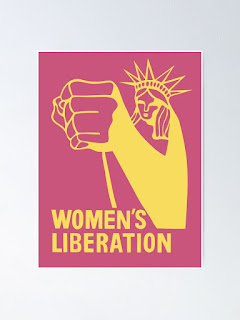
International Women's Day - A Liberation

I write this on 8 March 2022 – almost 50 years since the United Nations proclaimed 8 March as International Women’s Day.

The day itself has antecedents that stretch back to 1908 when women garment workers marched in New York demanding better working conditions and the right to vote. From there, women demanded (and celebrated the day) throughout a number of European countries.

In 1917, tired of the war, mostly women protested in Russia demanding bread and suffrage. This was to be one of the precursors of the revolution that brought the Russian empire, and the rule of the Tsar, to an end. Russian women gained the right to vote that year, before their sisters in the UK and USA.

Ofttimes in these days International Women’s Day is viewed through the lens of equality. Have women gained similar rights as men? Has the pay discrepancy reduced? Are women gaining access to institutions of power once reserved exclusively for men?

Yet, not all women are focused simply upon equality. Germaine Greer cynically stated that,

“I didn’t fight to get women out of behind vacuum cleaners to get them onto the board of Hoover.”

Germaine Greer, and many other feminists (especially during the 1970s and 1980s) advocated liberation. Indeed, the feminist movement of that time was often called the Women’s Liberation Movement.

Liberation, as readers will know, means something much much more than equality.

Did men hijack the intent of liberation? Did men simplify the message (or at least hear the message) to one of “equality with men”? Did men maintain the institutions of patriarchy by allowing for the equality of women so that women could participate in those institutions? Did men do this so that the institutions would not have to change?

Are men afraid of liberation? Any form of liberation – not women’s only.

I don’t know the answers to these questions. However, I would rather the questions were posed and that we have to think about them, than have glib and simplistic answers available.

During the 1970s and 1980s, women’s liberation was a political project. Yet, even within the political phraseology there was a radically different understanding of “political.” Political did not mean women having equal access to the political institutions. It did not mean more women in the seats of government. It did not mean more women heads of state. Although all those aspirations are worthy, for the women’s liberation movement, political institutions and structures themselves had to be rethought.

To quote Germaine Greer again:

“I do think that women could make politics irrelevant; by a kind of spontaneous cooperative action the like of which we have never seen; which is so far from people’s ideas of state structure or viable social structure that it seems to them like total anarchy — when what it really is, is very subtle forms of interrelation that do not follow some heirarchal pattern which is fundamentally patriarchal. The opposite to patriarchy is not matriarchy but fraternity, yet I think it’s women who are going to have to break this spiral of power and find the trick of cooperation.”

That, men and women, is a totally transformed understanding of the role and nature of politics.

Thus, as another International Women’s Day is celebrated, let us recall the radical liberation ideas of the feminists who were active fifty years ago – at the time the international institution of the United Nations was proclaiming the day.

Wednesday, 2 March 2022

It Was Fifty Years Ago Today (Limits To Growth)

We’ve long known it may come to this. At least fifty years anyway. Half a century.

On 2nd March 1972 a landmark book was published. Limits To Growth1 alerted the world to the possibility of collapse by the end of the 21st century.

Led by systems thinker Donnella Meadows, the team behind the publication drew on the power of computers (albeit miniscule compared to today’s technology) to run a number of scenarios for the future of the planet and humankind.

One of those scenarios - the ‘standard model’ (later referred to as ‘Business As Usual’) - tracked what may happen if humanity continued on the course it had been on. That scenario foresaw worsening pollution, food shortages, resource depletion, and industrial output plummet. Perhaps unsurprisingly, the world continued on with that business as usual model over the following fifty years since publication. Now, we are witnessing the sad results of that indifference.

Furthermore, by manipulating the model with the doubling of resources, unlimited resources, pollution control, birth control, and similar mechanical/technological possibilities, the outcome was not much dissimilar to that of the standard model. In other words, “solving” our way out of the coming predicament using the thinking of the past, just would not work.

The authors of Limits To Growth came to three conclusions (pp 23/24):

1. The limits to growth on the planet will be reached sometime within the next 100 years. The most probable result will be rather sudden and uncontrollable decline in both population and industrial capacity.

2. It is possible to alter these growth trends and to establish a condition of ecological and economic stability that is sustainable far into the future.

3. If the world’s people decide to strive for the second outcome rather than the first, the sooner they begin working to attain it, the greater will be the chance of their success.

Around the time of the publication of Limits To Growth a number of other significant books were also published.2 The modern-day environmental movement was being born. Friends Of the Earth (FOE) and Greenpeace were both founded in Canada in 1969 and 1971 respectively. The world’s first nationally based environmental party (the New Zealand Values Party) was founded in 1972, informed greatly by Limits To Growth.

The environment became a topic of political and social debate. Limits To Growth was applauded and adopted by many in the environmental movement. Sadly, it was ridiculed and dismissed by many who should have listened. By the end of the century, even the environmental movement had forgotten it, and had shifted its attention away from the core message of the book, morphing in large part into the single-focused climate change movement.

What was the core message? Very simply, that continued exponential growth in a system must, at some stage, come up against limits. Attempting to bypass or deny those limits results in collapse of the system.

We are half-way through the 100 year timespan that Limits To Growth extrapolated. The authors 50 years ago exhorted humanity to work on a sustainable option as soon as possible.

We didn’t do so. We better start. We’ve only got 50 years left.

In a recent (22 Feb 2022) interview (inspired by the coming 50th anniversary of the book) Dennis Meadows (one of the original authors, now 80 years old) had a prescient warning:

“Now it’s clear that the scale of human activities is far, far above the limit. And our goal is not to slow down, but to get back down.”3

A few agree with him – the de-growth movement for example. There are others who would now suggest that we do not have even those 50 years left.

Notes:

1. Meadows, Meadows, Randers, Behrens III, The Limits To Growth: A Report to the Club of Rome’s Project on the Predicament of Mankind, Universe Books, New York, 1972

2. For example: The Population Bomb (Ehrlich 1968) , Small Is Beautiful (Schumacher 1973), A Blueprint For Survival (Goldsmith & Allen 1972), Non-Nuclear Futures (Lovins & Price 1975), Gaia (Lovelock 1979), and the fictional books The Lorax (Dr Seuss 1971), The Monkey Wrench Gang (Abbey 1975), Ecotopia (Callenbach 1975), and The Word For World Is Forest (Le Guin 1972).

3. The full interview is here:  https://www.resilience.org/stories/2022-02-22/dennis-meadows-on-the-50th-anniversary-of-the-publication-of-the-limits-to-growth/?fbclid=IwAR38qMb63q_SH9XcXNqP8OeWRmMqEAChysd83LCfqQI8Ezzkl5JcAjO1FUE   Accessed 26 February 2022

Thursday, 24 February 2022

Respect Me, I'm An Elder

Sometimes when I find myself in a group of men of similar age to my own (I am in my late 60s) I hear a bemoaning of “the youth of today.”

It begins with a general observation of how untidy, messy, lazy, and/or rude, young people are. Eventually, the detractor is likely to conclude with, “They don’t respect their elders.”

That is a telling phrase, isn’t it? Don’t respect their elders. It is actually code for Young people don’t respect me.

There it is – me. Me! The cry of the ego, or at least, the cry of an immature ego.

There are at least two mis-applied opinions within the cry of they don’t respect their elders.

The first is that there is nothing new under the sun, as the Ecclesiastical author tells us. In a speech to the House of Commons almost 170 years ago, a member intoned: “…the morals of children are tenfold worse than formerly.”1

The history of older generations blaming young people is centuries old. As far back as the 8th century BC (that’s 2,800 years ago,) Hesiod was complaining that “When I was young, we were taught to be discreet and respectful of elders, but the present youth are exceedingly disrespectful and impatient of restraint".2

We could turn the phrase around and suggest that the older generation of today continue to blame and criticise young people.

The second misappropriation is perhaps more concerning. The misidentification with older age as being synonymous with elderhood is a common one.3 There is nothing to suggest that simply by attaining an age recognised (and understood) as old can one be considered an elder.

One of the attributes often associated with elderhood is that of wisdom. Yet, as Stephen Jenkinson disdainfully notes,

“The proliferation of old people has not meant the proliferation of elders… The probable reason is this: the presence of elders in a culture turns out not to derive from an aging population. We’d be awash in wisdom here if it did.”4

Jenkinson has possibly thought more about, and written more fully, than any other older (and younger for that matter) person within western culture. Rather than outline what he thinks elderhood is, he has attempted to uncover those aspects of our modern-day culture that have been lost, and thereby, have contributed to the loss of the elderhood function. Jenkinson is worth quoting again,

“We have fewer elders than ever before because we are living longer. That’s the thread I am pulling. That’s the poorly kept secret of the age. Something about the suspension of limit and ending compromises the function of elderhood, even the appearance of elderhood, because there is something about limit that conjures elderhood from age.”5

Bill Plotkin too, laments the loss of elderhood within westernised cultures. For Plotkin, a person does not suddenly become an elder upon attaining an older age; rather and elder appears (mostly towards the latter ages of life) because of a life-long journey of ecological, social, spiritual, and soul-centred enquiry and exploration, passing through a number of developmental stages along the way.

Plotkin outlines these developmental stages in several books, and notes that a true elder “creatively occupies their distinctive ecological niche as a life-enhancing gift to their people and to the greater Earth community.”6

Note here that Plotkin is referring to a much broader understanding of elderhood than is our modern-day narrow and incomplete perception. He speaks of an ecological niche and of gifts to the greater Earth community. The wisdom inherent in such niches and gifts can only be acquired from a lifetime of walking a path well clear of the highway of much of modern westernised life: a highway littered with consumerism, environmental exploitation and destruction, violence, racism, sexism, and anthropocentrism.

Fortunately, the role of elderhood, and the recognition of true elders, is not completely lacking in the world. Many indigenous and nature-based societies retain such awareness.

Peter Knutson and David Suzuki compiled a compendium of wisdom teachings from elders of many indigenous cultures throughout the world. In it they cite a University of Calgary lecturer who traces her heritage within the Iroquois Confederacy:

“Native cultures fully recognise that all (older) people have lessons to offer based on their life experiences. But they also realise that only a few have the specialised knowledge of the cosmos that uniquely equips them to provide wise counsel to the community and the world… They are characterised by a deep, abiding humility, a reverence of life and the natural world…The role of elder has traditionally been to point people toward their rituals and growth processes that might help them become more aware of themselves as well as of the natural world and their place within it.”7

When the insights alluded to above are fully appreciated, it should be apparent that the claim towards elderhood simply because of old age cannot be upheld.

It could also be inferred from these references to elderhood that part of the elder function is to respect the role and part of youth. Respect is a two-way street.

“The youth of today do not respect their elders,” is a hollow claim. It is code for “Respect Me, I’m an Elder.” I contend that such a statement is not one a true elder would make. If anything, the statement more than likely indicates that the utterer is not a true elder.

Notes:

1. Anthony Ashley Cooper, the 7th Earl of Shaftesbury, in speech to House of Commons on 28 February 1843.

2. Hesiod was an ancient Greek poet who lived around the same time as Homer, between about 750 BC and 650 BC.

3. Some readers may suggest that I am quibbling over semantics (the difference between an o at the beginning of older and an e at the beginning of elder.) Perhaps so, yet the difference (sometimes subtle) in words can allow us to tease apart meaning and discover deeper, more significant, insights to arise.

4. Stephen Jenkinson, Come Of Age: The Case for Elderhood in a Time of Trouble, North Atlantic Books, Berkeley, California, 2018.

5. Ibid. See also his book Die Wise, that he gives a subtle nod to in this quotation.

6. Bill Plotkin, The Journey of Soul Initiation, New World Library, Novato, California, 2021. His other books include: Soulcraft, Nature and the Human Soul, and Wild Mind.

7. Pam Colorado (Wisconsin Oneida of the Iroquois Confederacy) cited in: Peter Knutson & David Suzuki, Wisdom of the Elders, Allen & Unwin, North Sydney, NSW, Australia, 1992